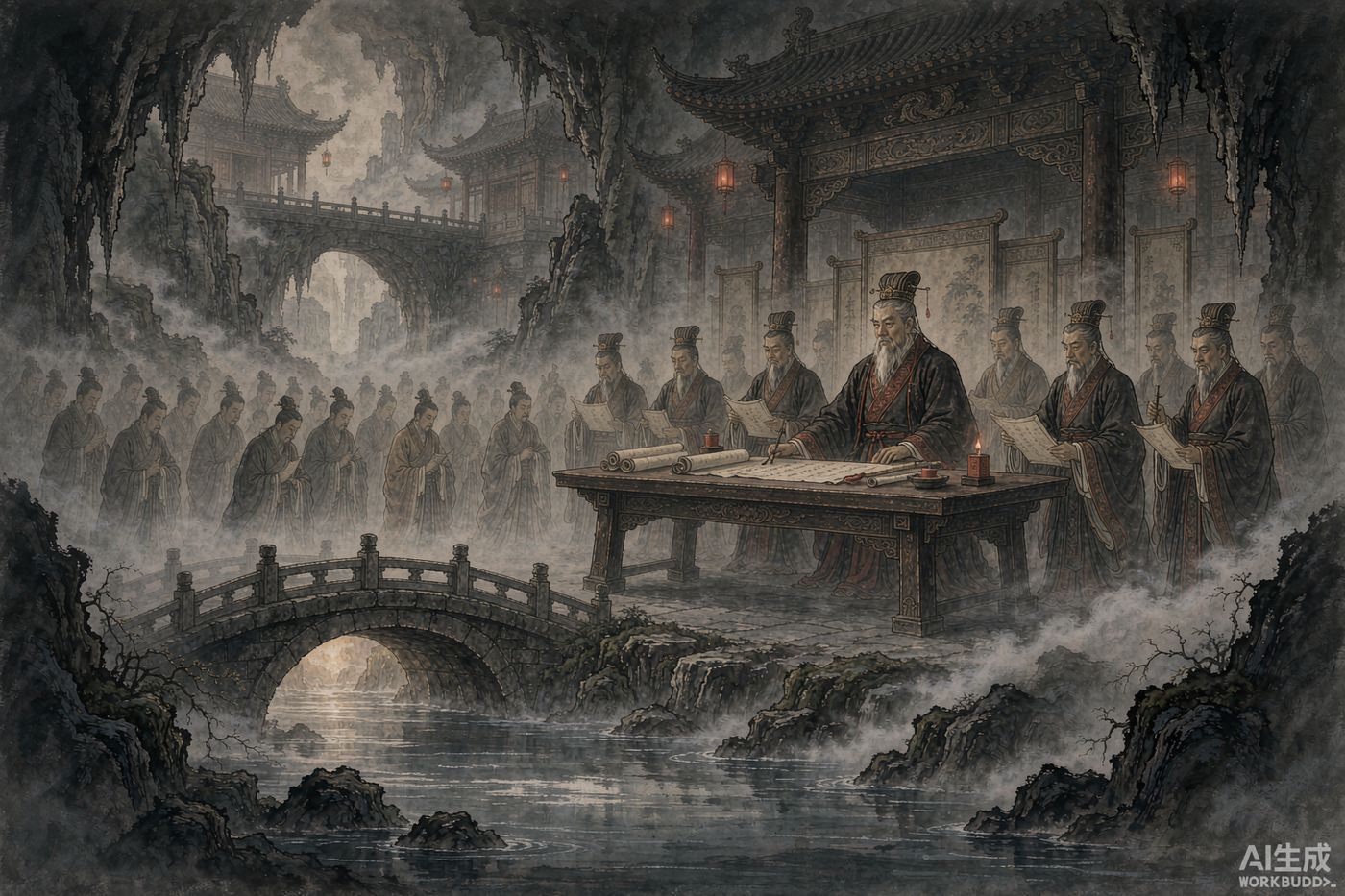
Every soul in the Chinese universe passes, after death, through the Difu (地府) — the Earth Administration — and the first thing to understand about it is that it is an administration.
Its capital is Fengdu, the Dark Capital. Its ruler is the Jade Emperor’s counterpart below: the Great Emperor of Fengdu, and under him the Ten Kings, each the magistrate of a court through which the dead are processed in sequence. The newly dead arrive escorted by constables — the ox-headed and horse-faced bailiffs — and are judged from a ledger in which every deed of their life is recorded. The virtuous pass quickly onward to rebirth; the wicked are sent down into the earth prisons (diyu), a graded system of torments matched to specific sins — the liars have their tongues pulled, the corrupt officials are crushed, the unfilial are sawn — until the debt is paid. Then they too pass on.
Two landmarks frame the exit. The dead must cross the River of the Dead on the Bridge of Helplessness (奈何桥, Naihe Qiao — the ‘what-can-one-do’ bridge), where the virtuous cross safely and the guilty fall to the serpents below. And on the far side waits Meng Po, the Old Lady Meng, who serves each soul a bowl of her broth of forgetfulness. Drink it, and the life you have just lived — and the judgment you have just received — is wiped clean. Then you are reborn, and begin again, ignorant.
This system explains the ghosts. A ghost is, in effect, a backlog case: a soul that for some reason — a violent death, an unburied body, an unsettled debt, a grief too strong to drink away — failed to be processed, and lingers in the mortal realm off the register. That is why so many zhiguai ghosts are solved by paperwork: a proper burial, a debt repaid, a wrong righted. The underworld wants them back. Its clerks are always behind.
It also explains the genre’s distinctive tone. Judgment in this cosmos is not wrathful but administrative — which means it can be appealed, negotiated, bribed and occasionally sued, and the stories do all four.