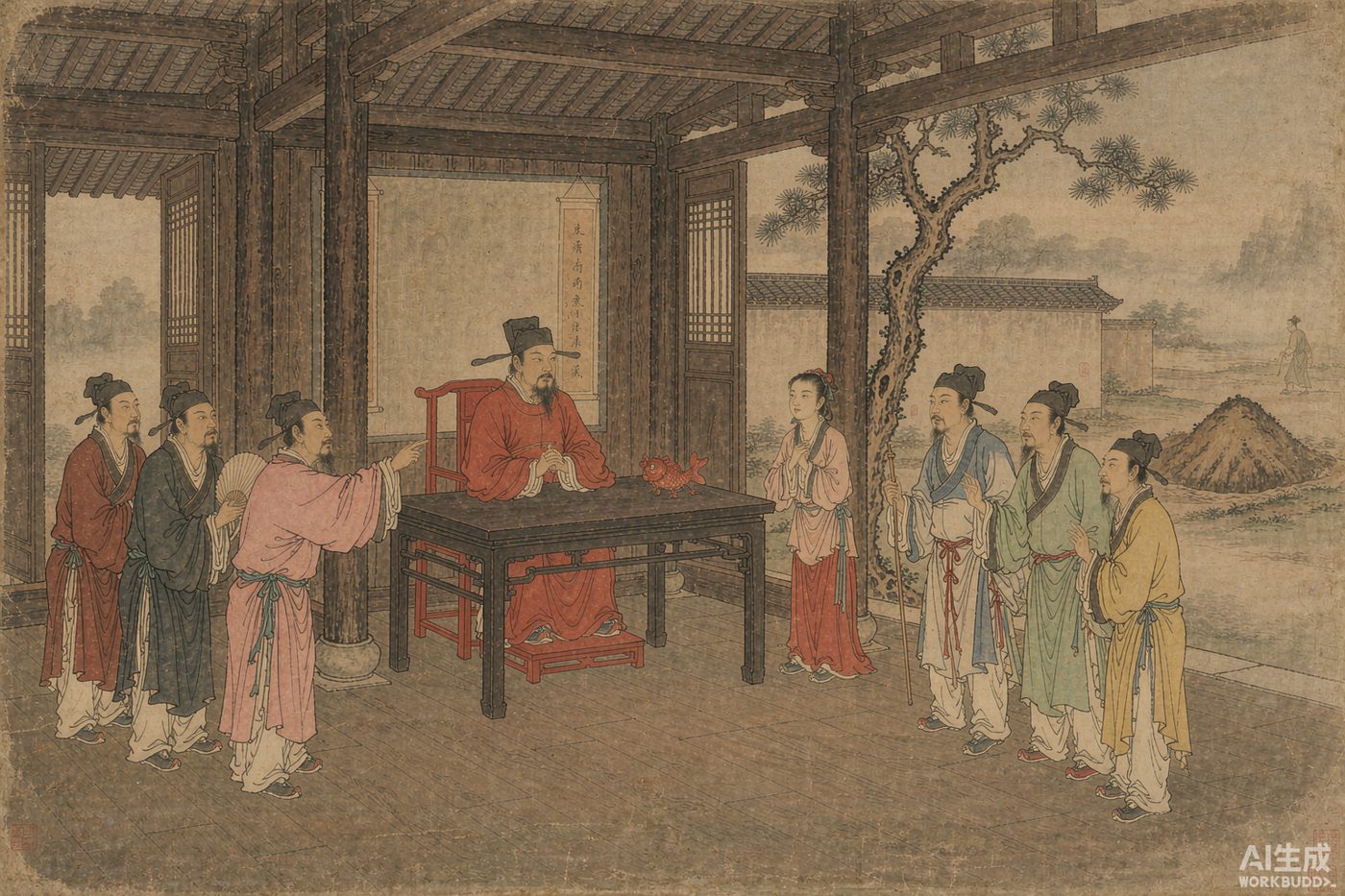
A modern reader arrives at the walking dead already knowing the rules: something bites someone, the condition spreads, and by the end of the film the question is how far it has got. Almost none of that transfers. In these tales nobody is turned. There is no bite, no agent, no incubation, and no way to catch it from a corpse — because what is standing up in the room is not a disease and was never contagious.
It is an unresolved death. That is the whole of the theory, and everything else follows from it.
1. It is the body, not the soul
The clearest statement in the corpus is a doctrinal paragraph in 《南昌士人》 (The Friend Who Would Not Leave):
人之魂善而魄惡,人之魂靈而魄愚。……魂在,則其人也;魂去,則非其人也。世之移屍走影,皆魄為之,惟有道之人為能制魄。
A man’s hun is good and his po is bad; his hun is bright and his po is dull. … While the hun is present, he is that person; when the hun has gone, he is not that person. Every walking corpse and moving shadow in the world is the work of the po, and only a man who has the Way can govern a po.
Read that against the two-soul doctrine and the genre reorganises itself. A human being carries two souls: the 魂, intelligent, rising, the thing that makes you you; and the 魄, dull, heavy, tied to the flesh. Death normally separates them. But if the 魄 stays with the body — or is left behind in it — the flesh keeps operating after the person has gone. What stands up is not a wicked soul in a stolen body. It is the residue, and it is stupid.
This is why a corpse in these tales never explains itself. It has no speech, no plan and no grievance it can articulate. It has an appetite and a direction, and that is all. It also explains the counters, because whatever governs a po is authority rather than sanctity.
2. Why the corpse is standing: four faults
Corpses do not rise at random. Each case in the collection names the fault, and the fault is always procedural.
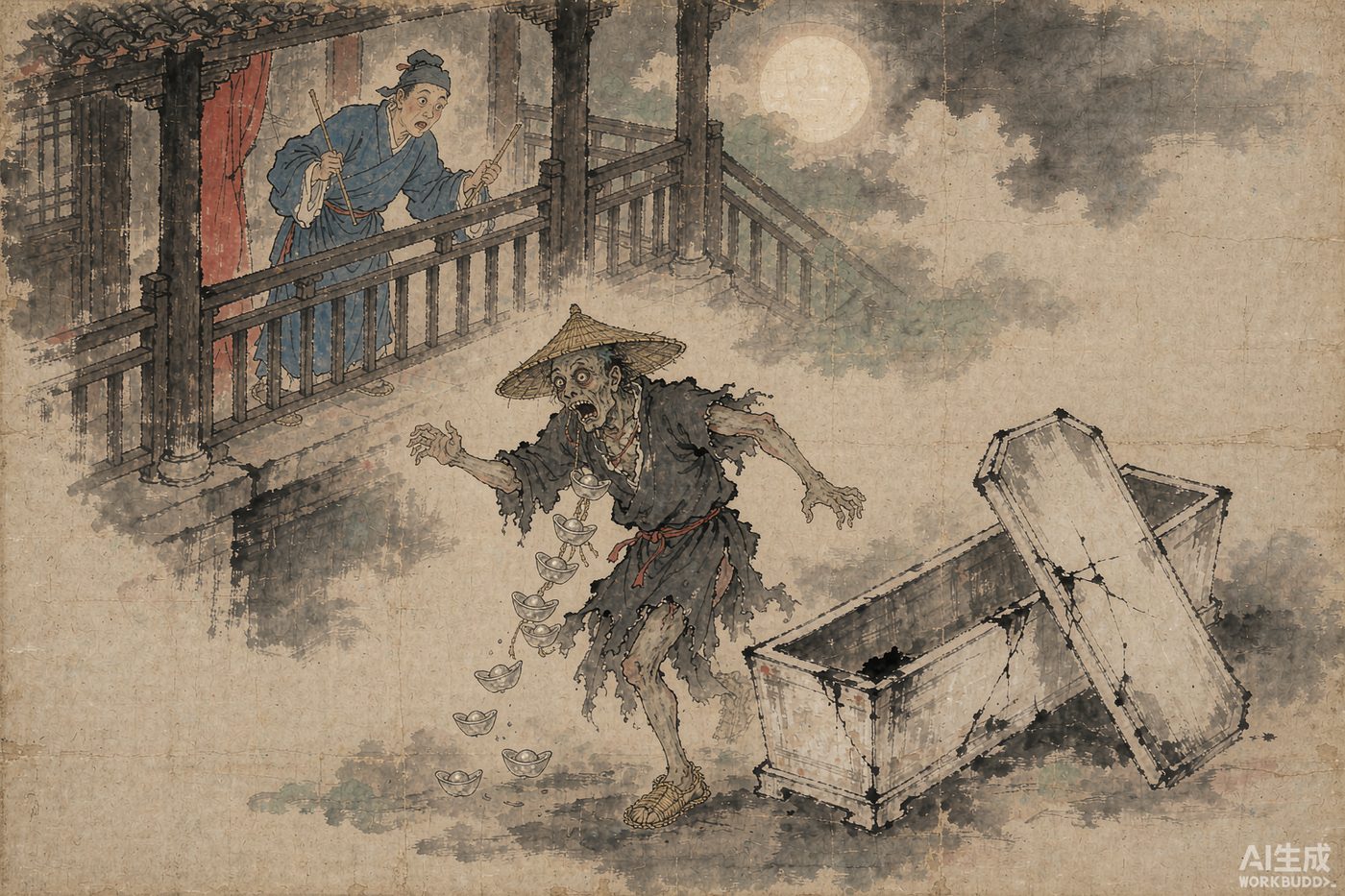
The coffining. In 《僵尸貪財受累》 the detail that identifies the corpse is its dress: 麻冠草履……越俗:凡父母在堂而子先亡者,例以此殮 — hemp cap and straw sandals, because in the Shaoxing country a son who dies before his parents is coffined in mourning dress. A death out of sequence, and the body handled by people in the wrong order.
The ground. 《皂莢下二鬼》 produces two hauntings from one orchard, and digging finds both: a vermilion coffin under the bed and a black coffin under the trees. Neither corpse wanders — each is domiciled. The reliable procedure is to follow the ghost to where it went and dig there, which is only possible because a haunting is a function of burial.
The neglect. The orchard is a cash crop nobody is watching at night. This is the most ordinary cause in the corpus: an unguarded place, a body in it, and no rites performed since.
The soul deliberately withheld. 《藏魂壇》 is the cleanest experiment in the collection. A man keeps his soul out of his body in a jar precisely so that the state can beat his flesh to death and he will walk away from it: 官府所刑殺者,其血肉之體,非其魂也。以久煉之魂,治新傷之體,三日即能平復. The demonstration comes at the end. With the jar broken and the soul gone, 驗其屍,不浹旬已臭腐 — within ten days the corpse was rotten. A body that stays intact is intact because something is still in it. The technical term the texts use for that state is 僵而不腐.
3. The physical rules
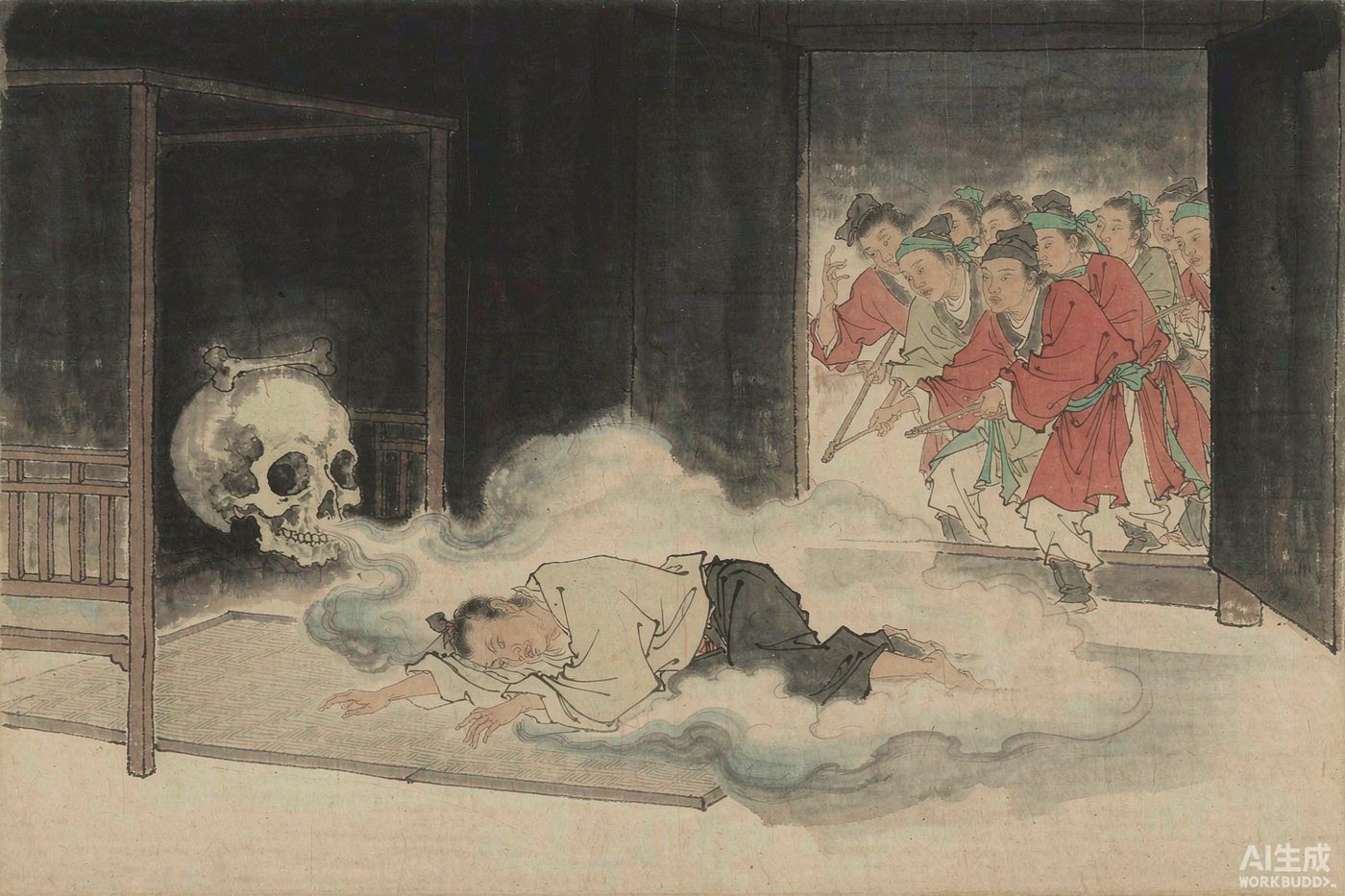
Cold, not violence. A corpse’s weapon is temperature. In 《骷髏吹氣》 a skull under the bed blows through the mat, and the cold starts the size of a walnut, spreads to a plate, and then takes half the bed: 直透心骨. In 《皂莢下二鬼》 the neighbours come with knives and staves and cannot approach, 畏其冷氣射人.
Thresholds hold it. 至大門,忽僵立不動,一足在門外,一足在門內 — the woman stands rigid in the gateway, one foot out and one in. An uninvited threshold cannot be crossed; the door-gods of other tales are enforcing exactly this. She gets in only by going low: 傴身入床下, stooping under the bed, straight to the thing she is attached to.
Cockcrow ends it. 旋聞雞啼,從此寂無聲響矣. Whatever the corpse was doing, the night was the licence for it.
It chases, and the chase has a route. A corpse follows a man up the stairs, misses him behind a barred door, and then deals with the door by crying — 三呼而諸門洞開,若有啟之者. It cannot pass a threshold, but it can be let through, and a body that has not yet left its flesh is harder to hold out than a ghost.
And it keeps its appetite. This is the rule that makes them characters instead of monsters. A zombie in this collection is driven by whatever drove the person: in 《僵尸貪財受累》 it follows a scholar onto an upper floor and is defeated because it stops to pick up a dropped silver ingot, which is how the scholar gets behind it. 《棺中鬼手》 makes the same point as social comedy: a hand reaches out of a coffin for payment, the famine-dead of the eastern row withdraw it for a single cash, and the coffin of a 典史 — a petty police official — will not close for anything under two strings.
4. The counters, in order of strength
Fire first, and fire only, for the flesh: 官命焚其尸 in 《僵尸食人血》, and 聚而焚之,其怪遂絕 in 《皂莢下二鬼》.
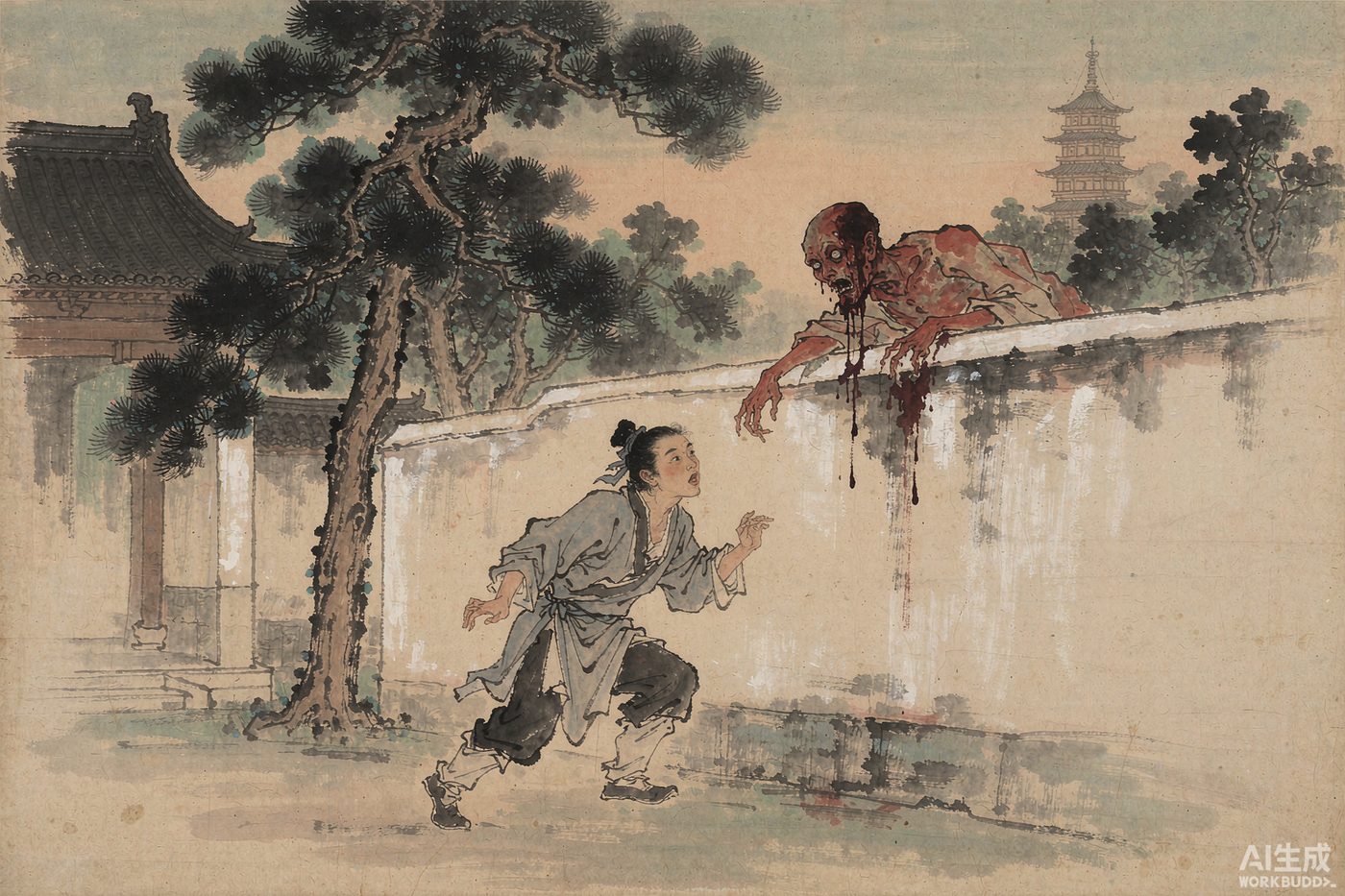
Second, a magistrate’s order. When a zombie has already taken blood, the text does not send for a priest — it sends for the county. 官命斧斲僵尸之臂,鮮血淋漓,而劉某之頭反無血矣,蓋盡為僵尸所吸也. The arm is hacked off by order of the yamen because the yamen is the authority that governs a po.
Third, the spade, as diagnosis before treatment: find the coffin, identify the fault, then burn.
What does not work on a corpse is worth stating plainly: talismans and official seals. In 《鬼受禁》 a Daoist’s charm plus the magistrate’s seal confines a ghost in a side room for years — but that ghost has already left the body. A seal is an instrument for a person who is still a person, in the sense of still having a 魂 and a name in a register. A corpse has neither. If you want the talisman to work, the problem has to be a ghost; there is no scene anywhere in this corpus of a paper charm stopping a body.
The one apparent exception proves the rule. 《木箍頸》 gives the standard human defence against animated things — 能呼其名,則不為害, name it and it cannot harm you — and attributes it to the Baopuzi. Note what the creature is: 水木之精,游光畢方類, a spirit of water and wood. Naming works on 精怪. It does not appear in the corpse tales at all.
5. The special cases
The corpse that changes the weather. 《旱魃有三種》 lists three kinds of drought demon, and the second is one of these: 一種乃僵尸所變,皆能為旱,止風雨 — a drought demon is a transformed corpse, and it stops the rain. An unmanaged body is therefore not only a domestic problem; it becomes a meteorological one. The remedy is the same (dig, burn), but the motive is different: nobody is being punished and nothing wants anything. At the top of that family is 格, the mountain drought demon — 似人而長頭,頂有一目,能吃龍,雨師皆畏之 — man-shaped with a long head and one eye on top, it eats dragons, and the masters of rain are afraid of it.
The corpse from before the world. 《盤古以前天》 gives the limit case. A sinkwood coffin (陰沉木, wood from before the separation of heaven and earth, which 再入土中,萬年不壞) is washed out of the sand after a landslide. The man inside is wood-coloured and uncorrupted; he opens his eyes and asks what the blue thing overhead is. He is told: the sky. 我當初在世時,天不若是高也 — in my day the sky was not so high. Then the wind rises and he becomes a stone. The coffin is taken by the county magistrate and passed up to the provincial governor: an artefact, not a relic.
The corpse as the site of a sentence. 《地師身後劫》 is the most interesting case, because the corpse is not the threat. A boy steps into an old grave and breaks the bones; the dead geomancer’s ghost demands the child’s life. The City God throws the claim out — 斷骨折骸,實由孽報,非其子之罪也 — and sends him to 惡狗村. The closing line delivers the punishment in this world: 羅棺中朽骨,被野犬銜嚼,狼藉滿地。始信惡狗村,即人間現報,陰司原無此地獄也. There is no such hell beneath. The sentence was carried out by dogs on the surface, on the bones themselves.
The cremation that returns a better verdict. 《李氏乳媼》 inverts the whole file. A harsh, quarrelsome wet nurse is cremated and the fire produces 舍利, and the bystanders are drawn by the smell: 火尸香如蓮花,聞於外,是異人也. The test applied is a physical property of the corpse — its odour — and it returns the opposite verdict.
The corpse that becomes a person again. 《靈璧女借屍還魂》 is the boundary marker. When a soul moves into an empty body, the result is not a 僵尸 — it is a person, with a name, a family, a claim, and two households fighting over her in a magistrate’s court. A body plus a soul is a resurrection. A body minus a soul is this entry.
6. What to do with it in a story
- The trigger is a fault, not a bite. If you want a walking dead, name the fault first: the wrong coffin, the wrong ground, an unguarded grave, or a soul put aside on purpose. The horror is that somebody got the procedure wrong, not that something is spreading.
- Give it the living person’s appetite. Greed, stinginess, a debt, a grudge about money. The corpse in 《僵尸貪財受累》 is defeated by a dropped ingot; the hand in 《棺中鬼手》 can be bought off, and the price tells you who it was.
- Give the scene a clock. Night is the licence, cockcrow is the end, and a doorway is a hard barrier. Three facts, one of which will solve your scene for you.
- Use cold, and use the smell of the ground. Not gore.
- Choose your counter by choosing your problem. Fire and a magistrate’s order for a body; a talisman, a seal and a registered name for a spirit. Getting this wrong is the fastest way to write something that does not belong in this universe.
- And if you want the corpse to keep going, make it the weather. The one thing in these texts that a corpse can do which no household can answer is stop the rain.