The oracle of Western fantasy is a warning. A prophecy says the king will die by his grandson’s hand, and the rest of the story is the king’s attempt to prevent it — and the attempt is what kills him. The engine is the gap between knowing and being able to do anything about it.
Chinese zhiguai has the same gap, and is largely uninterested in it. What these tales care about is narrower and stranger: the quantity is already fixed, but whose account it lands on is still open. A doom is not a curse hanging over a house. It is a debt with a name written against it, and names can sometimes be rewritten.
The five instruments
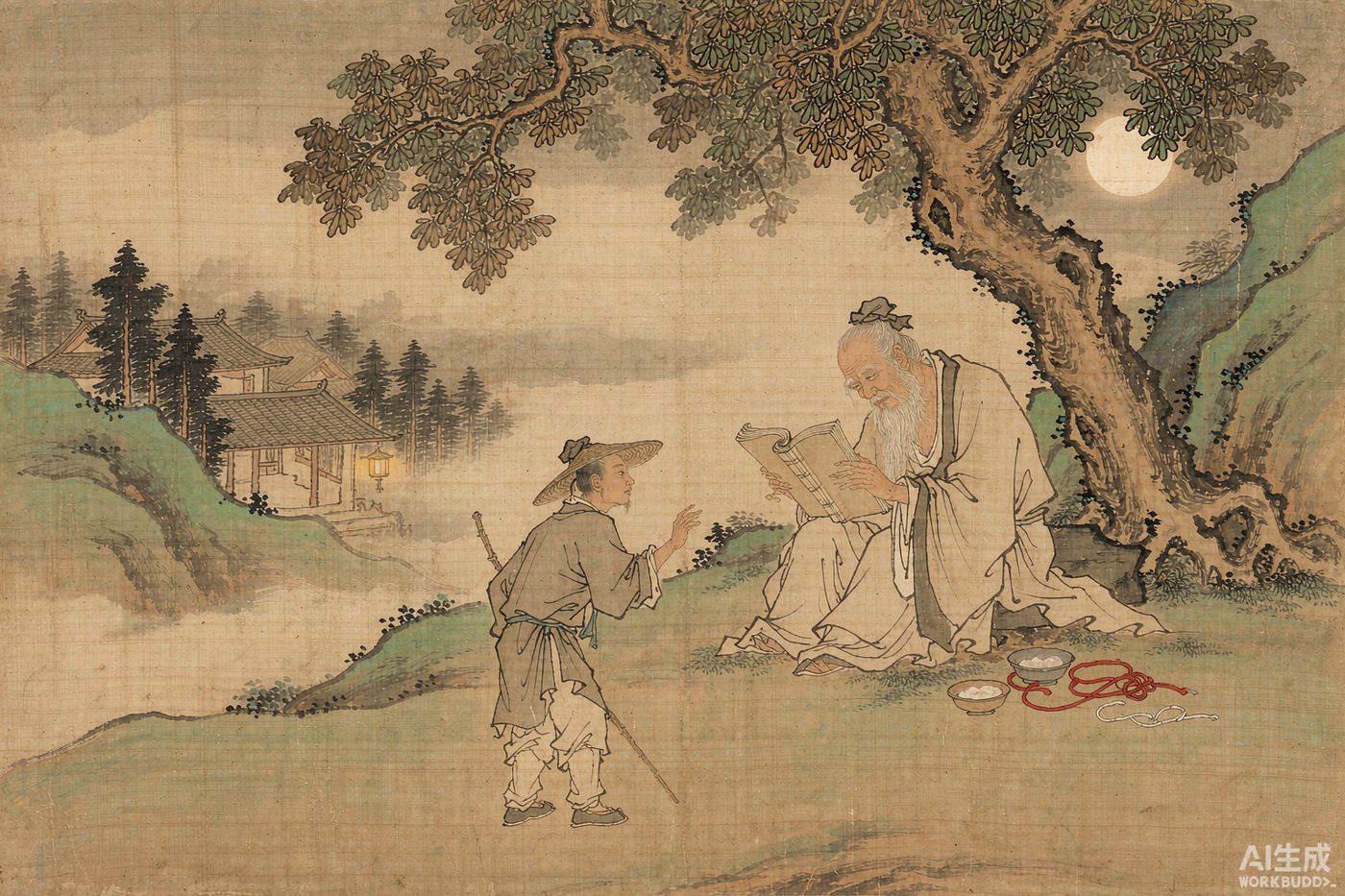
Physiognomy (相). Reading the face, the bone, the bearing. The manuals are a real Qing genre, and the tales treat them as a working trade with a body of doctrine. In 道人神相 a Daoist looks at a rich man and says his whole body is vulgar bone and his face an inch deep in dog-hair — the genuine countenance of a wealthy man — but that one thread of clear breath at his temple is a hungry grave, and famine will find him. It does: the man’s fortune is spent, in ships and fires and lawsuits, in proportion to his son’s success.
Sortilege (卜, 筮). The yarrow stalk, the shell, the temple lot, the written 讖. In 泄氣生員 a dullard is given the verse 聽之無聲,視之無形 — listen and there is no sound, look and there is no form. It is exact. It describes the fart that decides his career.
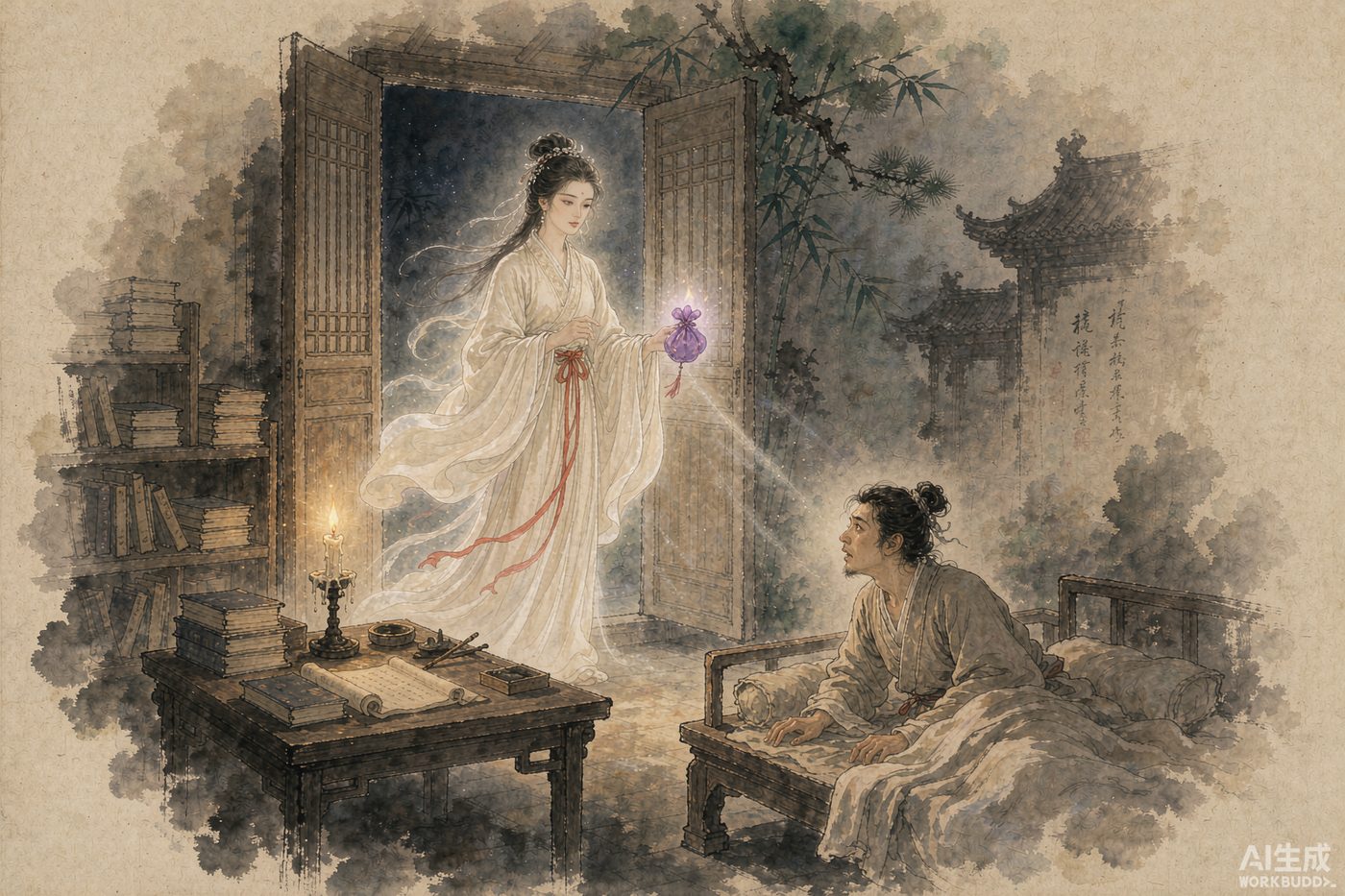
The planchette (扶乩). A suspended stick that writes, the way a whole sub-genre of literati poetry got itself composed. In 紫姑神 the goddess behind it explains why she has no posting: 以私奔故,無顏重上天曹 — because she eloped she cannot show her face in the celestial ministry, and the underworld will not take a former immortal onto its roll of ghosts. Even the spirit at the other end of the oracle is waiting on a register.
Geomancy (堪輿). Siting graves and houses so the ground works for the descendants. Shen Qifeng’s 地師身後劫 is the coldest account of the trade in the language: a geomancer’s ghost demands a child’s life for the trampling of his bones, and the city god’s court turns on him — you were a geomancer, so why could you not find yourself one decent plot? — and then the complaints come in: graves like chicken-coops, dragon-shapes with no feet, families told to wait on a perfect site until the coffin had sat unburied for fifty years. 造惡種種,罪不容誅.
Astrology (占驗). Reading the sky for the state, the campaign, the death. And here the rule becomes explicit.
The rule
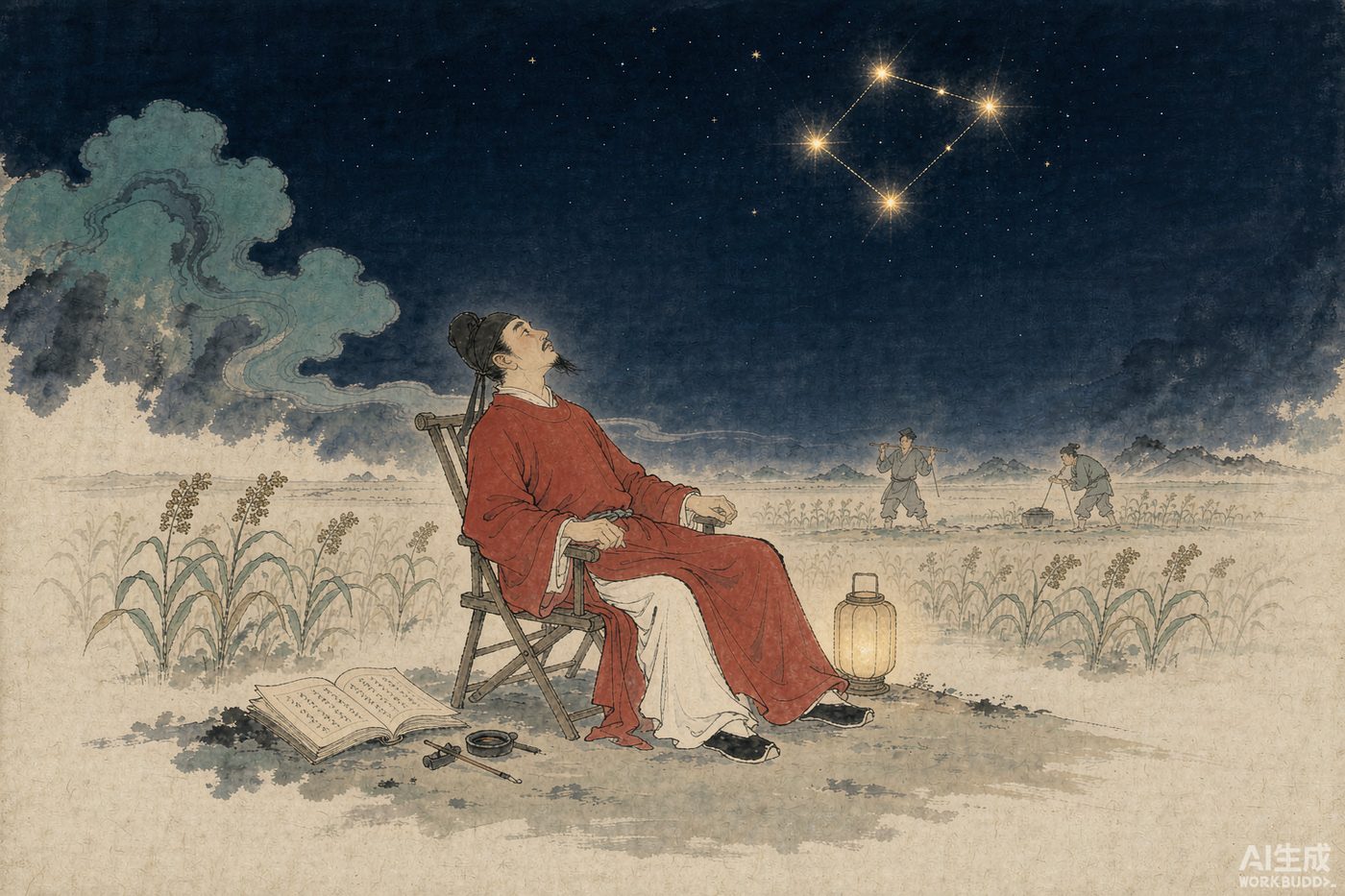
The clearest statement is a confession. The Daoist official Han Qingyan, who knew astronomy, told Yuan Mei what happened when he saw a guest star fall into the Southern Dipper while he was out supervising the locust-catching at dawn:
I privately noted what the divination book said: one who sees this disaster will die suddenly within the month; the correct method is to cut off an inch of hair and pace the Yu step three times to east and west, and the harm can be moved onto another person. I sent my clerks away and did it. Before long Master Li, who kept the records in my office, cut open his own belly with a small knife and died, and I was unharmed. Li was a candidate I had recommended — young, and good at letters. I had not expected him to take my disaster for me.
Yuan Mei’s reply is the collection’s whole attitude in one line. If a man like me has no astronomy at all, I see falling stars all the time and simply do not know the counter-charm, so what happens? Han: nothing happens to you. Yuan Mei: 然則公又何苦知天文,多此一事,而自禍禍人耶 — then why did you bother to learn astronomy, and add this one extra thing to the world, bringing disaster on yourself and on another man? Han laughed heartily and could not answer.
The death was not prevented. It was re-addressed. The method does not reduce the quantity; it changes the payee.
The same mechanics run through the rest. In 雷擊土地 the earth god privately warns a magistrate that his mother is due to be struck by lightning. Since he is only an earth god he cannot cancel it — but there is one way: 汝速盡孝養之道,凡太夫人平日一飲一饌、一帳一衣,務使十倍其數 — spend her ration of food and clothing at ten times the rate, fuel and dress her so extravagantly that her allotted 祿 runs out early, and she will die a natural death before the thunder needs to fall. It works. She dies within a few years, and when the thunder finally arrives, three years late, it circles the coffin, fills the room with the smell of sulphur, cannot get in, breaks out of the house, and destroys the earth-god’s shrine instead.
That is the model in miniature. The doom is a scheduled delivery, and the household has, in effect, changed the delivery address.
In 屏角相郎 the same arithmetic is done in the opposite direction. The girl reads her own face and knows she will be a widow for thirty years; she reads her suitor’s and knows he will not live long; and she marries him precisely because 是真短祿適合,違之不吉 — the two short allotments fit, and to go against the fit would be unlucky. In 郭大夫 a man is shown in a dream the few hundred cash and few pints of rice that are his whole 平生禄料, his lifetime’s ration; he never draws his salary again, and dies on the night of the twenty-fourth because the twenty-fifth is pay-day. The account closes to the day.
What the manuals are actually for
Shen Qifeng’s 龜鑑 is the joke that gives the game away. A professional fortune-teller is asked how he does it and answers: ask the turtle. The turtle’s lesson is not prediction at all. It is 靠背硬 — a hard back, meaning a great man’s patronage; 趁腳進 — going in on somebody’s feet, meaning three feet of recommendation and a visiting-card; 扯架勢 — the right ponderous walk; 軟火囤 — the confident swagger when you happen to be right; and 便好休 — tail curled, head drawn in, gone quietly, when you are not.
The planchette tale says the same of poetry. In 窮士扶乩 a starving scholar crashes a rich man’s party, operates the planchette, and passes off his own poems as the work of a dead zhuangyuan. They are praised to the skies. He then reveals the trick, and explains why it was necessary: 竊料近日名流,專於紗帽下求詩 — the famous men of the day buy poetry only from under an official’s hat. The oracle does not foretell; it authenticates.
The instrument is a bureaucracy
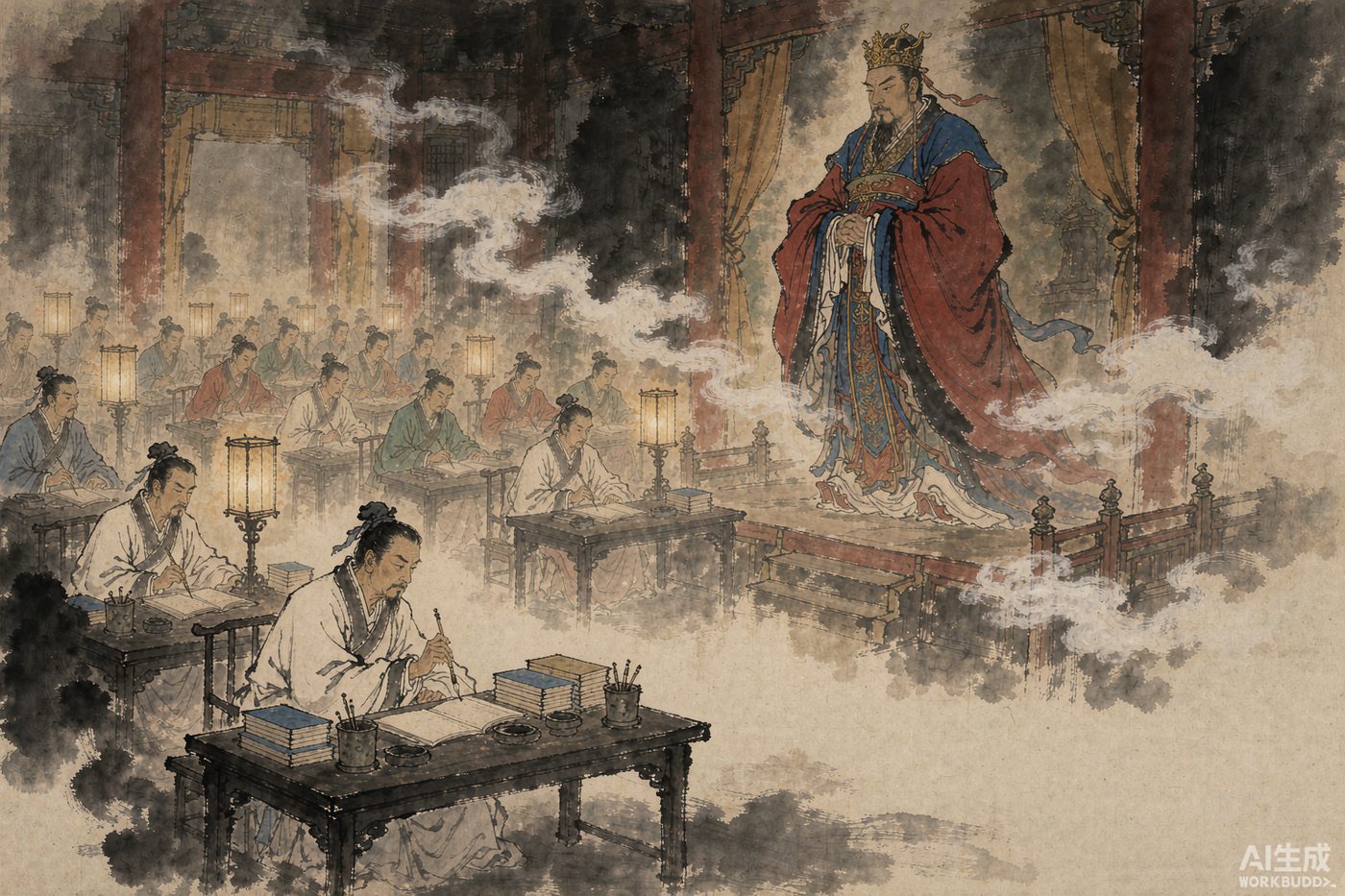
Everything above runs on paperwork. The book in 定婚店 that lists who marries whom is a 幽冥之書, kept by an old man sitting on a step at dawn with a cloth bag; Wei Gu can see the book and cannot read a character of it, because it is not written in any human script. 考城隍 begins with a summons to sit an examination. 紫姑神 needs her name entered on a register before she can be reborn. Foreknowledge in this universe is not a vision and not a trance. It is a look at the file — and a file can be opened, quoted, contested, and, on a good day, quietly amended at the bottom.
The limit
The one case where the arithmetic fails is also the best. Jiang Yong, the scholar who built wooden oxen and a bamboo speaking-tube, drowned himself in order to stand in for his two sons, who were due to drown together in Dongting at a set hour. He was pulled out and saved — and knew immediately what had gone wrong: 吾今而知數之難逃也……今諸公救我,必無人救二子矣. Now I know the number cannot be escaped; you have saved me, and there will be nobody to save my sons. Within a fortnight the news came. Knowledge, without a technique that can reassign the debt, is only a better seat from which to watch.
Seven rules for using an oracle
- Make the quantity concrete. A number of years, a sum of cash, a count of grains of rice. Vague doom reads as atmosphere; a stated ration reads as a system.
- Write the name on it. An oracle that says someone will die is a warning. An oracle that says you will die, unless is a mechanic.
- Charge a price for the re-address. Cut hair, a Yu-step, tenfold spending. The transfer always costs something, and the cost is where the story is.
- Show the wrong payee. The best version of this device has an innocent party take the doom by accident, and the reader left holding the balance.
- Never let the reading be wrong. Make it exact, and make it useless. The diviner in 泄氣生員 is perfectly accurate about a fart.
- Put a clerk behind the oracle. Not a vision, a file: a book, a register, a roll of names, a summons to sit an examination. Then the players can try to file something back.
- Let the professional be a fraud and the fraud be true. The turtle’s methods are all social, and the turtle is still right.