In Western fantasy the union between a human and a non-human is almost always a transgression — a forbidden love, or a fairy’s test that the mortal fails. Either way the point is the crossing of the line, and the story is over when the line is crossed.
Chinese zhiguai treats it completely differently. The line is crossed constantly, and nobody is scandalised. What the tradition is interested in is the terms: how such a marriage is contracted, what condition it runs on, what object holds it together, who polices the border, and — most importantly — how it ends.
There are dozens of these marriages in the collection and they obey the same five rules.
1. It is contracted, not accidental
Begin with the least romantic fact in the whole universe. In 《定婚店》 the old man reading by moonlight at an inn turns out to be holding the register of marriages, with a bag of red thread for tying the ankles of destined couples. The thread stretches across provinces, decades and family feuds, and cannot be cut.
In other words: marriage is filed under the same bureaucracy that processes ghosts. This is the cosmic joke of the tale, and it is structural. The most intimate human institution is administered by the underworld.
Nor is it only real marriages that are administered. In 《露水姻缘之神》 — literally the God of Casual Unions — 露水姻缘, the ordinary phrase for a one-night encounter, turns out to have a divine department with a book. The god in charge is embarrassed by his own portfolio (言之惭愧), which is not how gods are supposed to talk about their work. Asked to cancel an affair, he refuses: it is a number fixed by fate; how could I alter it? — and then quietly alters it anyway, not by striking out the number but by finding its weakest branch. Even casual couplings have a file.
2. There is always one condition
《谈生》 is the earliest surviving Chinese ghost-marriage, from a collection attributed to the emperor-poet Cao Pi, and it is the template. A girl comes to a poor forty-year-old scholar at midnight and asks to be his wife. She says exactly one thing:
I am not as other people are. Never look at me by lamplight. After three years, you may.
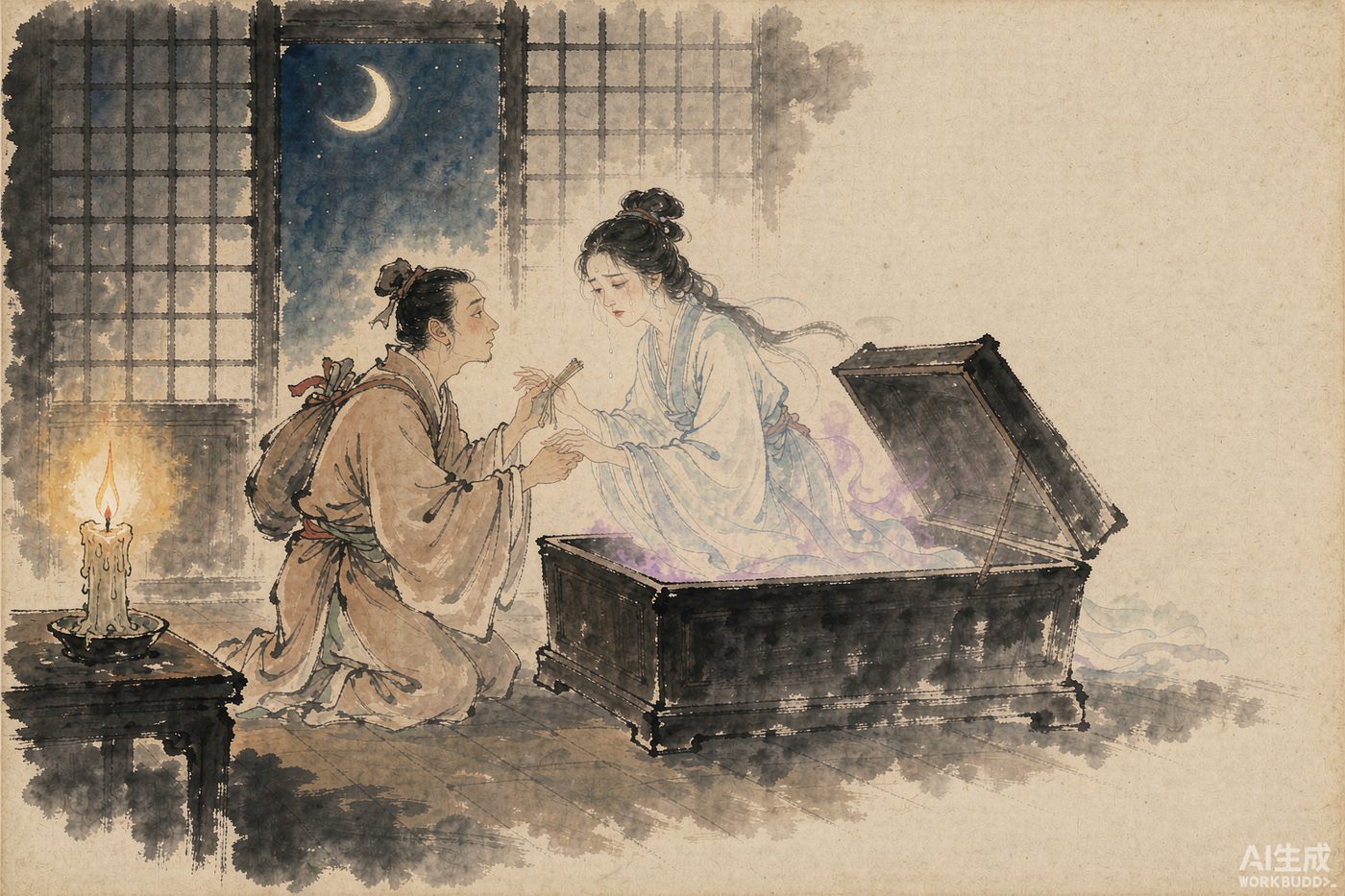
They marry. She bears him a son. The boy is two, and there has been no lamp. Then one night he cannot bear it, and brings a light close. Above the waist she is living flesh, warm and whole; below, nothing but dry bone.
She wakes and says: You have betrayed me. I was almost alive. One more year — could you not have waited one more year?
That line is the whole doctrine, and it is not what a Western reader expects. The marriage was not a disguise she was maintaining. It was a mechanism that was remaking her, and it had run nearly to completion. The condition was not a test of his character. It was the operating instruction for a process that turns a ghost into a woman.
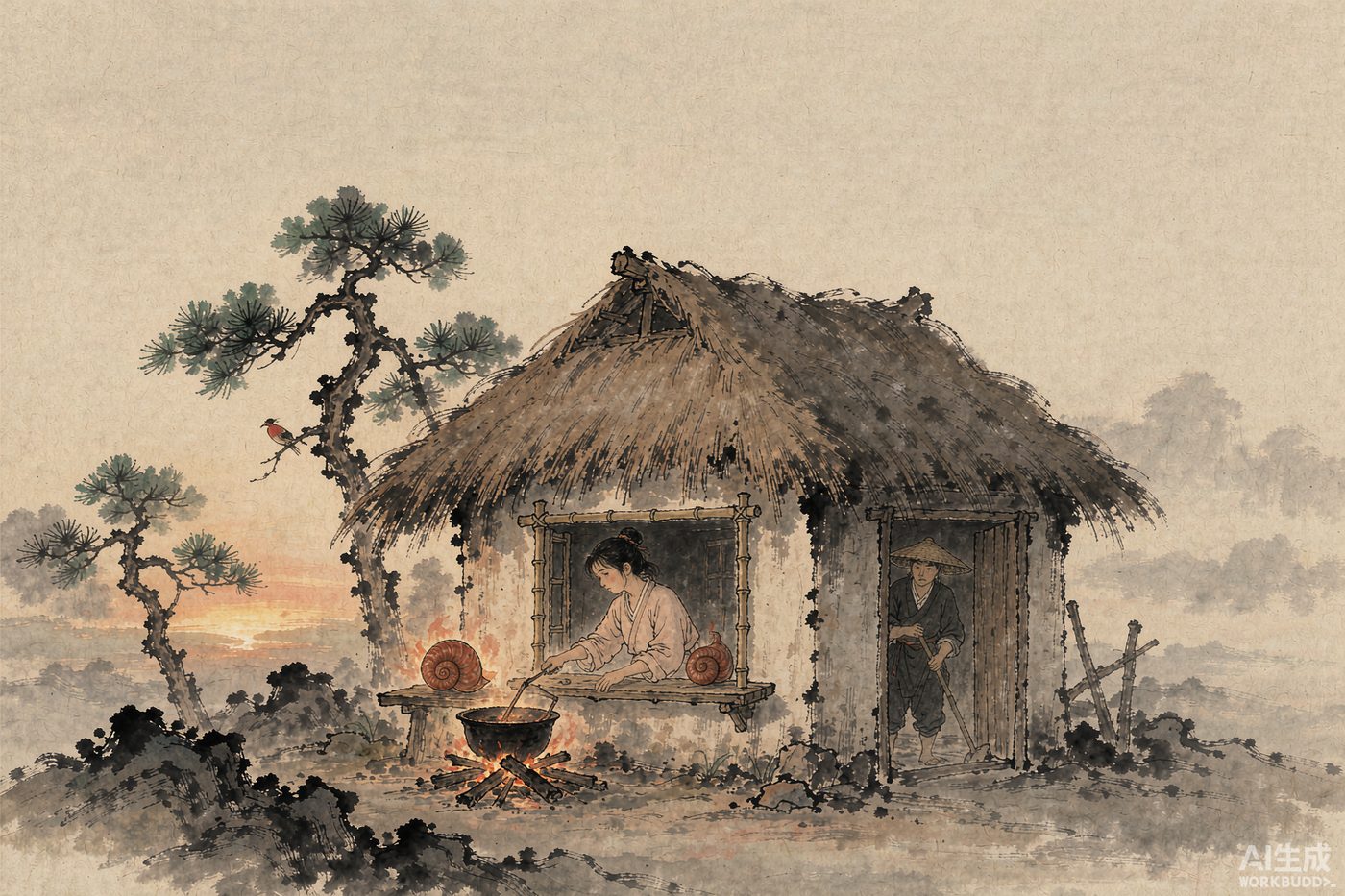
The same shape runs through 《白水素女》 — the snail-shell girl, who is the household until he finds the shell — and through 《賣胡粉女子》, where the direction reverses entirely: the boy dies of joy, the girl is hauled before a magistrate, and when she kneels at the bed and weeps come back and I will marry you, and I will never run again, the corpse sits up. He has no memory of dying, only of being glad. They marry; she sells face powder no more.
3. The bond is a physical object
This is the detail that most reliably surprises people. The marriage is not held together by feeling.
At the end of 《谈生》 she tears a strip from the garment he is wearing and takes it with her: if you ever need to find me, this is the token. The bond is cloth.
And in 《鬼妇持家》 the mother-in-law explains one of the strangest laws in the entire tradition. A man falls through the ground into his dead parents’ house and finds his dead first wife there, embroidering — and she does not know him. Why? Because 凡男子续娶后妇,与前妻即无结发情 — once a man takes a later wife, the bond with the earlier one is gone, and meeting, they no longer recognise each other. 结发 is the lock of bound hair cut at the wedding and kept. The bond is not in the memory. It is in the hair, and the hair has been recut.
The same tale then does something even better. The underworld court sentences the living second wife — who has been beating the children — to twelve years of instruction below, and lends her body to the dead first wife for the same twelve years, to run the house. 借渠手足,料理家务. It is not resurrection and not possession. It is a labour exchange, agreed in a court, with a fixed term.
4. Someone is stationed at every threshold
The border is not guarded against love. It is guarded against traffic, and the guards are minor officials doing a job.
In 《痴鬼恋妻》 a ghost who died at twenty-eight follows his living wife to her second wedding. Two things stop him. 陽氣逼爍不能近 — the living breath beats on him and he cannot approach. And then the architecture: the door god stops him at the bridegroom’s gate and lets him through only when he knocks his head on the ground begging; the god of the ceiling drives him out of the bridal chamber. Every threshold in a Chinese house has its own deity, and they enforce the boundary between the living and the dead without malice.
In 《女鬼守财待婿》 the hard rule is moonlight: the ghost cannot enter the patch the man stands in, and he survives by backing into the moon as it moves, with her following only as fast as the moon leaves him. Her haunting also has an expiry date — 今日心事已了,予亦不復作祟矣, my business is finished today; I shall haunt no more. A haunting in this universe is a duty, not a curse.
5. There are exactly three endings
Once you sort the corpus, the unions resolve in one of three ways, and the tradition is remarkably consistent about which is available to whom.
Absorption. In 《聂小倩》 Ning carries her bones home, builds her a tomb beside his study, and she comes with him — not as a demon now but as something between a ghost and a guest. She serves his aged mother and mourns her, manages the household, and bears him a son. The neighbours whisper for years and then accept her, as one accepts anything that has behaved well for long enough. This is the full human ending, and it is earned by conduct, not by magic.
Death in the true form. In 《任氏传》 Miss Ren lives with Zheng as his wife in everything but law. When the rich Wei Yin forces his way in and seizes her, she fights until his strength fails and then shames him with a speech about a poor friend’s one possession — and he becomes their patron instead. She dies anyway: she has cast the omens, the western road is death for her, her husband laughs at a fox fearing a journey and presses her, and at Mashan the imperial greyhounds come out of the grass and the woman riding beside him is a small white fox. He buries what the dogs left. The teller’s verdict: she had been faithful as few human wives are faithful, and she died for the crime of accompanying the man she loved.
The union that cannot continue at all. 《刘晨阮肇》 ends with two men walking back into a mountain because their village is seven generations on. 《死嫁》 ends with a scholar buying an actress’s coffin for three hundred taels because he could not buy her freedom, and burying her as his bride: could not live together, but returned in death.
And there is a variant worth separating out, because it is the one Western readers find most alien. In 《鬼借官衔嫁女》 a ghost asks a boy to obtain a neighbour’s official rank notice so that her daughter’s dowry procession can carry a real surname and a real post. Yuan Mei’s verdict is the point of the story: 鬼亦如人間愛體面而崇勢利 — ghosts love face and worship rank exactly as the living do. The marriage across the border is administered by the same snobbery.
How to use it
If you are writing inside this universe, a cross-border marriage needs five components, and the texts are unusually strict:
- A file — a register entry, a red thread, or at minimum a god with a book. Nobody in these stories simply falls in love by accident.
- One stated condition — and it must be operational, not moral. Do not light a lamp for three years is an instruction for a process, not a test of virtue.
- A physical token — a strip of cloth, a lock of hair, a shell, a root-stock. Cut the token and the bond ends, whether or not anyone still loves.
- An officer at a threshold — a door god, a ceiling god, a patch of moonlight, the living breath itself. The border is staffed.
- One of three endings — absorption, death in the true form, or severance. Decide which at the outset, because every other detail of the tale follows from it.
The reason this institution is worth having, though, is the thing the tradition keeps insisting on through all five rules: the human is the one being measured. Ren is faithful as few human wives are faithful. The neighbours judge Ning’s household by how long it behaves well. The boy at the face-powder stall dies of joy and is revived by a promise kept. In 《香玉》 the scholar does not rescue the peony spirit with a sword; he saves her with daily libations at the root-stock — courtship as horticulture.
In this universe a marriage across the border is not a reward for the hero. It is an audit of him.