The gods of the small pantheon — City God, Earth God, the Lady of the Ford, the General Who Protects the State — tend to be treated as fixtures. But a shrine is not a fixture. It is a decision, made by somebody, at a date, for a reason. And the texts preserve all four of the reasons, including the one that is a pure accident.
Once you can see the four founding types, the geography of the universe stops being decoration and becomes a filing system. A shrine is where jurisdiction sits. Knowing how it got there tells you who can be appealed to, and what they are permitted to do.
Founded where the ground needs one
Not every shrine begins with a person. Some begin with a problem.
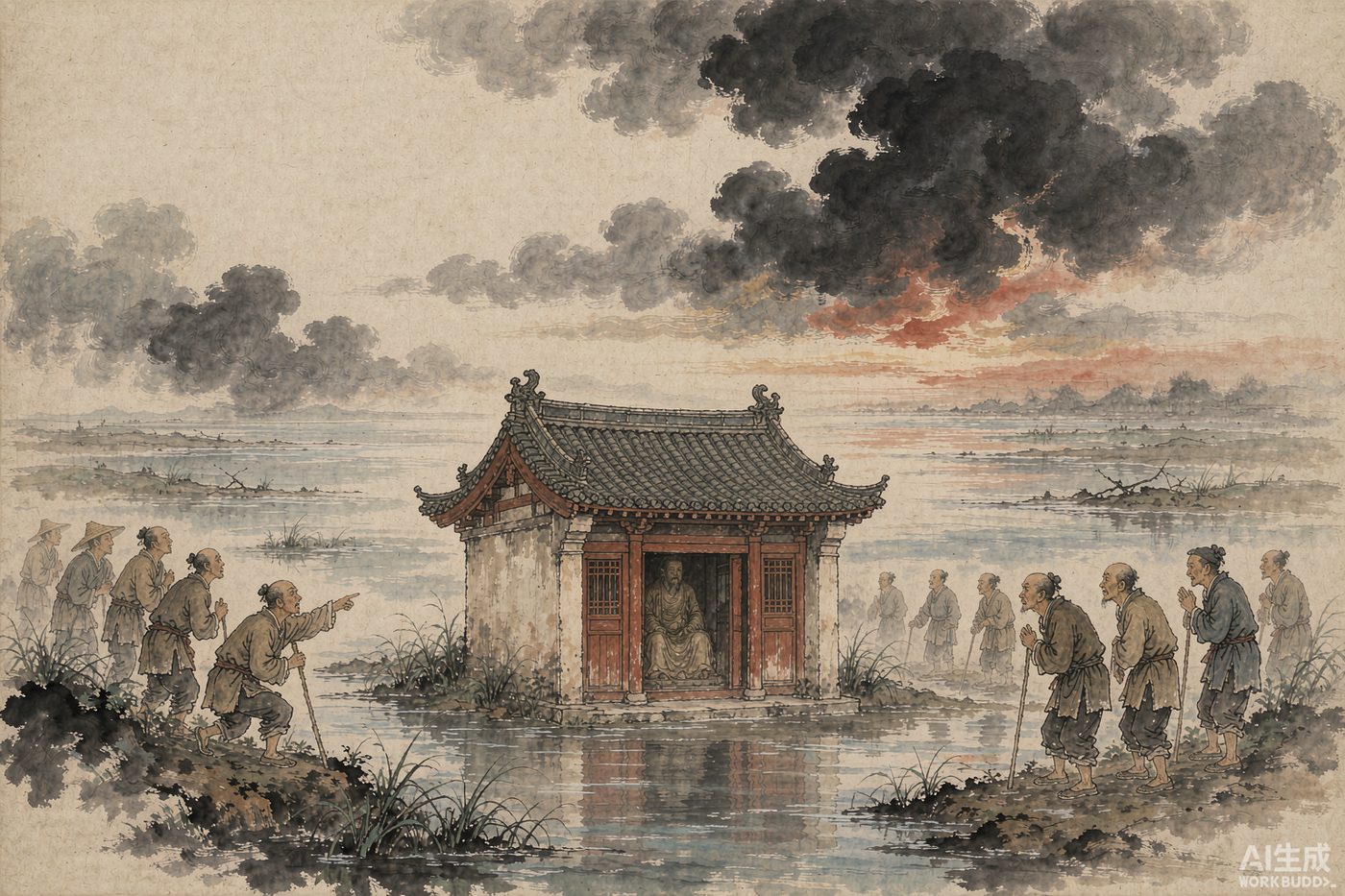
In 《七娘子灘龍女廟》 a village at the foot of a mountain is flooded every year, and the villagers ask the shrine on the slope to move down to the river bank. The divining blocks give a lucky answer. What happens that night is a sound like a mountain collapsing, foxes howling and ghosts wailing and rain coming down in rivers — and by dawn the sky is clear and the temple is finished, intact, on better ground. The god did not approve the relocation. He performed it.
The result is the line that tells you what a shrine actually is: 自是淫漲抵廟岸即止 — after that, whenever the flood rose it stopped at the temple bank. The shrine is infrastructure and the god is an engineer.
This matters because it is the opposite of piety. Nobody loved this god into existence. The village had a hydraulic problem, and the building solved it.
Founded by appointment from above
The second type comes from the celestial establishment, and it arrives on paper. This is the same machinery as 《神職》.
- In 《曾尚書》 a dead minister receives a celestial writ appointing him Earth God of a mountain shrine. His first act in office is to ask his sons for several thousand sheets of dyed paper to burn, because the handover gifts owed to the whole yamen still have to be met.
- The City God is the fully institutional version. Every walled city has one, the post is part of the celestial establishment, and the holder can be impeached and judged — as in 《城隍神酗酒》, where a drunken City God is arraigned before Guan Yu.
A god founded this way has a superior and a file. If you have a complaint against one, there is somewhere to file it.
Founded by the state
The third type is founded by the living government, and it is the most surprising, because it works on animals.
- In 《護國大將軍》 locusts darken the sky and strip the harvest. Thousands of birds fill their crops and spit them out again; in ten days there is not one locust left. Local officials memorialise the throne, the throne confers an army rank, and a shrine is built. The bird never asked, never appeared, and never speaks again. It is a god in the sense that a man is a colonel.
This is the route that makes the pantheon look like an administrative accident, and it is entirely real: titles were conferred on springs, mountains, rocks and insects. A shrine of this kind is a government office with incense in front of it.
Founded by mistake
The fourth type has no founder at all.
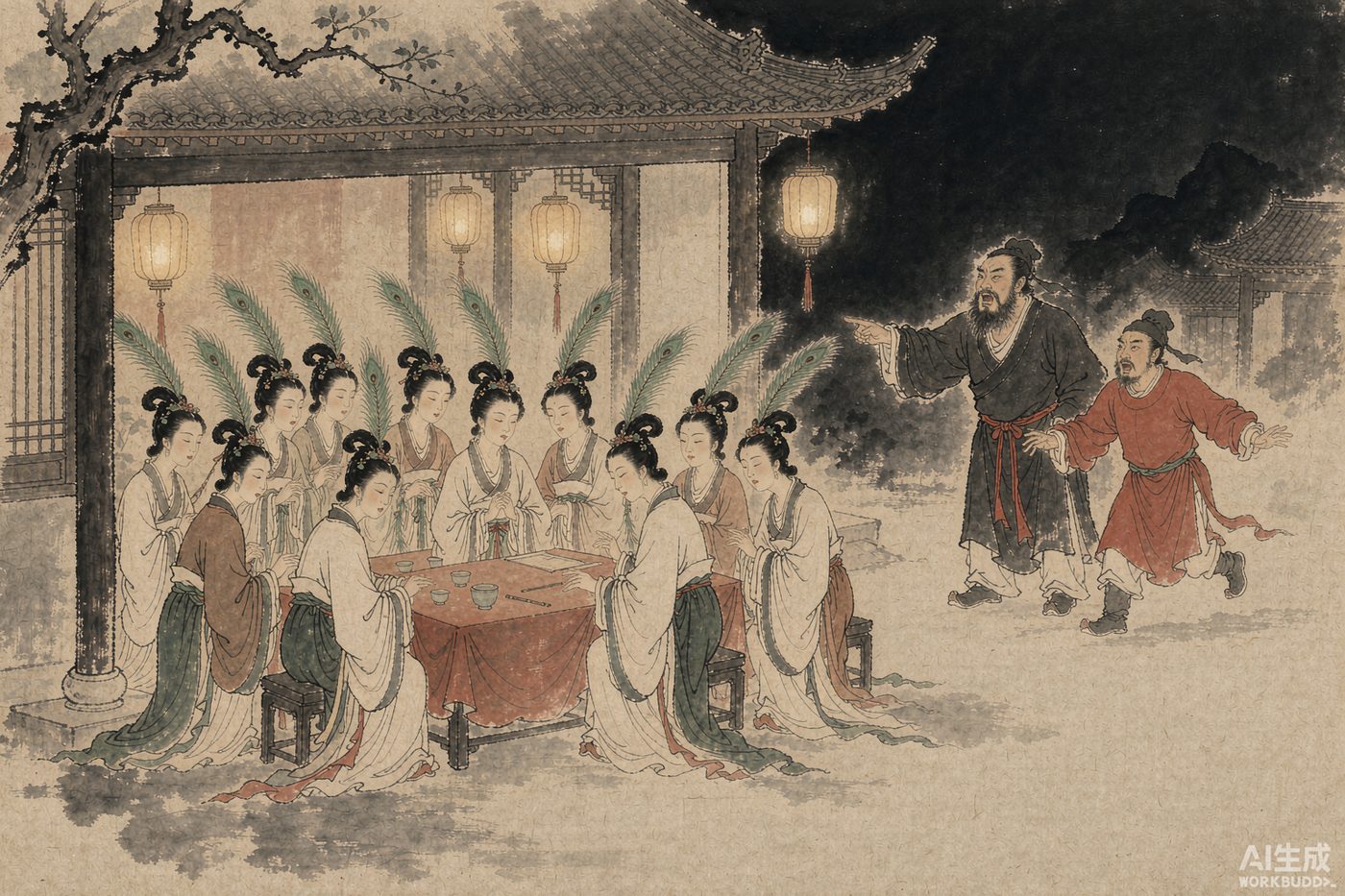
- In 《十姨廟》 a temple stands west of Duqu with ten beautiful women in kingfisher plumes, and nobody knows in what age it was built. The answer is that it was built for Du Fu, whose office of Reminder (拾遺, shíyí) sounds, in a country mouth, exactly like Ten Aunts (十姨, shíyí). The title became a plural noun, and a plural noun needs bodies, so ten women were made.
This is the one that tells you the most, because it is not a story about faith. It is a story about phonetics outrunning literacy and winning. The shrine ran for a thousand years on a mishearing. Nobody was defrauded and nobody was lying. The name simply survived the thing it named.
And note what the mistake reveals about the whole system: a shrine does not need the right god in it to keep functioning. It needs a name, a building, and people who come. The god is the last thing consulted.
The record
A shrine also needs a document — and here the texts are unexpectedly strict about who writes it.
In 《順濟王》 a disgraced official is commanded in dream to write the record of the god’s shrine. He objects that his name is obscure and carries no weight, and suggests the god commission someone famous. The god’s voice goes harsh: 誰為達官吾不知也 — who is this high official? I do not know him.
The god does not want prestige. He wants the brush of the man who is actually present. Compare 《鬼借官衔嫁女》, where a ghost household borrows a living man’s official title to paint on its lanterns — the exact same anxiety about whose name stands on the gate, and the exact opposite conclusion.
How a wrong shrine gets fixed
Two ways, and they are not symmetrical.
From below. In 《十姨廟》 the scholars of the district, once they have heard the story, destroy the ten images and restore the sacrifice to Du Shiyi. This is the rare case: the error is corrected by people who can read.
From above. In the same tale the god arrives himself. He sits down at the table, identifies himself as Du Shiyi of Huanhua Brook, explains how the mistake was made, says he tolerated the women only because he had assumed they knew something of letters — and evicts them: from this day forward, clear out three she-li and stay clear. He threatens them with the white-handled long spade, his own line from his own poem, the tool he dug for wild yams with while his children starved.
That the god of a mis-founded shrine still has the power to evict the error is the point. Possession is nine-tenths of the law, but not ten.
How a shrine ends
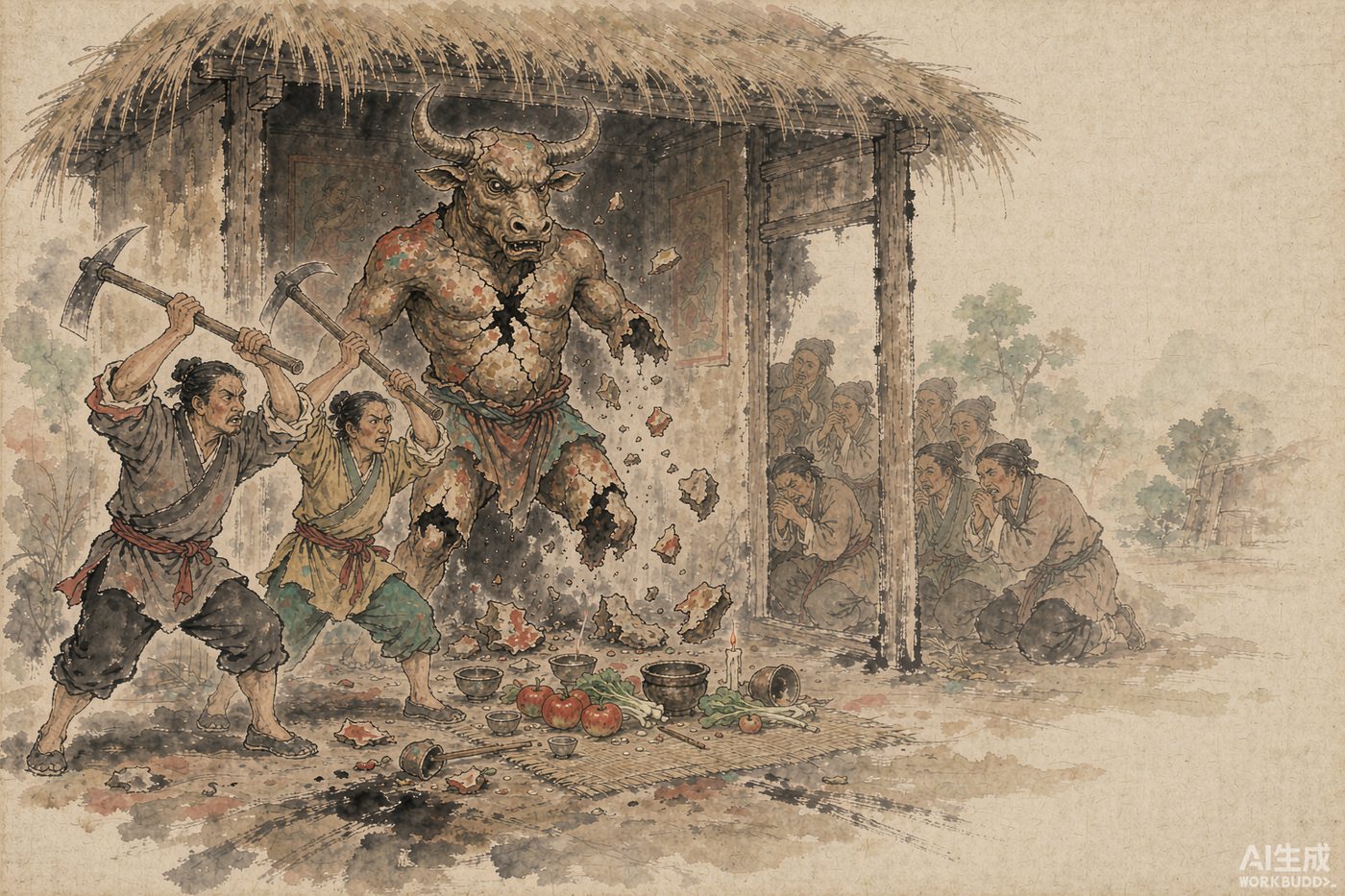
In 《牛头大王》 a god demands a temple in a dream, clears a village epidemic, and answers prayers for sons for several years. Then one father’s boy dies after an auspicious divination. The man takes a hoe to the statue.
No retribution follows at all. The shrine was a name and a statue and nothing behind it.
This is the same test the whole system runs on. A god who cannot keep a countable promise can be broken, and nothing happens. A god who can is a god. The hoe is the instrument of last appeal, and in these texts it is used.
Why it matters for the reader
When a hero in these stories needs help, the question is never do you believe. It is always:
- What was the problem this shrine was built to solve, and is it still solving it?
- Is there a writ, or only a story?
- Was this title conferred by a court, or adopted by a village?
- And if it is wrong — can the person being worshipped still walk in and throw the worshippers out?
A universe in which Du Fu can enter his own temple, find ten women in it, and have to explain who he is, is a universe in which the sacred is genuinely bureaucratic. That is not a bug. It is the reason these stories are funny, and the reason they are frightening.