Lü Shi, a man of Jianning, was reading in an old temple on the northern slopes of Mount Wuyi. It was daytime, but the light had gone grey, and he saw that every stone on the steps was standing up like a man.
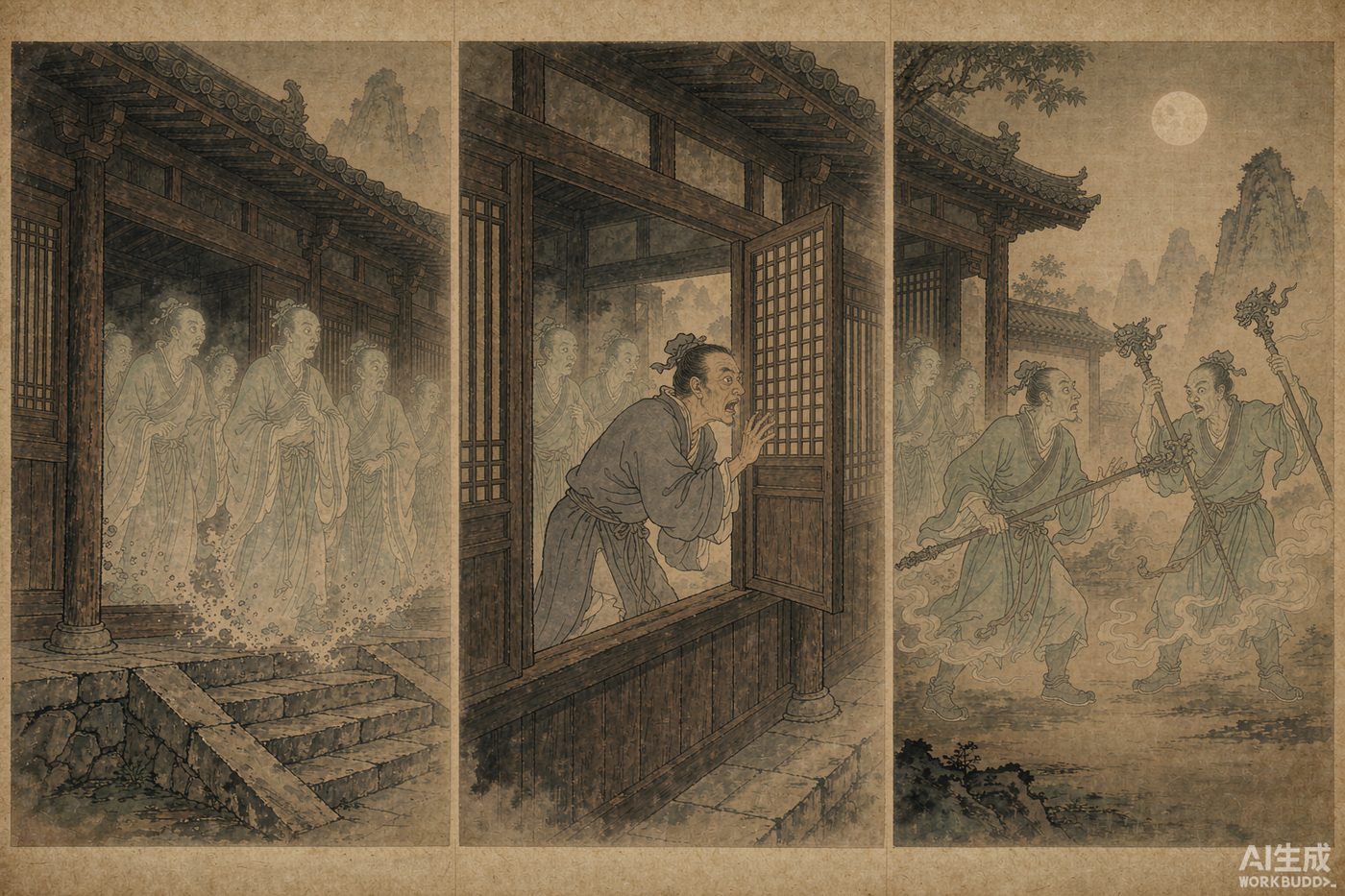
A cold wind passed. The paper from the windows and the leaves of the trees tore away and clung to the stones and would not come off; tiles blew off the eaves and stuck to them too. And the stones turned, all of them, into men: the window paper and the leaves became their clothes, the tiles became their caps, and there were a dozen or more tall gentlemen sitting at their ease about the Buddha hall, in refined conversation, delightful to listen to.
Lü was terrified. He shut the window and went to sleep.
In the morning he looked, and there was not a trace of anything. But that afternoon the stones stood up again as before. After several days it had become so ordinary, and so plainly harmless, that Lü went out and spoke with them.
He asked their names. Most of them had double surnames. They said they were men of the Han and the Wei, and two of the older ones were men of the Qin. And what they told of those times differed in a good many particulars from what the histories of Han and Wei have to say.
Lü was delighted. After the midday meal he would sit quietly and wait for them to come.
He asked them why they took shape by borrowing objects; they did not answer. He asked why they did not simply live in the temple; they did not answer either. All they said was:
“You are a man of taste, Mr Lü. The moon is bright tonight. We will come and match weapons with one another, so that you may see what you have not seen.”
That night they came, each with blade or sword. Some of them carried ancient weapons, not like the halberd or the lance, and such as no name could be forced onto. They rose to the dance in the moonlight, singly or in pairs, fleeting, marvellous. Lü bowed twice and thanked them.
Then one day they told him: “We have kept company with you a long while, and it goes against us to part. But tonight we are all to be born again across the sea, to finish business left over from a former life. So we must say goodbye.”
Lü saw them to the gate. After that there was silence. He was desolate, as though he had lost a good friend.
He took what they had told him of antiquity and wrote it into a book, and called it What the Stones Said. He wanted to have it cut and handed down, but he was too poor to manage it, and it is still in the keeping of his son Lü Dayan.