Stories/ 子不语/ Two Tales of Jealous Ghosts

Two Tales of Jealous Ghosts

鬼妒二則

SourceZibuyu (What the Master Would Not Discuss)
AuthorYuan Mei
EraQing dynasty · from Zibuyu, late 18th century
Written1788
GhostJealousyLoveDeath
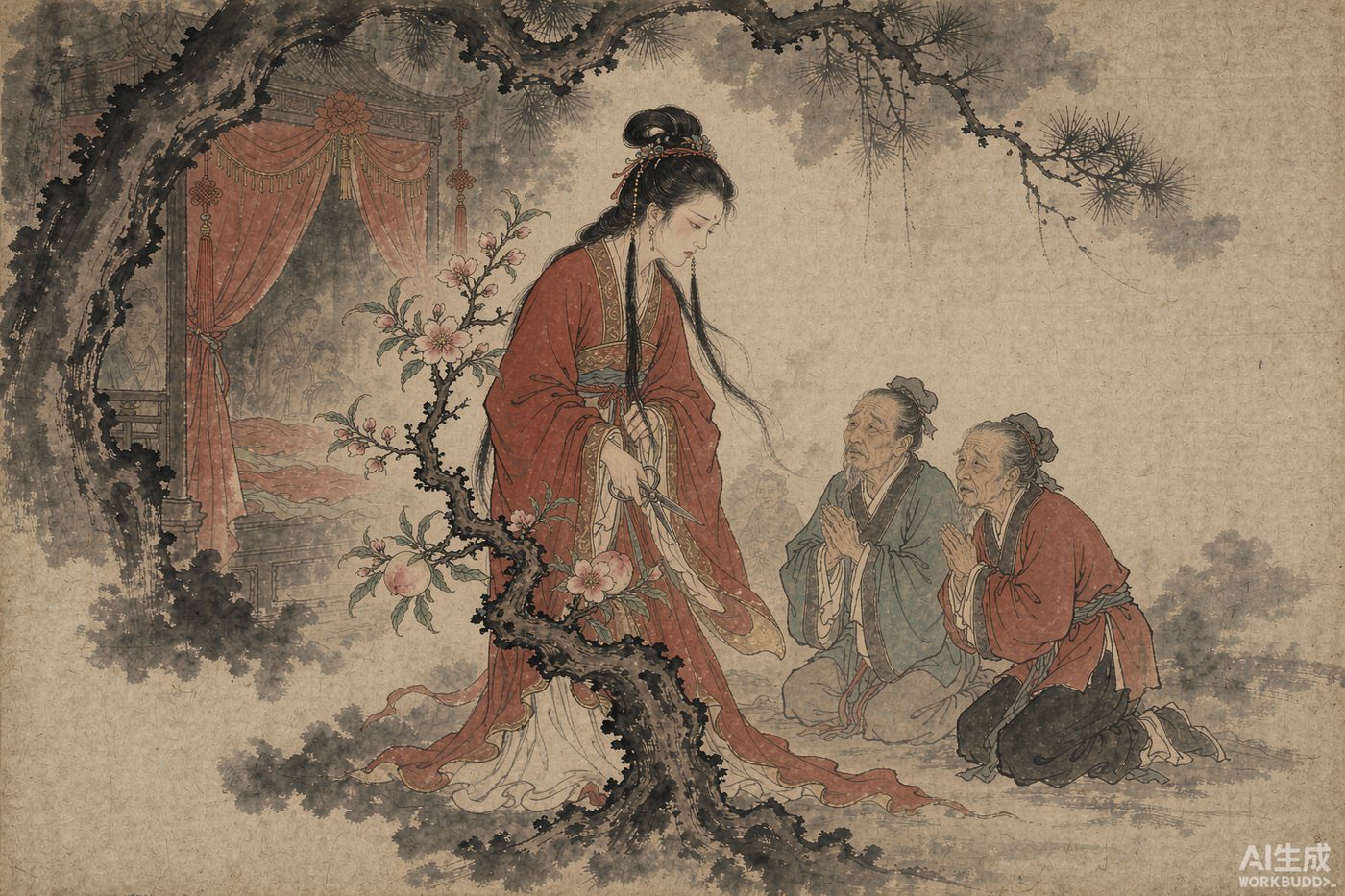
A Qing bedchamber where a possessed bride with loosened hair holds scissors to her breast while an old couple kneel in supplication, a peach branch on the floor, ink-wash painting
Illustration generated by AI, based on the ancient Chinese text.

The daughter of Prefect Zhang of Changde was betrothed to a son of the Zhou family; at seventeen she died of consumption. Zhou separately contracted a girl of the Wang family, also seventeen; the match was barely made, not yet the wedding day, when the Wang girl suddenly fell into a fit and slapped her own face, saying: “I am Miss Zhang the Fourth. Who are you, to dare steal my bridegroom?”

The Zhou boy heard and told the prefect. The prefect’s lady, who kept a strict house, flew into a rage on hearing it, and hung the dead girl’s portrait and scolded it: “You were betrothed to young Zhou but never wed; you died, and it is the common way of rites that he marry again — why go and harm the Wang girl, so shameless as this!” Having scolded, she broke a peach branch and whipped the portrait. Before many blows, young Zhou came running from outside the gate to beg pardon; asked why, he said: “The Wang girl says Miss Zhang the Fourth cried out in pain and went, and begs someone to plead for her with her mother — so the bridegroom came specially.” And the Wang girl was indeed cured.

Xie the old man of Mapo Lane in Hangzhou made his living selling fish and had two daughters, both pretty. A military licentiate Li saw them and was pleased. Li was himself handsome; earlier a cousin Wang had admired him and sent a go-between, but Li refused Wang and wedded into the Xie family; Wang died of consumption. Less than a month after the Xie girl married, she suddenly let down her hair and raved, crying “I am Wang! You a mere fishwife’s daughter, how dare you take my licentiate?” She took the scissors from the table and stabbed herself in the heart, saying “I take your honey-orange.”

Xie and his wife went to the licentiate’s house, burned paper money and performed a fasting rite on their knees to beg, but could not save her. Asked what a “honey-orange” was, she said: “Your daughter’s heart and liver.” Before long the girl died. The licentiate came again to ask for her younger sister; Xie, wary, refused. The sister admired his looks and said: “I fear no ghost; if it comes I shall wave my knife and kill it, to avenge my sister.” Xie had no choice and married her to him after all. After the wedding the ghost was silent indeed, and bore the licentiate a son before she was widowed.
Original classical Chinese text · 原文

常德張太守之女,許周氏子,年十七以瘵疾亡。周別聘王氏女,年亦十七,甫締姻,尚無婚期,王女忽中惡,以手批頰曰:「我張四小姐也。汝何人,敢奪我郎君?」周氏子聞之,告太守。太守夫人治家素嚴,聞之大怒,懸亡女畫像�罵曰:「汝與周郎連姻,尚未成親,汝死,周郎再娶,亦禮之常,何以往害王家女,無恥若是!」罵畢,折桃枝擊之。未數下,門外周郎奔來求饒,問:「何故?」曰:「王女口稱,張四小姐呼痛去矣,並求替他母親說情,故婿特來。」王氏女竟愈。杭州馬坡巷謝叟,賣魚為業,生二女,俱有姿,有武生李某,見而悅焉。李貌亦美,先有表妹王氏慕之,託人說婚,李卻王氏,就婚於謝,王氏以瘵亡。謝嫁未逾月,忽披髮佯狂,口稱「我王氏也,汝一個賣魚婆,何得奪我秀才?」取几上剪刀自刺其心曰:「取汝蜜羅柑。」謝叟夫妻往秀才家燒紙錢作齋醮跪求,卒不能救。問:「蜜羅柑何物?」曰:「你女兒之心肝也。」未幾,女竟死。秀才又來求聘其妹,謝叟有戒心,不許。妹悅其貌,曰:「我不畏鬼,如其來,我將揮刀殺之,為姊報仇。」謝不得已,仍嫁與之。婚後,鬼竟寂然,為秀才生一子而寡居。

From 《鬼妒二則》, Zibuyu. Translated in full. 瘵疾 is consumption, tuberculosis — the wasting death that leaves the young bride unfinished; 中惡 is 'struck by evil', the fit of possession; 太守 is a prefect; 蜜羅柑, 'honey-orange', is a euphemism here for the heart and liver the ghost means to tear out; 桃枝, a peach branch, is the standard apotropaic whip against ghosts; 齋醮 is a Daoist fasting and offering rite.

Source. From Zibuyu (What the Master Would Not Discuss) (子不语), by Yuan Mei , 1788. The original text is in the public domain; this English rendering and the accompanying notes are original work.
Where this fits in the universe: Ghosts

Keep Reading

Related Stories

Qing dynasty · from Zibuyu, late 18th century · 子不语

The Ghost Who Bought a Son

鬼買兒

A dead first wife, jealous of her own embroidered jacket, possesses the second wife to get it burned. Then she stays on — running the household each morning, choosing her own grave, and finally bargaining for three thousand paper coins to buy the family a son to keep her sacrifices fed.

GhostFamilyMarriage
Qing dynasty · from Zibuyu, late 18th century · 子不语

The Ghost Who Brought Dumplings

鬼送湯圓

A dead pupil returns on the eve of the Qixi festival with a bowl of hot dumplings for his old tutor, who eats three before realising the boy has been in the grave a year. The ghost gone, the house fills with a hundred hungry ghosts — until the right old monk is invited.

GhostDevotionFeast
Eastern Jin dynasty · 4th century · 搜神记

Dong Yong and the Weaver Maid

董永

Dong Yong sells himself into servitude to pay for his father's burial. On the road to his master's house a woman offers to be his wife — and weaves ten bolts of perfect silk a day to buy back his freedom.

ImmortalLove