Wang Qingyue of Tiantai, whose style name was Qingshu, was born in the middle of the Shaoxing era. He was quick of understanding and accomplished in many arts — the zither, chess, divination, musical pitch, archery, medicine; there was nothing he did not grasp beautifully.
He owned a zither of surpassing quality, and prized it above measure. He had gone out from his post as Court Diarist to govern Huaixi, and by the gengzi year of the Chunxi era he was forty-three.
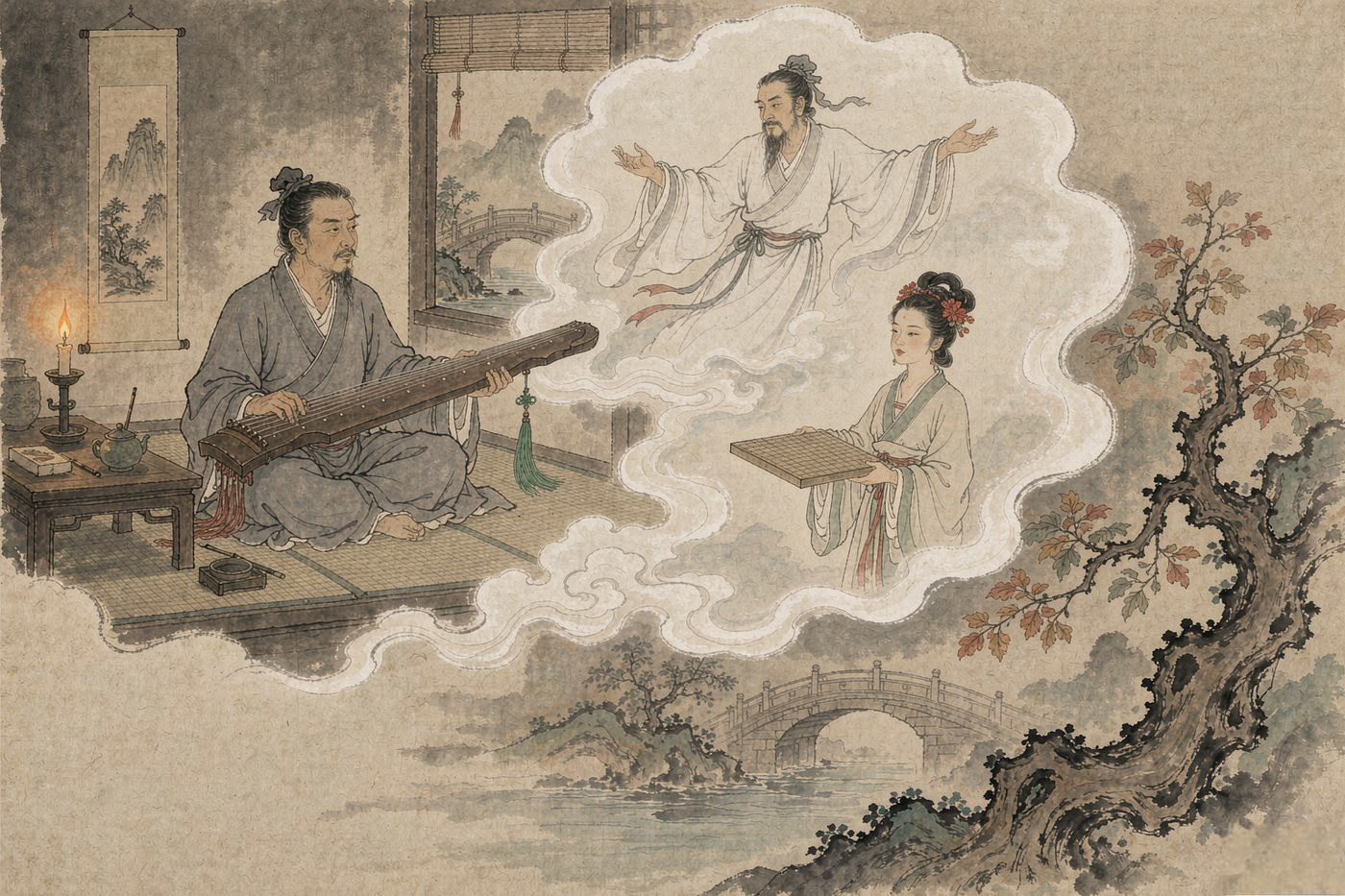
At home in his native place he dreamt of a Daoist in rose-cloud skirts and a shawl of cloud, whose bearing brushed the vault of heaven. The moment they met, the Daoist gave him a zither. Wang was startled and delighted; he took it and turned it over, and it was his own.
He laughed and declined it. “This is already in my house. Why do this?”
“You have the zither, sir,” said the Daoist, “but you do not know its meaning.”
He turned the instrument over and showed him the dragon-pool — and cut within it were eight characters:
In the year of the cycle, the matter rests with Little Red.
Wang was on the point of asking what it meant when he woke. He noted it down idly in a book, and gave it no more thought.
In the renzi year of the Shaoxi era he was recalled from the south of Lu and made Vice Minister of the Imperial Clan Court. Through a broker he acquired a young maidservant who played chess well. He asked what she had been called at home.
“Little Red.”
He remembered the old dream with a jolt — and the interval was exactly one cycle of twelve years. She was skilled at chess and could also play the seven strings, so he bought her at twice the ordinary price and gave her the zither he had treasured. His favour towards her was extreme.
Two days later he was ordered to go as envoy to the Jin.
Wang was expert in the Five Phases, and because the year’s circuit and its limit clashed, he did not wish to go. He declined again and again and was not excused. On the seventh day of the seventh month he passed out of the capital gate. At Gusu a carbuncle broke out on his back. By Jingkou it had grown much worse. And ten li short of Yangzhou he died.
His last instruction, sent home as he was dying, was that the girl should be sent back to her parents at once.
There is a Huainan saying: Ten li from Yangzhou, Little Red Bridge. And this too answered to the dream.
Earlier, when Wang was south of Lu, he had been immoderate in rewarding the soldiers, without limit of any kind; and by the time he left, the military stores were empty. His successor, Zhang Kaofang, could not keep the level up and cut back wherever he could, and on that account met a strange disaster. Huai and Shu are several thousand li apart, east and west — and the two men died on the same day, the twelfth of the seventh month.
Ah. How strange.