From the islet at Ezhou to Xiangyang is seven hundred li. After the wars the long road was a waste, with no inhabitants anywhere. Only the garrison armies, every twenty li, had set up a flying-arrow horse post to carry documents; and every seventy or eighty li there was a rest-house for troops on the move, which travelling officials also lodged in.
In the sixth year of the Qiandao era, Jiang Tongzu, an officer on the staff of the Huguang commissariat, was going from Ezhou to Xiangyang and came by Hanchuan to the post-house at Yangtai. The mosquitoes worried him all night and he could not sleep, so he told his men they would start at the first cockcrow.
“This is the most desolate place there is,” the post clerk said to him. “There are many fierce tigers here, and there has long been a tiger-spirit that harms people. Not long ago a military officer rode out before dawn, and both he and his horse were eaten. You would do well to wait until you can see the colours of things before you take the road.”
Jiang did as he was told.
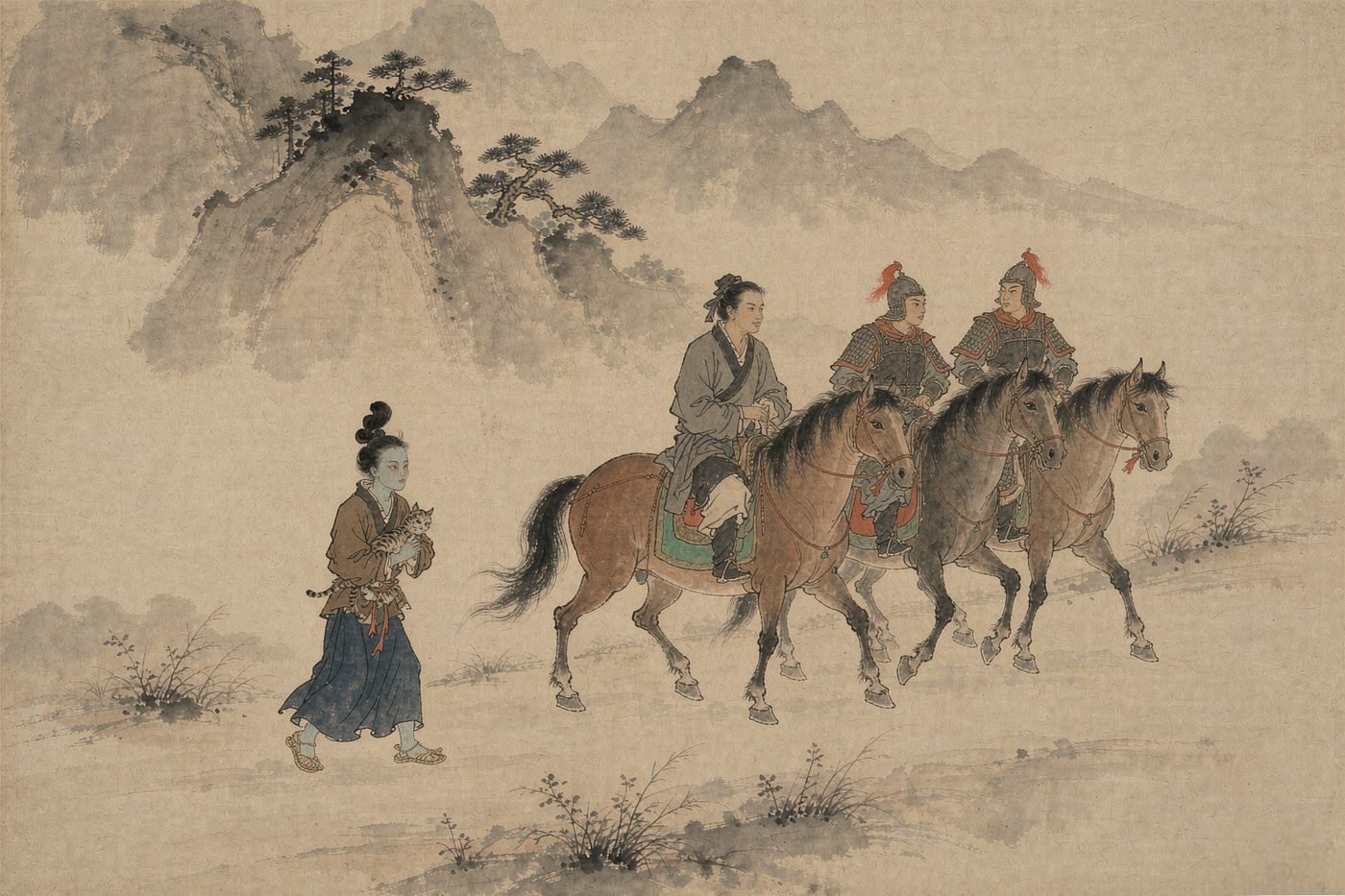
On the way back he had to pass through Ying prefecture and put up there again. He set off early, three riders with the yamen runners and two soldiers, and presently he was aware of men and horses shying. Far off he saw something yellow racing through the grass, and his heart turned over. As they came near it turned out to be a huge deer, the size of an ox — and he was frightened enough by that.
Half the stage on, a woman appeared suddenly in front of his horse. She might have been forty or fifty. Her hair was wound in a single horn of a bun; her face was faintly blue; she wore no paint or powder. Her eyes were absolutely red, and most dreadful to look at. She had a brown jacket on, a blue skirt, straw sandals trailing, and she carried a small tabby cat in her arms. Now behind, now in front, she followed without ever letting go. When they came to set down their loads for the night, she was not there.
Jiang thought to himself: is this not what they call the tiger-spirit? And he said nothing of it to anyone.
At daybreak he was for going east, and one of the post soldiers said: “Yesterday we found two tiger cubs on the left of the road, not able to walk yet. Would you like them, sir? We would give them to you.”
Jiang laughed. “Why should I rear tigers to trouble myself with afterwards?” he said, and did not take them.
Two nights later, crossing the river from Hanyang with several others in the boat — she was there. Her face, her clothes, everything as before. A woman travelling alone, Jiang thought, and she can keep up with a galloping horse. He was more afraid than ever, and sat in his sedan with the blind down and his eyes shut, not daring to look at her straight.
He had been home nearly a month when he heard gongs and drums and shouting in the street outside, and some thousands of people, gentle and simple, ringed round as though a dangerous bandit were being marched through. He went out to look.
It was the woman again.
He asked what it was about. They told him: “For nights on end the households of the south market have been losing pigs, and losing children too, a great many. Nobody could be traced for it. But in a small inn there, this woman has lodged alone these thirty days, and never once lit a fire to cook, and has not a cash in her purse; she only keeps a cat, and now and then you can see fur and blood on its muzzle. They were sure it must be a monster, and so they took it to the authorities. Now we have her under arrest and are delivering her to the prefecture.”
The woman’s manner was entirely composed. She showed no fear at all.
In the city, the prefect Li Shouqing — a vice-minister — had her brought to the administrative hall to make a statement. She could handle the brush herself, and she wrote:
My surname is Tu. I am the daughter of a gentleman; my father was once magistrate of Yuan’an county. I was married to a man who did not suit me; he too is dead. I have no children to continue the line. I am one solitary person, drifting about, keeping myself alive as I can. The young ruffians of the market persecute me between them, and now they turn me into a beast. My wrongs could not be greater. I ask your lordship to stand by me.
Li Shouqing could not bear to press it. He had her admonished, took a bond from her, and had her escorted out of the prefecture.
She went into the tea hills of Xianning and lived among the tea-pickers’ huts. After a long time she was seen seizing and eating a farm dog, and was beaten and driven off.
After that, nobody knew where she was.