The Commander-in-Chief of Jiangdu, Zhao Shi, tells this.
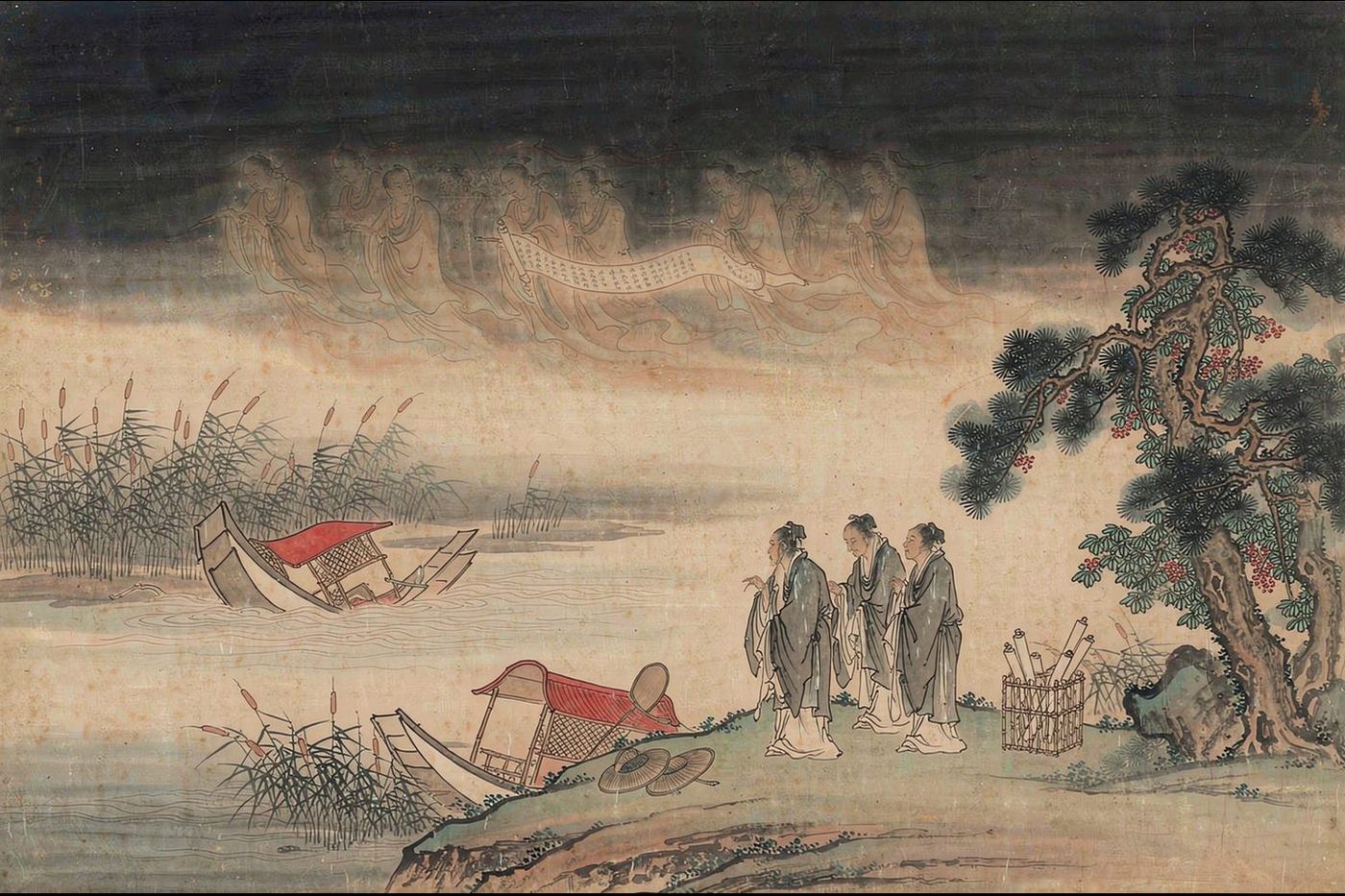
In the twelfth year of the Chunxi era, three men of the imperial clan — an uncle and his two nephews, all from the same district — were travelling home from Lin’an, where they had been through the selection for office. It was the turn of the fourth or fifth month. They bought a small boat between them and took the road by water through Wuxing; and as they were crossing a shoal in the stream, at midday a great wind got up, the sky went dark, and something seemed to take hold of the tiller. The boat went over then and there. Luckily the water was shallow and they did not drown.
They got to the bank and stood there with no idea what to do next. Then a basket came drifting towards them. They looked, and it was the uncle’s certificate of appointment, his robe and his boots. The things had been soused in the river and were not even damp. The uncle was delighted. His two nephews wept and said, “You have nothing to worry about now, uncle. But what about us?” And then a second basket drifted up, with the nephews’ papers in it.
By now it was evening, and they put up at a village house. At first light they set off on foot, and on the way they saw an old farmer working his ground with a hoe over his shoulder. He saw how wild and wretched they looked and asked them what had happened, and they told him.
“Why not go and ask Master Zhao?” said the farmer. “He would know what is behind it.” And he told them where to find him.
So they went. Zhao was of the imperial clan too and an old acquaintance. He questioned them closely about every particular, and then said: “That place is a small stream. A small stream cannot sink a boat. There is something else at work. I practise the art of constraining gods and spirits. I will hold a summons for you, and we shall see at once.”
The rite was no sooner finished than the house was full of spirits — and the one at their head was the farmer they had met that morning.
Zhao read them the catalogue of their offences and demanded the contents of the boat. Every item was produced; all of it was in use among the spirit’s own household, and the earrings and hair ornaments of the kind they wear in the capital had been quietly appropriated by his women. The inventory complete, Zhao rounded on him.
“You sank a man’s boat,” he said, “and then stole what he was carrying. How do you expect to escape punishment?” And he moved to bind him.
The spirit answered: “I am unworthy, but I am the earth god of this jurisdiction. Some days ago I received a public warrant from the City God’s office, naming this boat for overturning. I took delivery of the goods item by item against that warrant. Only the three men’s certificates of appointment and the imperial rescripts were not entered in the register, so those I sent back at once. The warrant is still in my keeping. You may inspect it.”
Zhao took it and read it. He could find no charge to bring.
And so he let him go.