Stories/ 子不语/ The Tiger Who Carried Off Wenchang's Head

The Tiger Who Carried Off Wenchang's Head

虎衔文昌头

SourceZibuyu (What the Master Would Not Discuss)
AuthorYuan Mei
EraQing dynasty, c. 1750–1780
Writtenc. 1788
TigerJusticeMurderDeityStrange
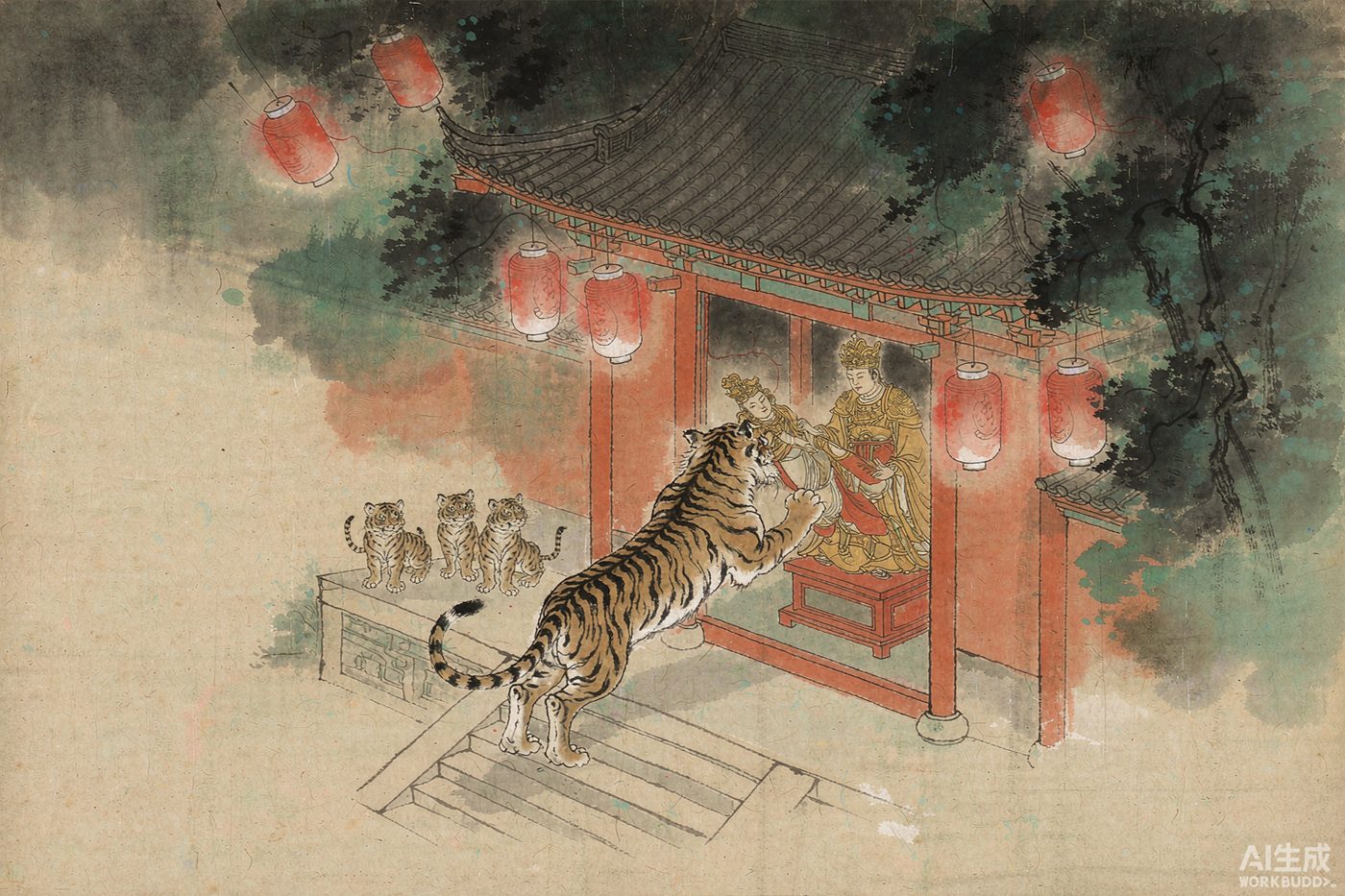
A small village shrine to Wenchang at night, a huge tiger leaping over the wall with a clay statue head in its jaws, three tiger cubs curled on the altar steps, and villagers with lanterns crowding at the gate
Illustration generated by AI, based on the ancient Chinese text.

A villager of Xing’an prefecture in Shaanxi took a wife in the sixth month. The day was high summer and the road was long, and the bride, her head wrapped in a red scarf, could not bear the stifling heat — she died suddenly in the cart.

Her parents were wild with grief. They bought a coffin and laid her in it, but it was not convenient to carry her home, so they lodged the coffin behind an old temple outside the city walls. The coffin was not very stout. It chanced to rain hard, the cool air soaked into the coffin, and the girl revived, groaning aloud.

In the temple were a monk and his disciple, who heard her and came to look. They opened the coffin — a lovely young woman, smiling faintly. They lifted her up, revived her with broth and medicines, and carried her into the temple. But the disciple, wishing to keep the girl for himself alone, sent his master to buy wine, and when the man came back half drunk he killed him with an axe. He laid the master’s corpse in the girl’s own coffin behind the temple, and fled with the girl to a Wenchang shrine in another village, where he grew his hair and set up as a lay Taoist.

More than a year passed.

Then, one night, a tiger suddenly leapt into the shrine, seized the head of the clay image of the Lord Wenchang in its jaws, and carried it off — leaving three suckling tiger cubs behind.

The neighbors spread the news and everyone crowded to see the cubs. The girl’s parents came too — and suddenly saw their daughter. They thought she was a ghost, and wept holding her for a long time. The girl could hide no longer. She told the whole story from the beginning, and told them also of the stolen wife and the murdered monk.

Her parents laid an accusation before the magistrate. On examination the truth came out; they dug up and verified the monk’s corpse; the disciple was dealt with according to law; and the girl was given into her parents’ keeping and taken home.

The reader-in-waiting Yan Dongyou told me this himself on his return from Shaanxi.
Original classical Chinese text · 原文

陕西兴安州民某六月娶妻,天大暑,路远,新妇以红巾裹首,不胜闷热,暴死车中。其父母悲甚,买棺殓之。不便仍舁至家,乃厝之城外古庙后。棺不甚坚厚,会大雨,凉气浸入棺中,女复活,哼咛有声。庙中僧师徒二人闻而视之,启其棺,嫣然美妇也。扶起,以汤药灌苏,抱女入寺。其徒思独占此女,嘱师买酒,饮半醉,持斧斫杀之,即以女棺盛其师尸置庙后,而负女逃居别村文昌祠,蓄发为火居道士。 逾年,夜,忽有虎跳入祠中,将所塑文昌帝君头衔去,而遗下乳虎三只。村邻喧传,争来看虎,女之父母亦至。突见其女,以为鬼也,抱哭良久。女不能隐,具陈始末,且告以占妻杀僧事。其父母控官,讯鞫得实,掘验僧尸,置其徒于法,女交父母领归。此事严侍读冬友从陕西归,亲为予言。

From 《虎銜文昌頭》, Zibuyu juan 17. Translated in full. 興安州 is Xing'an (modern Ankang) in southern Shaanxi; 厝 is to lodge a coffin temporarily pending burial; 文昌帝君 is Wenchang, the god of literature and examinations; 火居道士 is a lay Taoist who keeps his hair and lives at home; 嚴侍讀冬友 is Yan Dongyou, a reader-in-waiting of the Hanlin Academy — the named source, as in 《神仙不解考據》 with Yan Daofu, a relative.

Source. From Zibuyu (What the Master Would Not Discuss) (子不语), by Yuan Mei , c. 1788. The original text is in the public domain; this English rendering and the accompanying notes are original work.
Where this fits in the universe: Sprites, Monsters and Strange Beasts · The Small Gods

Keep Reading

Related Stories

Qing dynasty · Qianlong era, c. 1736–1798 · 谐铎

The Tiger Fool

虎痴

A girl whose father was framed to death vows herself to whoever kills the murderer. A tiger does — and comes to claim her. What follows is not a marriage but a devotion that outlasts death.

AnimalGhostLove
Qing dynasty · Qianlong era, c. 1736–1798 · 谐铎

The Man Who Bound Tigers

壮夫缚虎

Jiao Qi kills tigers with his hands and carries them home over his shoulders. At a banquet given in his honour a cat jumps on the table. He breaks every dish on it, smashes the window, and catches nothing — and the host laughs.

MartialSatire
Southern Song dynasty · 12th century · 夷坚志

The Tiger at the Fireside

武昌客舍虎

A family of four are sitting round the brazier one winter night when a tiger walks in, sits down beside the fire, and stays. Nobody moves. Nobody even puts more wood on without thinking about it. At dawn it gets up and leaves; and the neighbour who came to borrow a light dies of it.

AnimalMonsterHorror