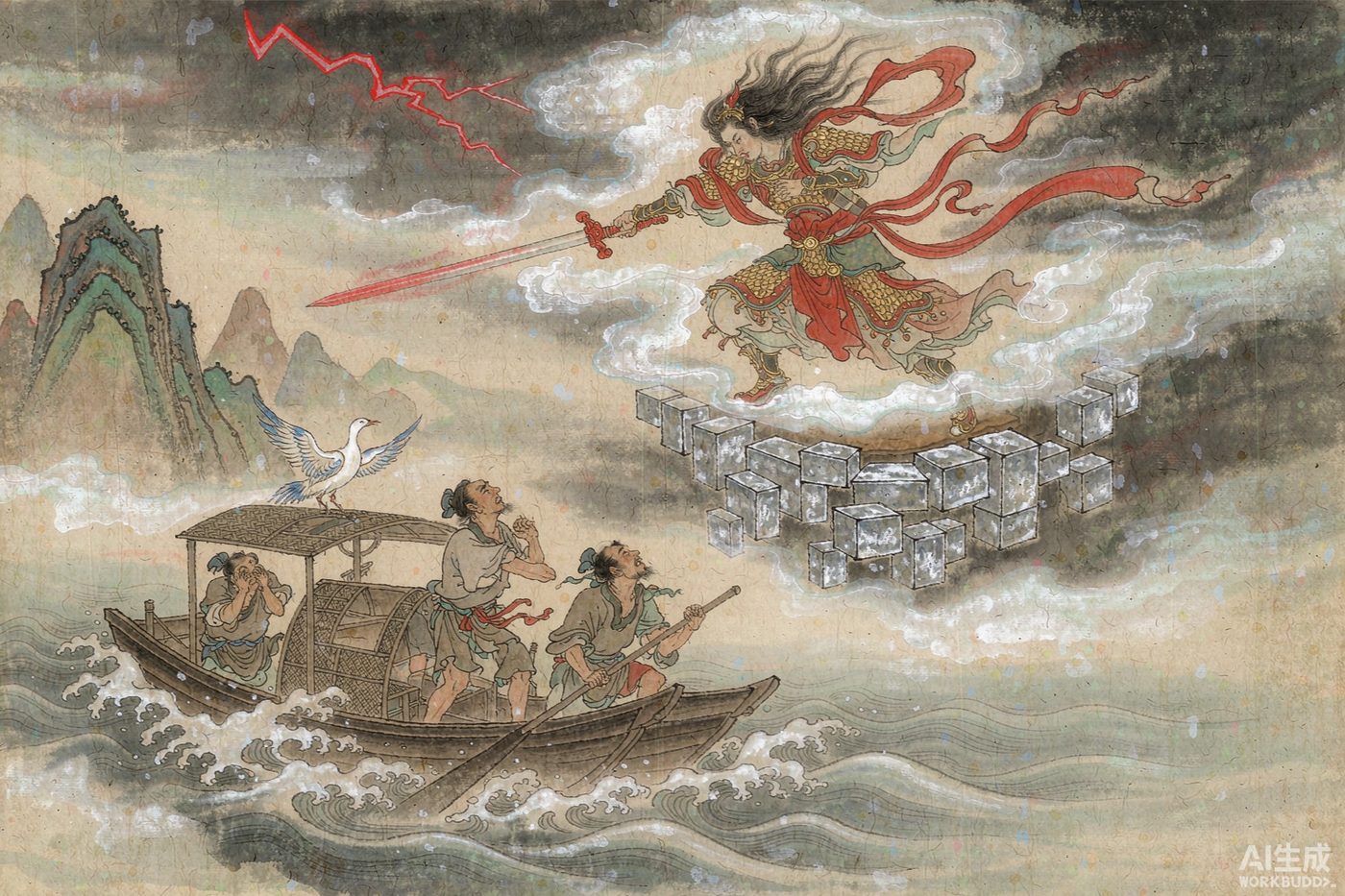
In the eighth month of the wushen year of Qianlong, the intendant Sima sent two servants home: one, Zhu Sheng, aged thirty; the other, Shouzi, aged sixteen. The two hired a boat, and as they reached Liujiapu in Baoying the sky grew dark. Shouzi suddenly cried out in delight: “Ahead a stage is raised for opera, and a golden-helmed, golden-armoured god is upon it — such a crowd!”
No one else could see it. They laughed: “Ahead the river runs wide; there is no stage at all. You are a child, with your heart set on theatre!”
But Zhu Sheng and the boatman’s punt-pole man insisted: “There is a play indeed — why are we the only ones who cannot see it?” Before the words were out, a vicious wind snapped the mast, the boat fell to blackness, and a single thunderclap struck Shouzi and Zhu Sheng dead at the bow and the boatman dead at the stern.
When the storm eased, those in the cabin were terrified; they moored and reported to the county, asking the magistrate to view the bodies.
Presently Zhu Sheng revived, and said: “Shouzi and I were watching the play on the boat when suddenly ahead there were ten thousand streaks of gold light and no river path to be seen, and the ground was paved with snow-white silver bricks. On the stage stood a towering palace, and at its centre sat a god in the mitre-and-tassels crown, square-faced with a white beard, and around him stood dozens in golden helms and golden armour. One golden-armoured god bowed and reported to the crowned one — the words I could not make out — but I saw the crowned one nod, and the golden-armoured one came out, boarded our boat, and seized me and Shouzi and the boatman, and dragged us kneeling before the throne. He drew the sword hung at his waist, its red light blazing, and ran it horizontally through Shouzi’s neck, and then through the boatman’s chest. Seeing how things stood, I turned to flee, but another golden-armoured god grabbed me and struck me on the head with a gold-melon mallet, and I blacked out, and knew nothing after.”
Magistrate Wan came to examine the bodies and took down this statement and filed it. He inspected the corpses of Shouzi and the boatman, and sure enough each bore a fine puncture through throat and chest; he bought coffins and had them buried. Zhu still lived, but could not be treated conveniently on the boat, so they poled to the Temple of the Great King and berthed there, and carried Zhu in. Zhu looked up at the Great King and cried in alarm: “The one seated above just now — that is this very god!” Then, glancing aside, he said: “All you gods are on the throne there — why did none of you save me?” With that he ate a bowl of congee and breathed his last.
That winter I travelled to Shuyang with Liu Xiaoshang, passed Liujiapu, and moored at the Temple of the Great King. We went in to look at the gods, and they were all ordinary gold-lacquered wooden idols, with no other marvel about them. Liu asked the god: “Shouzi was only a child; what evil did he do to meet heaven’s execution?” The god made no answer. I laughed and said: “Foolish licentiate! This is what is meant by ‘the people may be made to follow a path, but not to understand it.’ The seen and the unseen run by one rule — why bandy words with a god?”