Stories/ 谐铎/ The Temple of the Traitor's Lackey

The Temple of the Traitor's Lackey

黑衣太仆

SourceXieduo (Miscellaneous Bell)
AuthorShen Qifeng
EraQing dynasty · c. 1790 (tale set under the Ming)
Writtenc. 1790
Small GodsSatireOfficialdom
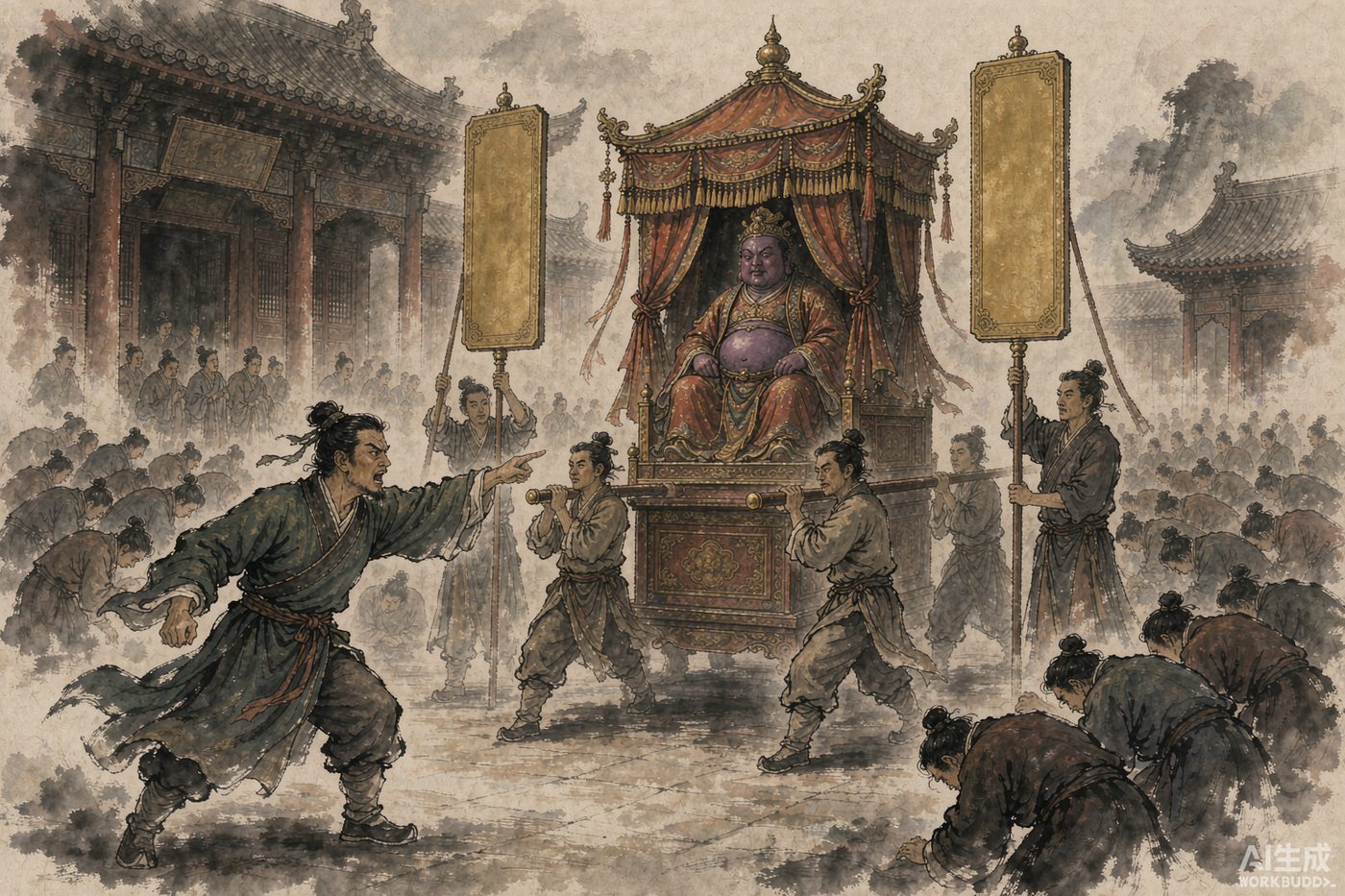
A festival procession carrying a fat purple-faced god on a sedan chair past golden placards, a furious young scholar in scholar's robes pointing, ink wash painting
Illustration generated by AI, based on the ancient Chinese text.

Zhang Bangbi of Maoyuan, a licentiate, was invited into the secretariat by a friend of his father’s who was the magistrate of Fenxiang county. One day, strolling to the market, he found the town holding its festival, the whole city turned out, men and women massed like clouds. Zhang stood under an eave to watch.

Soon gongs led the way, banners, fans and canopies advancing in order. Two golden placards proclaimed in large characters: “Grand Steward of the Chancellor’s House.” Zhang did not know what god this was. Then incense drifted sweet, and in a warm sedan chair sat a god’s image: a fat purple face, whiskers like halberds, a black silk cap, a black court robe, a jade belt and pointed black boots. Zhang thought this strange and followed it to the temple, where victims were laid out in abundance and the lamps and candles blazed. The crowd prostrated below, all in short collar-robes and squat caps, frog-mouth shoes, chattering away in officialese. Then the prayer was read, begging: “May the god’s blessing extend from governors-general down to prefects and county magistrates: power over the gate, and heavier parcels.”

Zhang asked what god this was.

“Lord Niu Er,” they said, “chief doorkeeper under Chancellor Yan of Fenxiang.”

Zhang was furious. “When that traitor Yan sold offices and ruined the loyal, it was creatures like you who encouraged his evil. Now Yan’s name is filth in history — and a dog like you gets a public temple?” He climbed onto the god’s seat, intending to slap its cheek.

The crowd was alarmed and dragged him down. “Are you mad, you penniless bookworm? Two pages of learning and you put on scholar’s airs. If you had lived in the Chancellor’s time, you’d have been trooping after Yan, Ma and Zhao to his gate, grinning and rubbing your shoulders — who knows what you would have looked like! Everyone has his own patron. Scholars worship Wenchang to beg a pass in the exams; butchers and vintners buy candles and silk at the God of Wealth’s shrine hoping for tenfold profit, and the neighbours call them rich men. Our worshipping Lord Niu is the same as your Wenchang and their God of Wealth. What’s your grievance?”

Zhang realised these people could not be argued with, so he spoke to the magistrate, who had the temple destroyed at once.

From then on the ghost of Niu grew fiercer: it took a million million bodies, and fed on sacrifice everywhere under heaven.
Original classical Chinese text · 原文

茂苑张孝廉,名邦弼,父执某为分宜邑宰,招之幕下。一日,闲诣街市,适里中赛会,倾城士女,云屯雾集。张立檐下候观之。 亡何,锣声前导,旌旗扇盖,按部徐驱。有金字牌两面,大书'相府太仆'四字。张不知何神。俄而香烟飘馥,暖轿中坐一神像,面肥紫,须髯如戟,头戴罗帽,身着黑直身,腰系鸾带,下穿尖头皂靴。张异之,尾至神庙,牲牷盛设,灯烛辉煌。众罗拜其下,皆秃襟袍,短襻帽,蛙头鞋子,满口刺刺作官话。继而宣祝文,有"伏愿神灵庇佑,上自督抚,下及州县,管门有权,包儿加重"云云。 张尤异之,因询问何神。答曰:"此分宜相公门下班头牛二太爷也。"张大怒,谓:"严贼当日私鬻官爵,倾害忠良,皆若辈逢迎长恶。今严贼名污青史,何物狗奴,公然庙祀?"上神座,欲批其颊。 众大惊,曳令下,且曰:"汝颠耶?穷措大读得两行书,动辄作腐气。倘生相国时,随鄢、赵辈投谒门下,见牛公胁肩诌笑,不知作何状!且人各有主,秀才家崇祀文昌,不过欲祈福荫,侥幸得科第。屠沽儿日市烛帛,拜祷财神座下,亦欲获什倍利,里党称富翁。今吾侪崇奉牛公,亦犹士子之文昌,服贾辈之财神也!何尤焉?" 张知若辈不可与辨,言於邑宰,立毁其庙。自此牛信之鬼益厉,化为千百万亿身,血食天下矣。 铎曰:"五祀之内,门居其首。后世此祀不传,馁鬼处处觅食,遂于白昼现将军丞相形矣!何牛班头之神,尚穿黑直身哉?或曰:'冠进贤,系羽箭者,是其变相耳!'"

From 《黑衣太仆》, Xieduo. Translated in full. 分宜 is the home county of Yan Song (1480–1567), the Ming dynasty's most notorious Grand Secretary, so 分宜相公 is Yan Song; 太仆 is a household office of a chancellor's mansion, here a doorkeeper; 赛会 is a temple festival procession; 牲牷 is sacrificial animals; 铎曰 is Shen Qifeng's signed closing comment, a moral delivered with an audible smirk. The 五祀 (Five Sacrifices) are the Gate, the Door, the Well, the Stove and the Inner Roof.

Source. From Xieduo (Miscellaneous Bell) (谐铎), by Shen Qifeng , c. 1790. The original text is in the public domain; this English rendering and the accompanying notes are original work.
Where this fits in the universe: The Small Gods · How a God Gets a Post · How a Shrine Gets Built

Keep Reading

Related Stories

Qing dynasty · c. 1790 · 谐铎

The Crow That Knew a Man Before His Rise

祥鸦

Everyone says magpies report good news and crows bad, so the author feeds the crows in his courtyard instead. Through three decades of examination failure and one family success, the crows prove to be the only honest omen-bearers in the story — and the magpies arrive last.

Reading the FateOmensAnimals
Qing dynasty · c. 1790 · 谐铎

The God of Books Who Took Revenge

书神作祟

A family of scholars gives up books for trade. That night something sighs by the bed — and a scholar in a square cap appears to say he is the God of Books, homeless in this house, and that the money now binding him will bring disaster. The merchant's answer is to burn him.

Small GodsSatireScholars
Qing dynasty · c. 1790 · 谐铎

Why the Star-God of Literature Is Blue

奎垣真像

Why is the Star of Literature painted with a blue face and a demon's grin? Because the God of Wealth once lost a lawsuit to the God of Prose, and the Star was sent in wearing a borrowed face and carrying a golden measure.

Reading the FateImmortalsSatire