Zhang Jun, the Duke of Wei, was a clerk in the provincial administration at Chengdu in the Xuanhe era. His mother, Lady Ji, practised the Way, and every day she gave the vegetarian meal to one Taoist, asking nothing about where he came from. Sometimes she lit the incense and performed the courtesy herself.
Once a visitor came who sighed and said, “Madam should have a noble son. Where is he now?”
“He holds a clerkship,” she said. “He is at the prefectural granary just now, taking in the grain.”
The visitor went straight off to see him. When they were face to face he studied him closely and said nothing. Zhang called to a junior clerk about something; and then the guest bowed, and asked Zhang to walk a few dozen paces with him, and addressed him as “my lord chancellor”.
With folded hands he said: “Your noble physiognomy is in the sound of your voice and in your walking. Within ten years of this the whole empire will be in great disorder. You will pass in and out of the highest civil and military office; you will hold the handle of the armies; you will set up the work and the merit of the state. I beg you to take care of yourself.”
Zhang started, and thanked him, and said he could not possibly deserve it. The guest went out at once in a hurry, and there was no time to ask him what place he was from or what his surname was.
When it had all come true, Zhang used every scholar he could find in Shu to search for the man privately, and never got him.
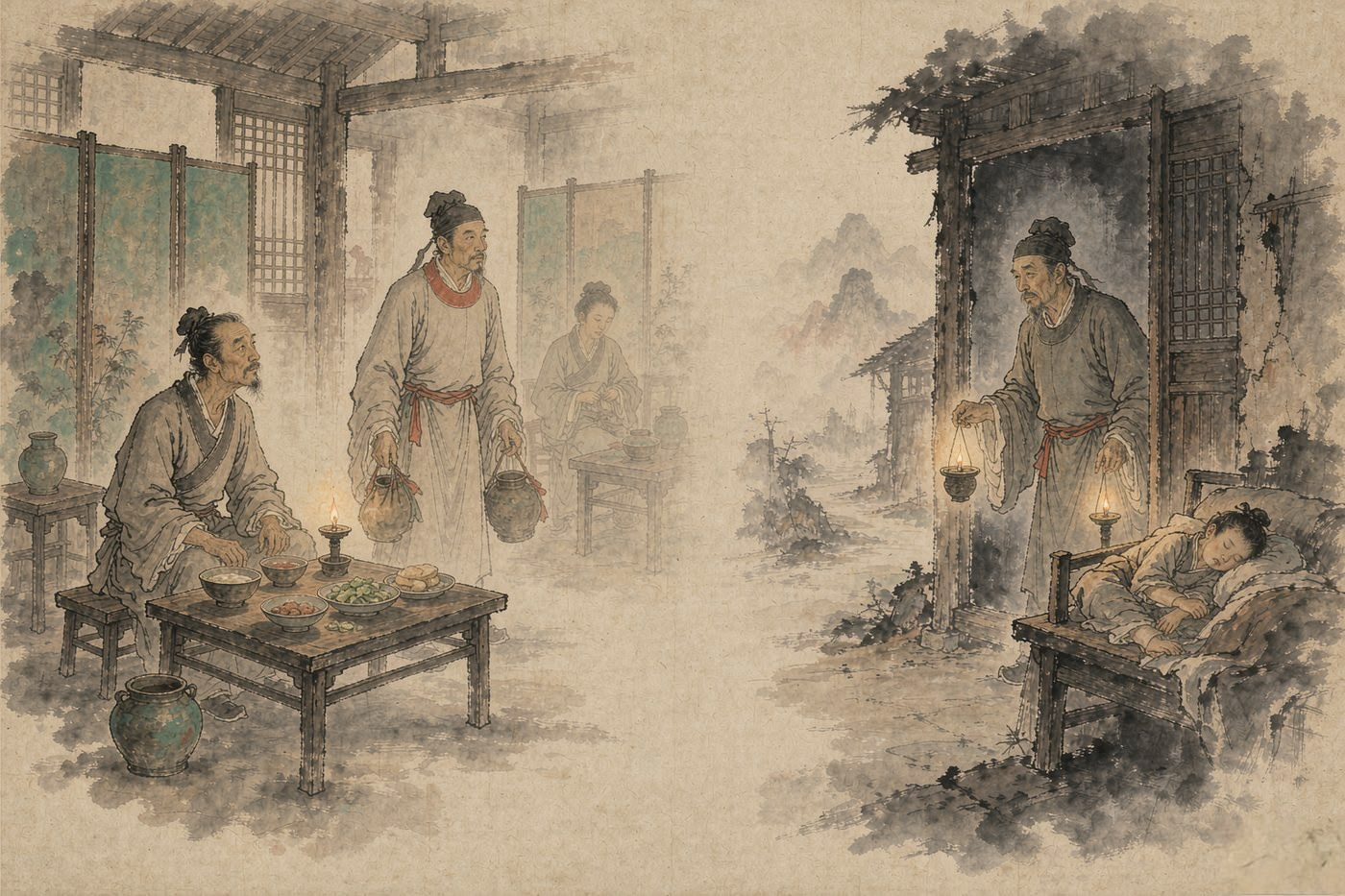
Later, living in exile at Hezhou, hated by the chancellor Qin Hui, who was determined to put him to death — desperately anxious, and with no notion how to get free of it — he heard the door pushed open, and there was this guest. His bearing, his looks: exactly as thirty years before, not the smallest difference.
Zhang went to meet him. “I sought you for years and could not get you to come,” he said. “And here I am at my lowest. What brings you to look in on me?”
“I knew you were troubled about the present chancellor,” said the guest, “so I came to tell you. That man is a dead man. What is there to worry about? In due course you will have your old dignities back. Your good fortune is not yet spent.”
Zhang’s eldest son, Zhang Shi, came out and bowed. The guest stared at him for a long time.
“His two eyes look at things as though they would split them open,” he said. “The good part is right in there. One day he will be commander in the south-west, and his name will fill the world.”
The second son was a few years old and still asleep and not up. “There is one more, a little one,” said Zhang. “I would beg an opinion on him too — but he is fast asleep and I cannot bear to wake him.”
The guest took a candle and went to look at him, and laughed. “Great fortune there. Better than his brother’s. Not easily measured.”
Shortly after he took his leave, and was never seen again.
Yu Zhongyong heard this from Zhang Shi.