The Water-Painted Garden — where Mao Xiang gathered the famous men of his day for the spring rite — is now a disused Buddhist monastery. Hu Wenshui of Qichang, a visitor in Rugao, rented a room in the monks’ quarters. He had a high opinion of his own talent, and was esteemed by the elder Shen Jinzhai and Wang Xiyuan, which made him more pleased with himself still. He once wrote a poem of his feelings containing the lines “Am I deluded? Let it pass. — In the prime of life, still less than other men.”
I happened to see it and said, “This is the Song-Yuan school.” Hu was unwilling to concede, and pressed me on the lineages of poetics. I only nodded and grunted. He flushed. “Does the master think me beneath teaching?” And swept out in a huff.
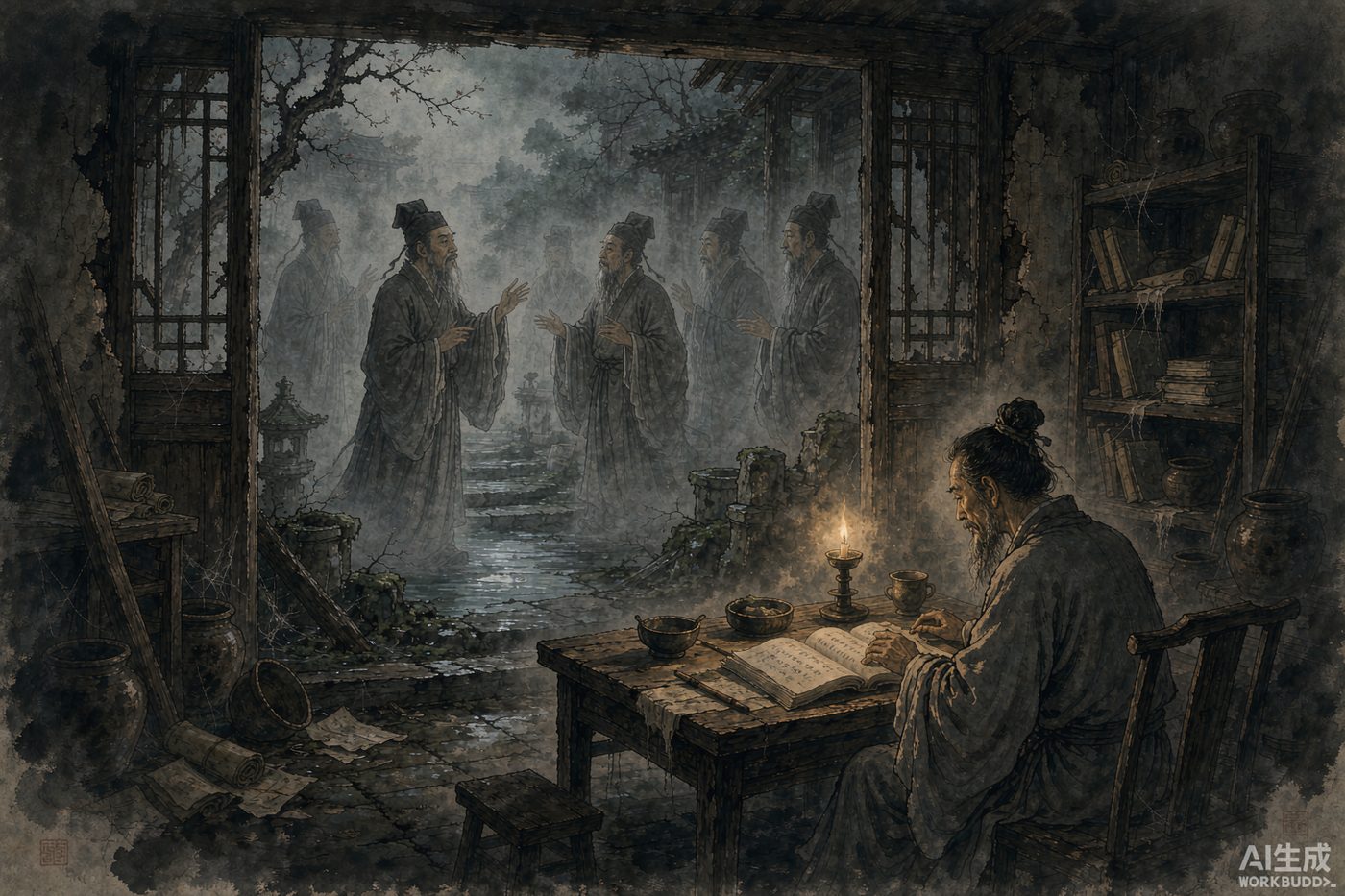
I sat alone by the lamp. After half a cooking-time, I heard a chuckle in the dark. I demanded who it was.
“I am the former owner of this place, Mao Xiang,” came the answer, “and I wander here with Wang Tonghua, Cui Huangye, Chen Jialing and the rest. You unlearned fellow of Wu — how dare you carry a leather drum past the thunder-gate? If one word of yours is unwise, we shall have you thrown out.”
“Master Mao,” I said, “are your hungry spirits in good health? If you do not scorn me, pray instruct me.”
A loud voice asked: “What is the model for ancient verse?” And the answer came: “For four-character verse, the Three Hundred Poems; but to resemble them too closely is plagiarism, and to depart too far is absurdity… For five-character verse, from the Western Capital through the Cao-Wei and Jin, each master has his own face… Seven-character verse begins with the Great Wind and the Bailiang…”
“What of regulated verse?” — “Yin, He, Xu and Yu are the forerunners of the five-character lüshi… Wang and Meng ride abreast in cool distance; Li and Du split the road in magnificence…”
Before it finished, a voice shouted harshly: “I am the Old Man of Yuyang, who has discussed poetry for more than sixty years, taking Du Fu’s poetic history as the standard. What madman cites Sikong Tu’s secret and tells men to abandon learning?”
I laughed. “You, the master of a whole generation of poetry, the historian of a thousand autumns — how would I dare discuss you? Only, on ‘Lamenting Pang Shiyuan at Fallen-Phoenix Slope’ the topic could bear reconsidering.”
As the argument continued, men announced themselves as Cui Budiao and as Chen Qinian, and wrangled noisily. I refuted each of them in turn. When they still would not stop, I clapped my hands and laughed: “Master Mao gathered a whole generation of poets — and in the end the nest burned and they starved in the ditches. What a pity!”
In the turning of an eye Hu came in laughing. “The master thought me beneath teaching,” he said, “but now he has heard every word of my instructions.”
It turned out the student had wanted to hear my wild talk, and had secretly arranged for accomplices to hide under the window and stage the whole trick. I laughed heartily, and Hu became my pupil for two years; when we were not discussing prose we ranged over poetry, fu, ci and qu.