An Chuhou of Guang’an was a professor at Chengdu. Once, visiting the great Daci monastery — which stands at the busy heart of the city and in every spring is thronged with visitors — he was received with extraordinary courtesy. The abbot, weary of endless entertaining, reserved his full rites only for the military governor and the surveillance commissioner, and treated other officials with contempt. An was puzzled by the exception and asked. The abbot said: “Last night at the third watch a voice outside cried that the Grand Chancellor was coming; at dawn you arrived. I knew you would be honored one day, and so I received you thus.”
An was later summoned to court for a memorial on the examination system and made a censor, then intendant of Hunan.
Dun Wenshi, demoted from the censorate to a tax post at Tanzhou, dreamed of greeting the Grand Chancellor on a riverbank and knew his face in detail; that night word came that An was entering the region, and the next day he saw him — exactly the man of the dream.
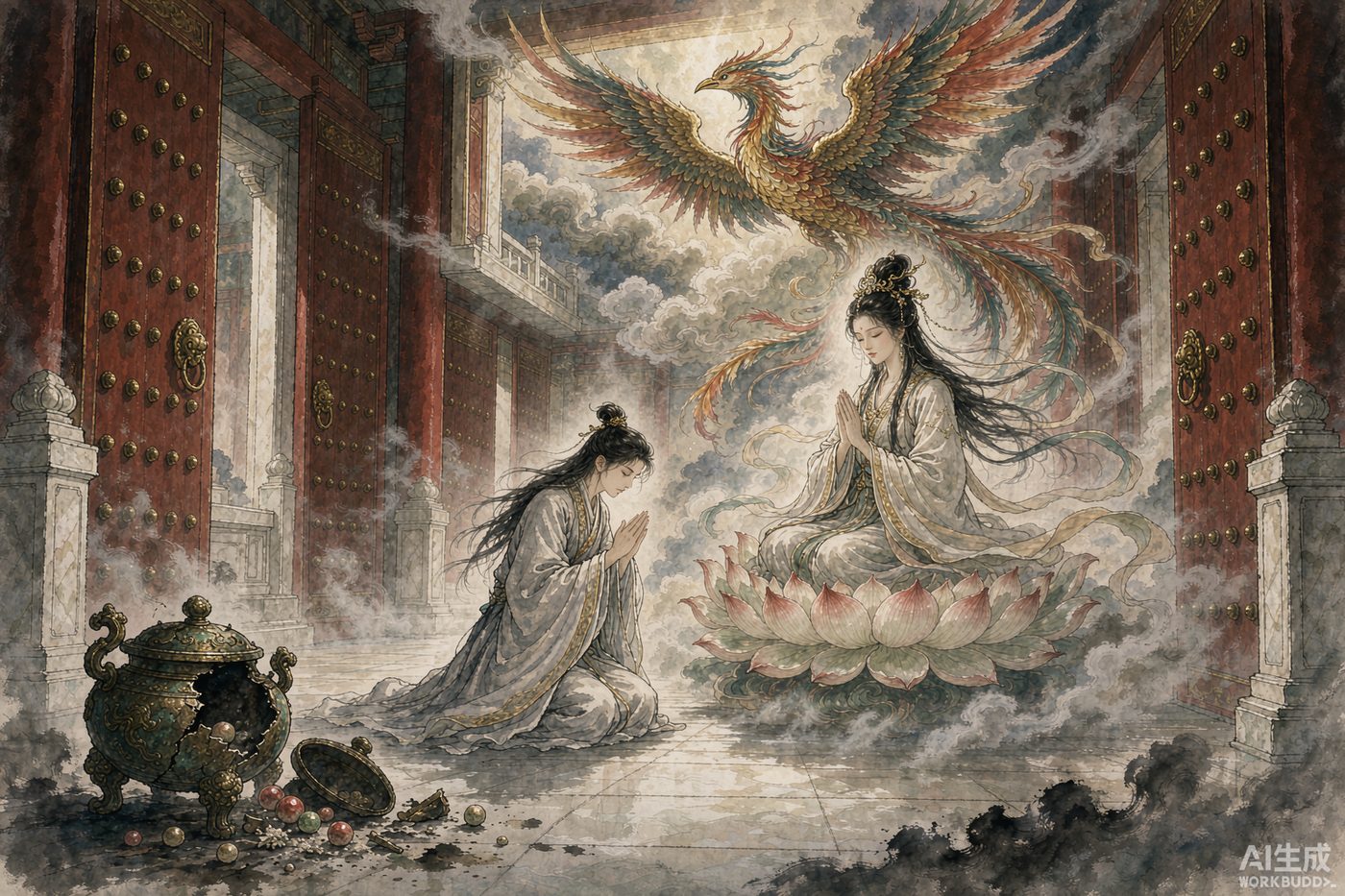
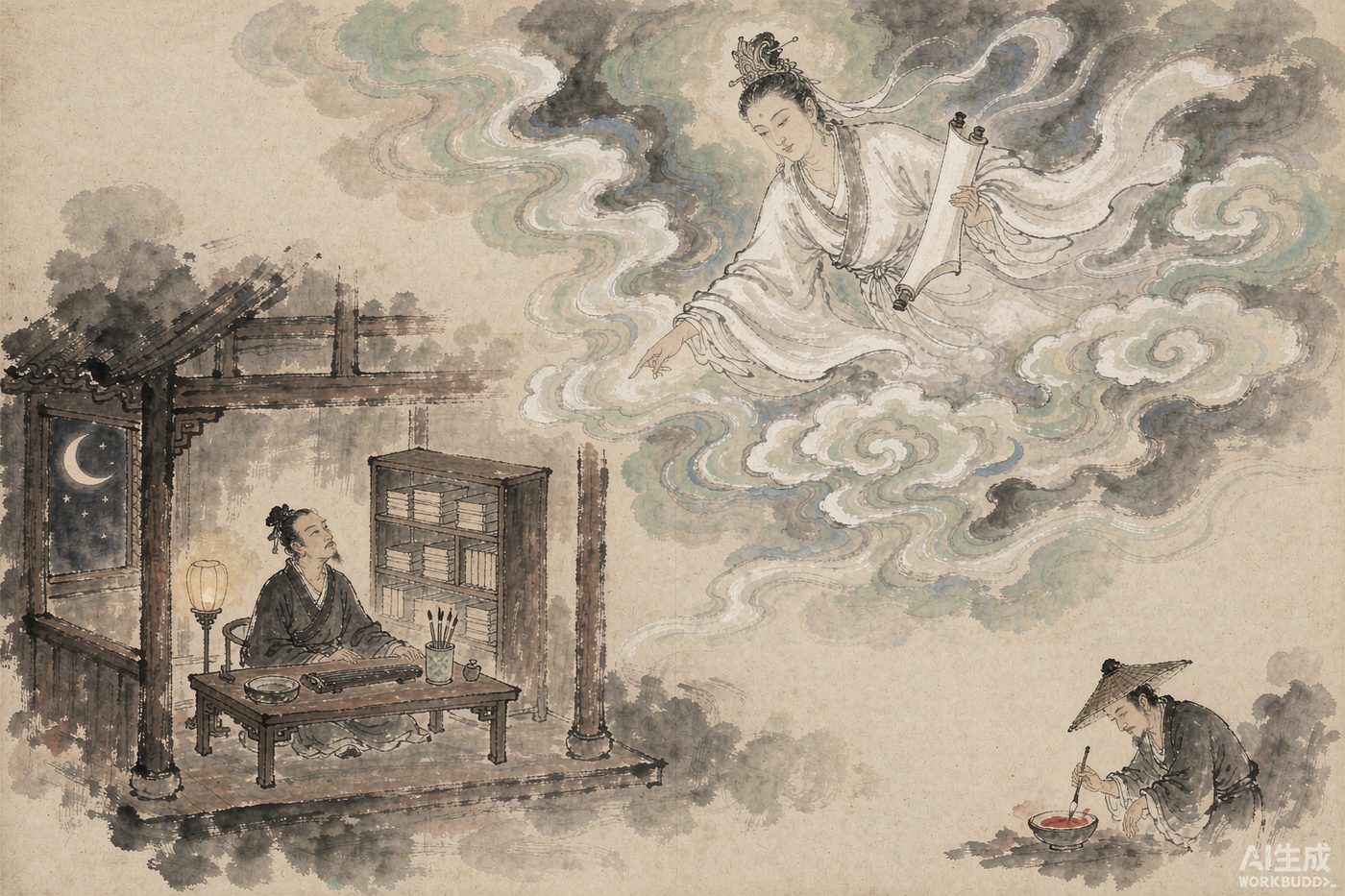
An himself said that as a student he had dreamed he was led to a great palace, where a Perfected Official in coronet and robes sat on the throne. The god of the Yangtze was already in the court below, in the same rank as another god above him. After a long while the Perfected Official had an attendant draw the god back and bow, then take the higher seat himself. When An had paid his respects, he was summoned up and given a seat. An asked: “The god of the Yangtze is a revered spirit the Sichuan people have long held in awe — why is he ranked below?” The Perfected Official said: “How can the ranks of ghosts be placed above the immortals? In a former life you were the Perfected Man Zhu of Fuling, and in this life you shall be prime minister — only I regret that your nose-bridge is not straight.”
He woke and quietly rejoiced, and wrote a quatrain to record the vision: I dreamed I wandered the immortal court and met my true companions, who confirmed my former life and this one; I am the hermit of Fuling, come briefly to wield the potter’s wheel of state.
Sun Zongjian, in his Miscellany of the Eastern Hill, recorded this, and said that An rose only to vice-president of the Bureau of Military Affairs and was granted the honorary title of Grand Mentor — his nominal rank had once been the left and right vice-chancellors.
I hold that this account is not so. In the Shaosheng era An was a remonstrance official who clung wholly to Zhang Dun and to Cai Jing and Cai Bian; hence the saying “Great Dun, small Dun, who destroy men’s households.” He went so far as to accuse Sima Guang, Lü Gongzhu, Liu Zhi and Liang Tao of great treason, and seven or eight hundred scholars were ruined through the documents of their appeals. He was a chief of villains; the dream of an immortal prime minister came from his own mouth, mere self-aggrandizement, hoping that those who heard it would not dare to criticize him. Surely the people of the clear capitals and crimson palaces, even when banished to the dust, would not be as he was. The Tang tales call Li Yifu, Li Linfu and Lu Qi upper immortals — which closely resembles An. An’s younger son Jiao was executed for treason, his second son banished to Fuizhou, and his sacrifices came to an end. The high heavens are clear-sighted; the net is wide but lets nothing through.