The fashion of joining genealogies is nowhere more rampant than west of the river. There was one of a certain surname whose house had declined and who had risen by peddling, and who wanted to climb into the society of official families. He took counsel with Master Wu of the Bureau of Judgements.
Wu was a man who enjoyed mockery. He said: “I have an old tale. Let me tell it to you.” The man listened with great respect.
Wu said: “Long ago the Ox-Herd borrowed the Jade Emperor’s bride-price money and was banished to the Encampment. Afterwards he grew diligent at ploughing and harvesting, and piled up tens of thousands in cash. These he bound on an ox’s back and carried to the Gate of Heaven to pay in before his time.
“But the ox suddenly broke away and fled down into the lower world. It looked at itself and felt that its form was too foul to face a crowd. Then, remembering that the load on its back was rather substantial, it thought it would not be hard to attach itself to a noble clan and show off in its village.
“It went to the Eastern Sea and sought out the qilin, and told it what it wanted. The qilin said: ‘My horns are the noble clan; my toes are the noble sons — and one horn and five toes beget a marvellous form generation after generation. Can you, who make characters by butting your head against a wall, muddy my lord’s kind?’ And it shouted the ox away.
“It went on to the Western Regions and sought shelter under the throne of the Blue Lion. Before it could announce itself, the lion saw its stupid and clumsy looks, gave a great roar, dropped dung all over the ground, and drove it off thousands of li. There it wandered the wilderness with nowhere to turn.
“Then it recalled the Long-Ear Lord of Mount Lu, with whom it had once shared a cart, and went to plan with him. The Long-Ear Lord said: ‘Here in the southern mountains there is one called the Golden-Coin Leopard, who claims to live in the mist but in fact takes in a wide acquaintance. Let me introduce you; you will surely be accepted.’
“So they went together to the southern mountains, and the Long-Ear Lord first conveyed the ox’s wish. The leopard said: ‘Things gather by kind. Those who mix with you are for the most part the bloated-bellied sort.’ The Long-Ear Lord praised the ox to the skies, and brought him in. He came into the hall with awkward little steps, ashamed the whole time of being unlike.
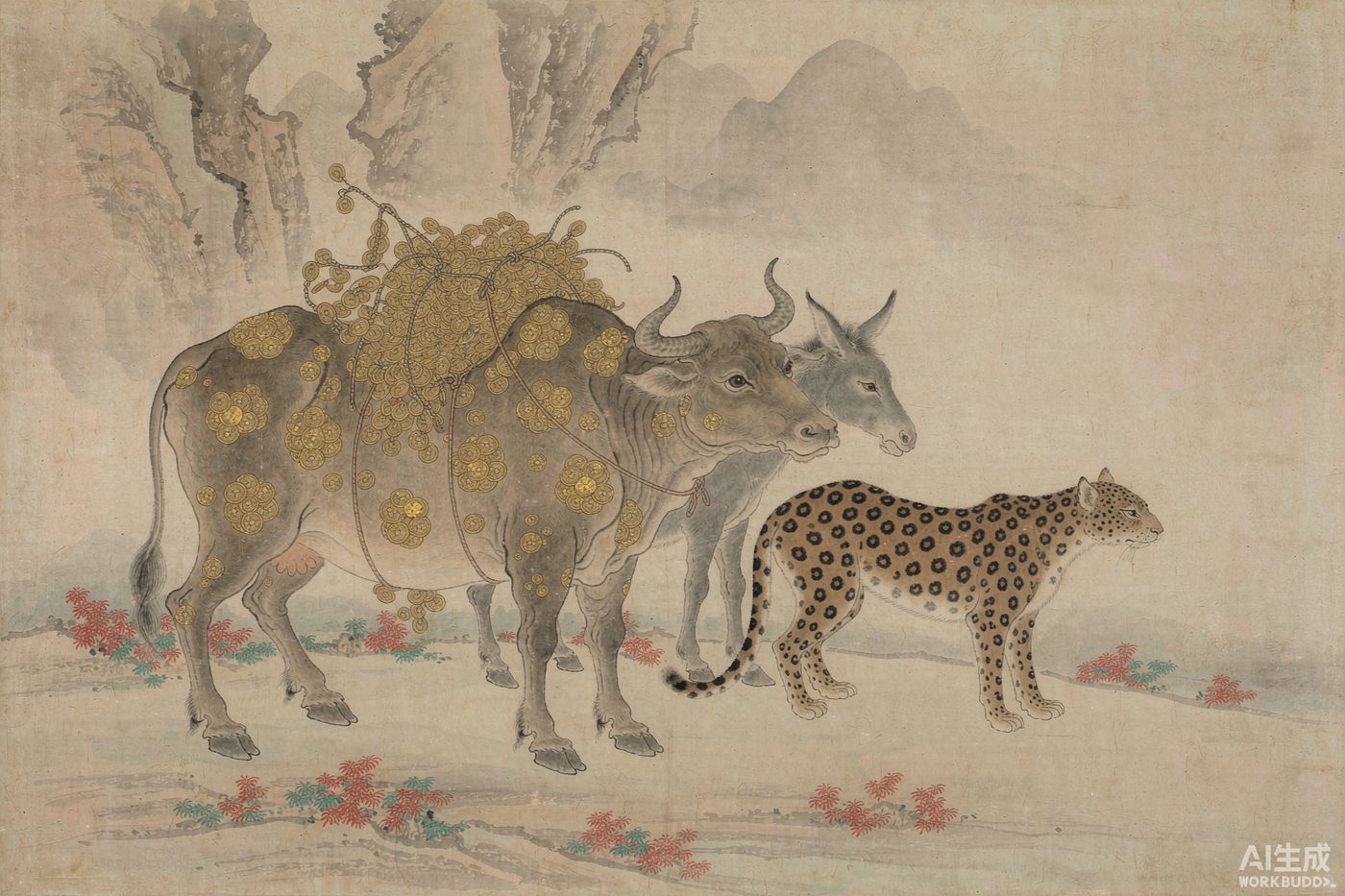
“The leopard at first refused him. Then, seeing the money he carried on his back, it laughed: ‘Looking at your back, your wealth is beyond words. And the reason my house is called the leopard’s transformation is that our backs bear the golden-coin pattern. Yours was not made by Heaven’s hand — but it can still be made by human effort.’
“It ordered the money brought out, and drawing up the hair of the hide, arranged it into a pattern. Before long the skin was dappled with strange colours and glittered with gold, and it was quite a leopard, only small — not the single spot that one sees through a tube.
“The Long-Ear Lord looked steadily at him, and laughed: ‘One broken money-box, and you are a fine creature. Even Jie Gelu could not tell you apart by your voice now.’
“So it took its leave. From that time on the leopard treated the ox as one of its own kind, and the ox too wagged its tail and called itself heroic, following in the leopard’s dust day after day and shining among the tall woods and the rich grass.
“But before ten days were out the golden coins had all come away and the hide was as it had been. The leopard raged: ‘Such an ugly condition disgraces my noble line.’ And it drove him out with a great noise.
“The ox wandered with nowhere to go, and went back to the Palace of the Dipper-Cloak. The Ox-Herd beat his back with a coral whip a hundred times, and then demanded where the money was. The ox told him everything.
“The Ox-Herd said: ‘Stupid beast. The only reason those creatures wished to join clans with you was your tens of thousands of cash. Once the money is gone, will they still lead a thing out of the mud to be the worthy descendant of their fathers and grandfathers?’
“And he ran an iron chain through the ox’s nose and tied it up in a pen. And so men afterwards called the Ox-Herd the Ox-Leader.”
When the man heard this, sweat poured over his forehead, and his appetite for joining genealogies was gone.
— The author’s comment (condensed): the wood-carrier was in fact the descendant of an honest official, and the runner in the yamen is the last of a noble line. Yet to go looking for some remote ancestral glory, to think little of one’s own forebears, and to pass oneself off as another man’s grandson — I do not know what sort of lungs and liver that takes. And if the great ministers rise by favouritism and the foxes all wear official seals, though they are not of one surname and are still proud of the attachment, what wonder is it that men of the same surname should start arguing about who is of the clan?