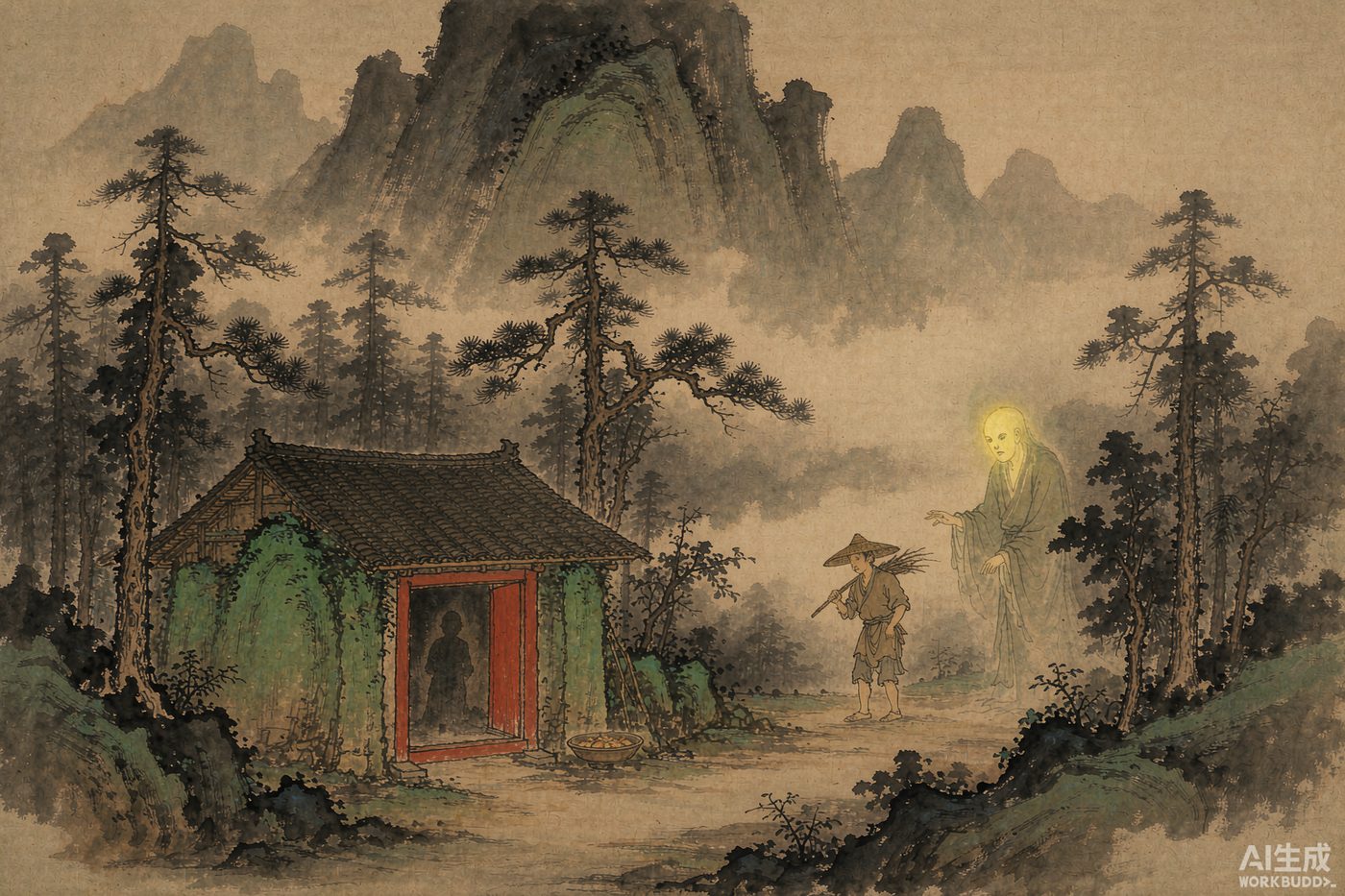
In the third valley of Mayuan in Jianchang, the hills and streams are clear and deep — a noted beauty spot of Jiangxi — with a Buddhist temple and a Daoist abbey, one of each. A monk surnamed Chen had hanged himself; his disciple, a boy of the Zou family named Yan, took over the temple affairs.
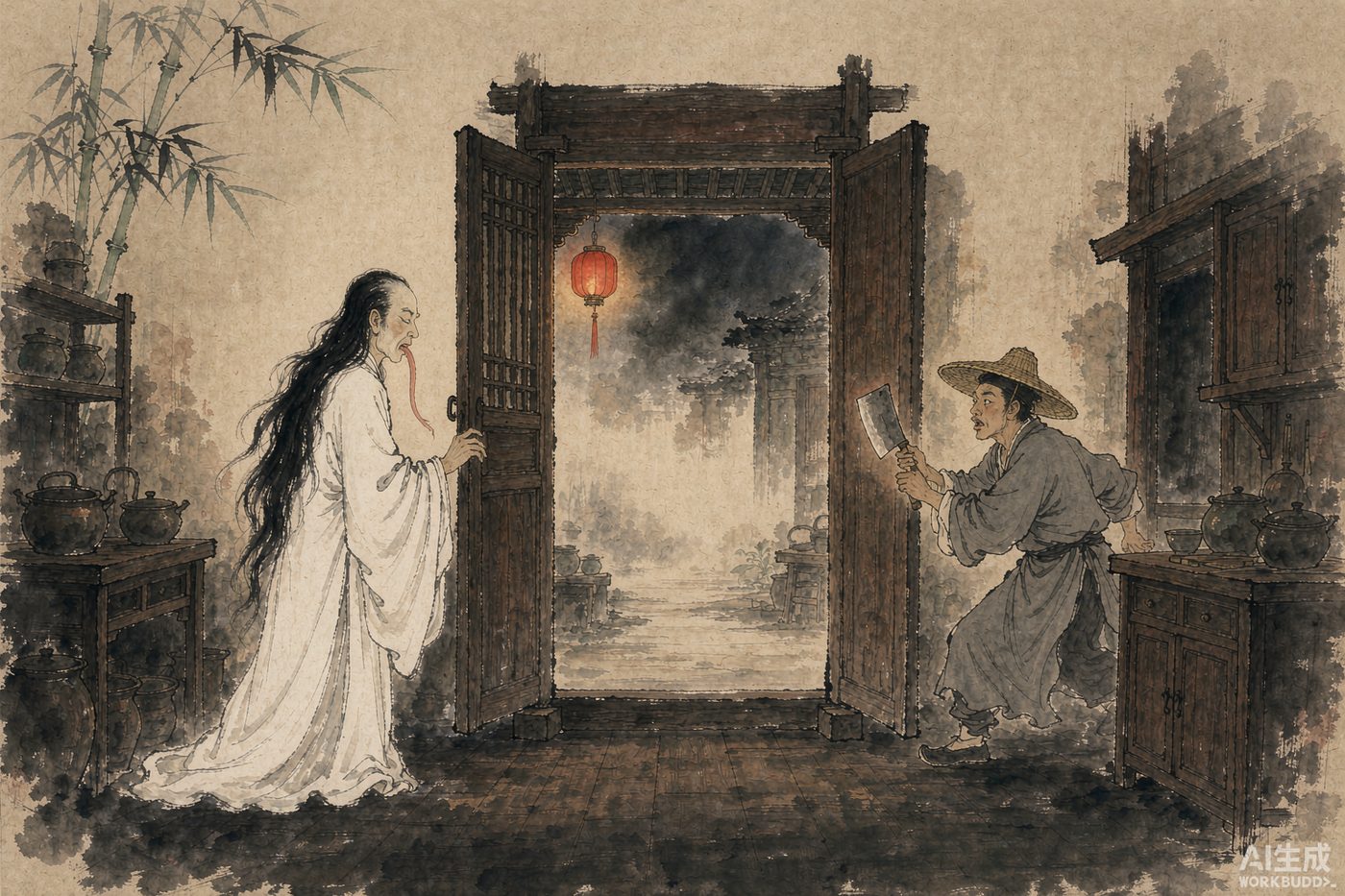
Once Yan went to a lay family three li away to conduct a merit service, and all the monks went with him; he hired a village man, Chen San, to watch the place. Just past the second watch, Chen San sat alone by a bright lamp when he heard a “duo duo” sound outside the door; while he was still wondering in fear, a monk lifted the curtain and entered, his tongue hanging to the ground. Chen San fled in panic into the kitchen, gripped a kitchen knife and slashed wildly at the air, nearly out of his mind.
Past midnight the monks returned, heard the commotion in the room, rushed to look: Chen San was already in a daze, and only after a long while came to.
Lu, a lacquer-worker of Linchuan who often worked for the temple but lodged at the abbey at night, was at the time reading there; Wang Sanxi of Nancheng said to him: “You work over there — why not pick a room there to rest, instead of dragging yourself here?”
Lu laughed: “I have gone between the two places for a long time. At first I knew nothing of the haunting. Yesterday, because of the heat, I brought my boy to sleep in the temple’s covered corridor, and to escape the mosquitoes we moved into the screen behind the Dharma hall. It was just past midnight, the moon filling the courtyard, when I saw a monk in a black skirt and slippers go from the east corridor to the west, calling ‘Yan, Yan’ over and over, several times. My boy and I were terrified, fearing he would come; we held our breath and dared not stir. Luckily he went off of his own accord, and from then on I have not gone there at night.”