At the City God temple of Lu’an prefecture in Shanxi there lodged a strange guest who called himself Master of the Five Peaks. By his accent he was a man of the Yan-Zhao country, and every day he amused himself by turning the flowers and trees of the four seasons upside down.
One day the busybodies of the neighbourhood gathered and asked him for a show.
He said: “Good.”
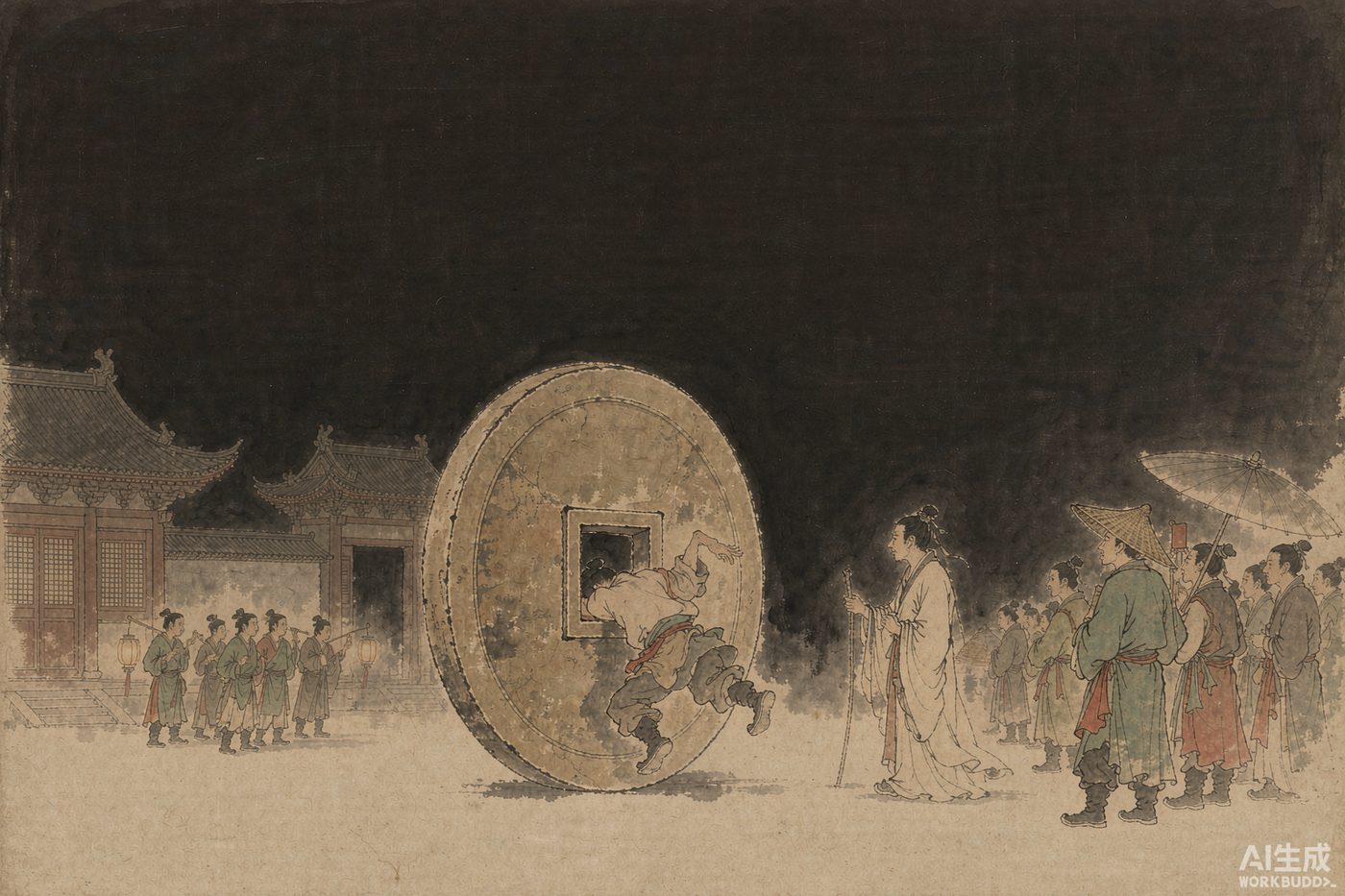
He took a copper cash from his sleeve, set it on edge in the courtyard, and made a talisman-writing pass with two fingers. In a moment the coin was as big as a cart-wheel. They all marvelled.
“A certain Master Cheng Lian is waiting for me by the sea. I must go. I will be back in the morning.”
At parting he pointed at the coin, laughing: “This thing is enjoyment to whoever has the fortune for it, and disaster to whoever has not. Do none of you look lightly at it.” And he went, and the crowd drifted away.
There was a certain rascal called Yu who hung about until night, stroking it a long while. Then he peeped through the hole of the coin — and inside were jewelled towers and kingfisher pavilions, embroidered rails and patterned windows, glass screens and coral couches, pearls and jades and precious toys, nothing lacking. Presently several beauties came flying in, in five-shu robes and light gauze skirts, bright pendants at their girdles, each carrying a musical instrument of a kind not known to the zithers and flutes of this world.
One said: “The Purple Cloud Returns suite has not been played since Ahuan stole it away. Shall we set it in order?”
They spread a carpet on the ground and played. When it was done: “Aman’s pretty bearing is unmatched in her generation. Let her give us the bending-waist dance.”
One beauty stood dumb, seeming unwilling. The others laughed: “Silly girl — ridden hard by young Master Bai, and her waist has thickened!” The girl blushed and shook out her sleeves and danced; and the peach petals at the courtyard’s edge came down in a rustle like red rain.
The rascal, at the coin-hole, first only put his head in; then, warming to it, and without noticing, he shifted his body forward as far as the waist.
At once there was an angry shout from the hall: “What filthy slave is this, peeping into the women’s quarters!”
Everything scattered, and not one storey of those towers remained. And he felt the coin-hole shrinking, gripping him all round below the waist: he could not go forward, he could not draw back, and where it gripped him the pain was past bearing. He screamed for help. The whole neighbourhood came running to stare, and none could think of a way to get him out.
At dawn the stranger came back, and said in anger: “You starveling. One pauper’s skeleton, and you lusted after the beauty of palaces and the service of wives and concubines — to the point of boring your way through a cash-hole and landing in trouble at every move. The evil is of your own making. You cannot be saved.”
They all pleaded for him.
“In the world, propriety, righteousness, integrity and shame — wine, lust, wealth and anger — are like the Marquis of Wu’s Eightfold Battle Formation. Integrity is the live gate; wealth is the dead gate. He went in by the dead gate. Do you expect him to come out by the live one?”
The rascal wept aloud at this. The stranger laughed.
“You have a heart that repents. Perhaps you can be pulled out.”
He took up a great brush, dipped it in ink, and painted over the coin-hole to bring him out. The coin at once shrank to its old size, and he put it back in his sleeve.
He said to the man: “For now, a brush has granted you life. Hereafter, do not hold your own life cheap for the sake of a single cash.”
The man knocked his head in thanks and went off with the rest. To this day there are temple keepers who can tell the story.
The Duo comment: The lofty hermit buys his mountain; the talented man flatters the dead for a epitaph fee. Even one as clean as Liu Chong would still pick out the largest cash to accept — how much more the man whose hobby is like He Qiao’s? And yet, look at the round-coin law of the Nine Treasuries: the outer circle images heaven, the inner square images earth. Then to bore through a cash-hole — how is that different from burying your head in hell? A spring can drown you; a blade can kill you. Even so to draw the comparison is to make it seem distant.