Lord Gao Yan of Rugao was magistrate of Gaoling in Shaanxi, and a friend of his went out to visit him. Some ten li short of the city the light began to fail, and fearing he could not get in before dark, he saw a ruined temple beside the road.
The main hall was sealed and barred. The western wing had two bays, with a small door leading through into the main hall, and that door too was sealed and barred. Thinking the rooms looked decent enough, he put up there for the night. He bought wine and drank a little, then undressed and went to bed. His servant went out to sleep in the eastern side-room with the man who kept the temple.
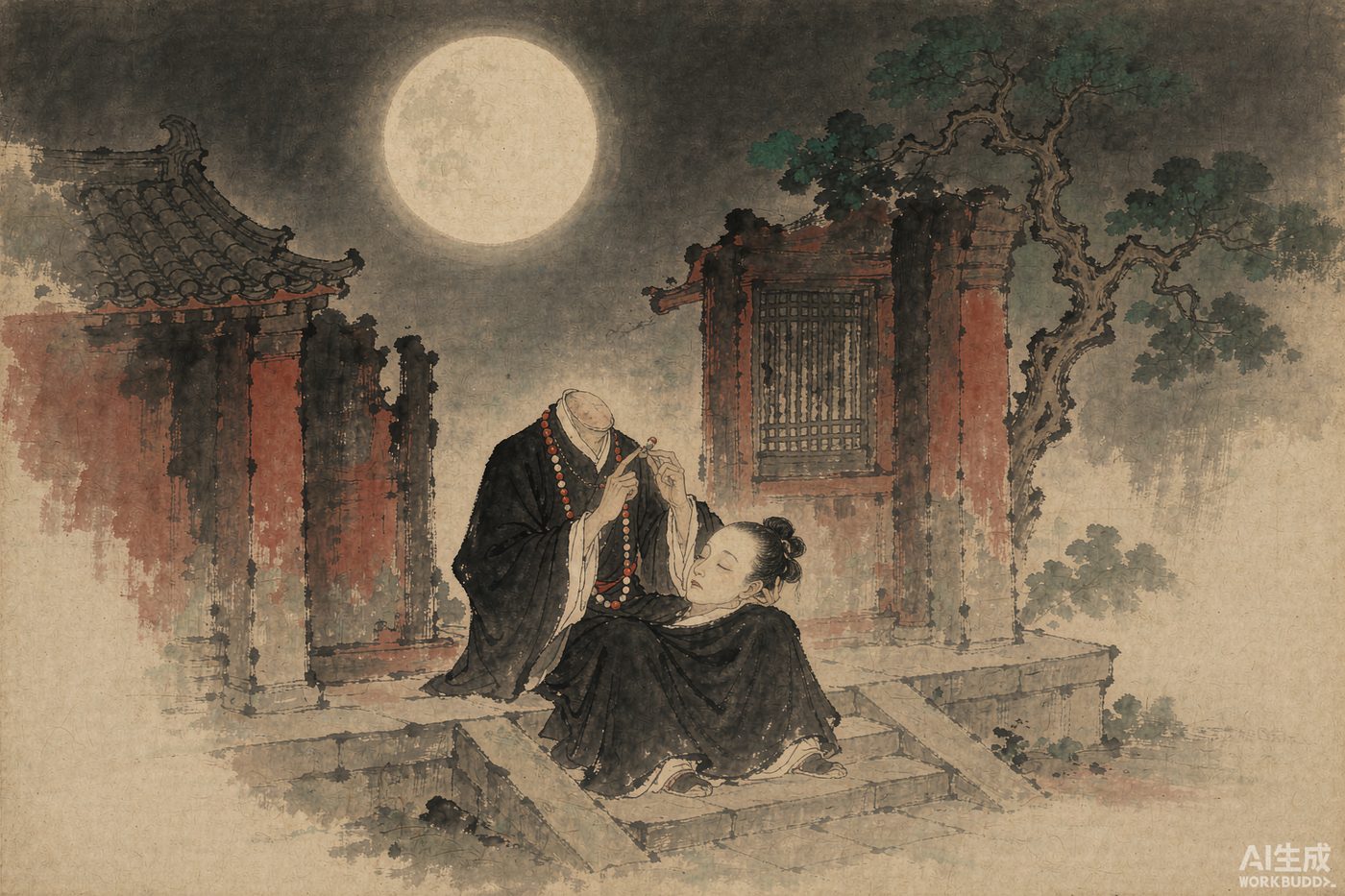
It was the sixteenth of the month and the moon was bright as day, and he lay a long while without sleeping. Suddenly he heard a shuffling of footsteps in the main hall, and the small door creaked open, and there sat a man under the window in the patched court surcoat with the court necklace of beads, and without a head, in the attitude of someone admiring the moon.
He was still in the first moment of his fright when the figure turned inward, as if it had noticed him, and at once walked back into the main hall. He leapt up and opened the door to run — and found that the outer door had been barred behind him by his own servant. He shouted, and his voice would not come out of his throat, and his servant did not answer. At a loss, he went out through the window instead. Outside the window a wall ran round the building and he could not get over it; but a tall tree stood close by the window, so he climbed it, and looked down.
The figure had by then come out carrying its head. It sat down again where it had been before, laid the head on its knee, and slowly put out two fingers to wipe its eyebrows and eyes; then it took the head up in both hands and set it back in place on its neck, and the two eyes shone with a cold light that came at a man.
By then his soul had flown, and he knew nothing more.
At dawn the servant came in and could not find his master. He searched everywhere and found him up in the tree. He tried to pry his hands loose, but they were locked around the branch in a grip that would not open. After a long while he came back to himself, and still thought the ghost was coming to seize him.
He asked the temple-keeper, who said: “Twenty years ago, when there was fighting at Ningxia, there was a man of Chu who held the post of subprefect. He was late delivering the grain and the commanding general had him killed. His coffin got as far as this and the money ran out, so it was left here in the temple. Perhaps now he longs to go home, and showed himself to a guest.”
The friend told Gao, and Gao gave from his own salary for the cost of carrying the coffin, and wrote to Chu as well, so that the man’s son might come and fetch him home.