Peng Sheng of Zhenze was a handsome, free-spirited young man. Enamoured of the story of Wen Xiao and Cai Luan, he longed for an immortal’s love. His parents chose matches for him repeatedly, and he blocked every one.
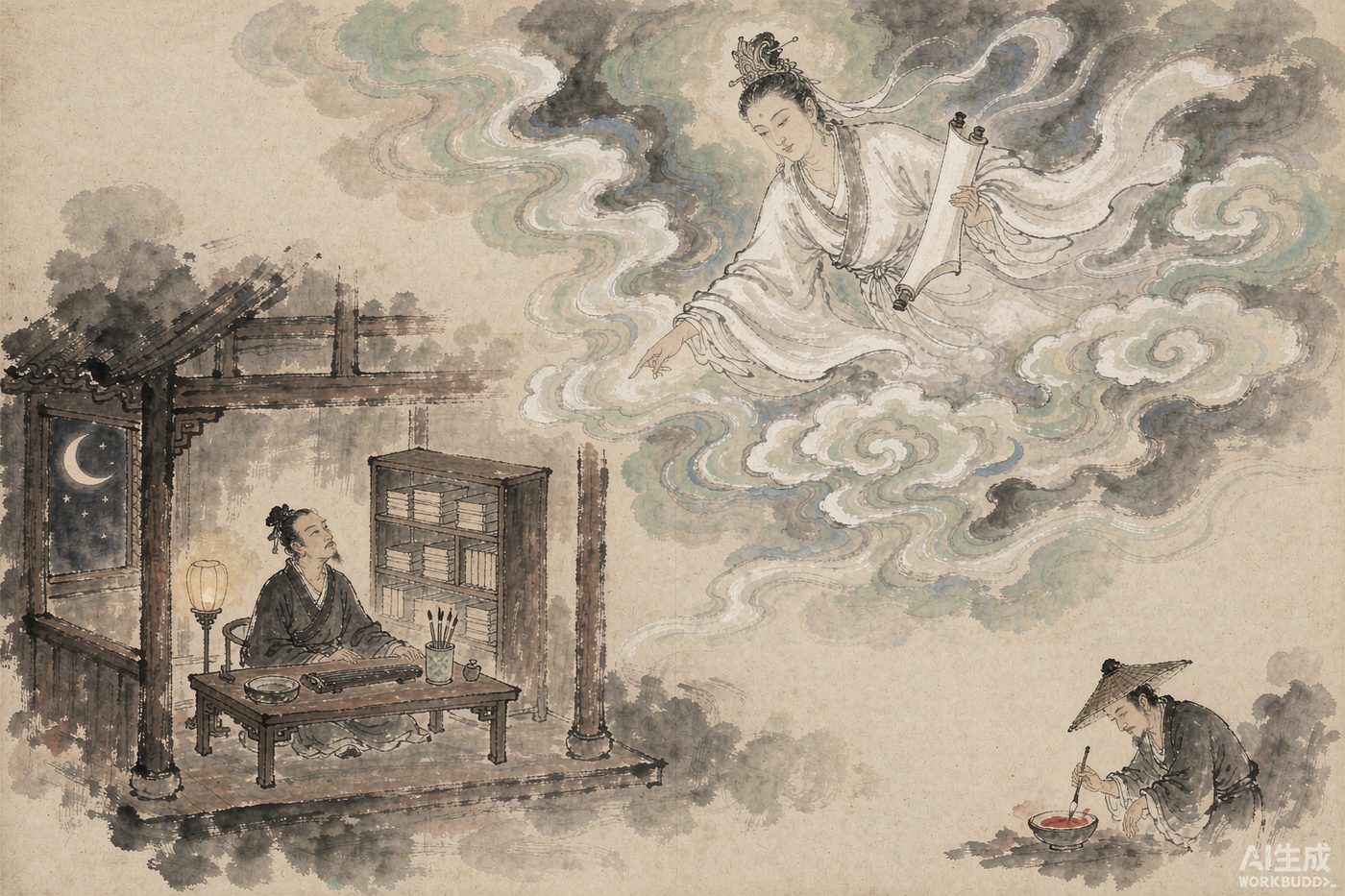
One day he was boating on the lake when he saw a single lotus petal floating down from upstream. He picked it up and looked: on it was a short song —
By the little Fu mountain the water runs wide, where we met. / I would have gathered the duckweed, but the east wind took it. / The noon bridge rain is heavy; better to go home and dream of the curtained room. / East of the little tower, half the balustrade left in the moonlight. / The night is cool and the flower-shadows are deep.
He thought it strange, left the boat and went ashore. A hundred paces off stood ten thousand lotus plants spread out like a brocade canopy. At their centre were vermilion doors, closed and heavy, with bronze rings bolted in broad daylight. Then a maid in blue opened the door and looked out. “Master Peng has arrived,” she said, and led him in.
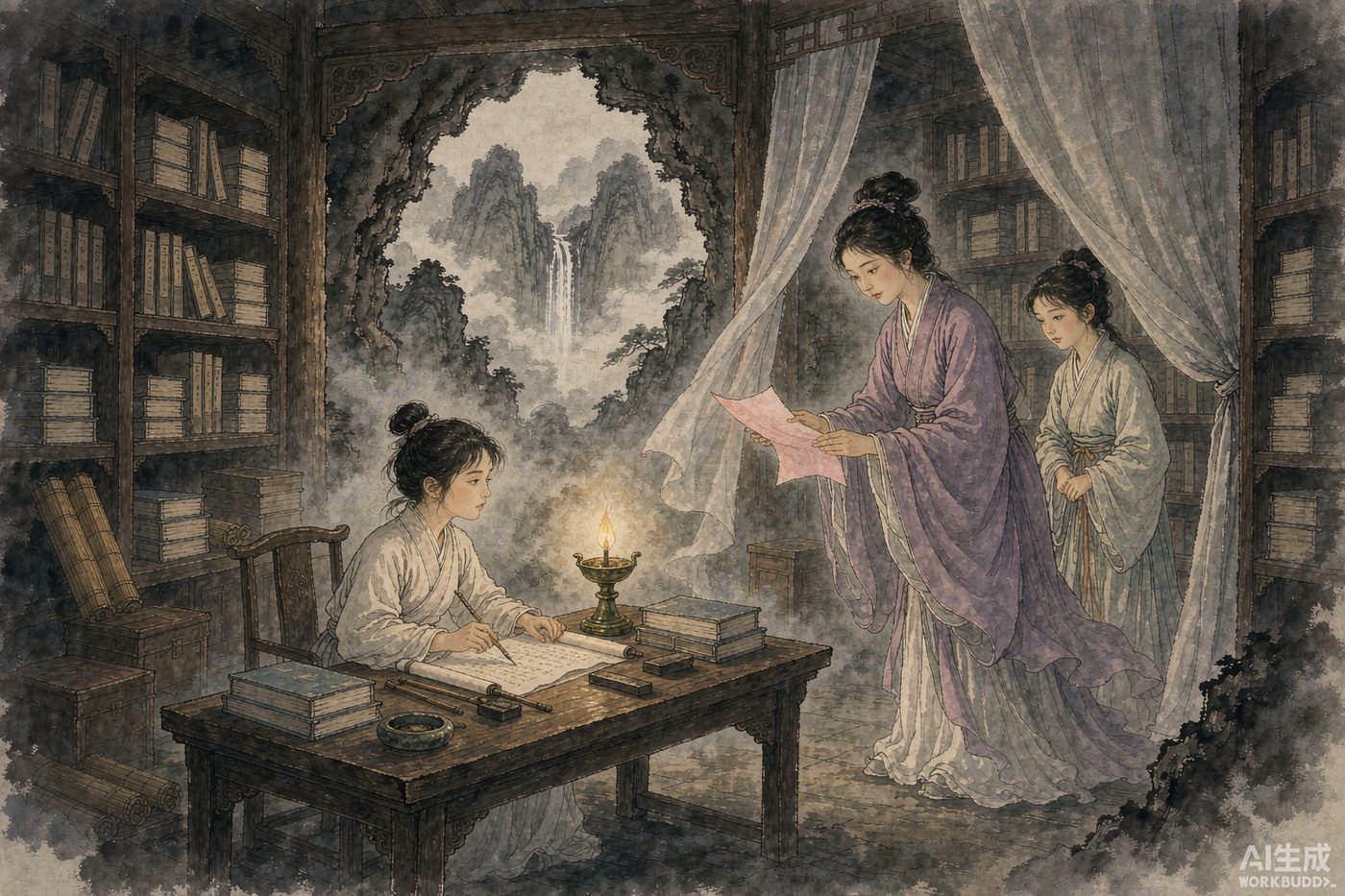
East of the phoenix screen a woman came forward with unhurried steps, and Peng hurried to greet her. “I am Xiang Guzi of the City of Lotus,” she said. “Long fallen into the dusty world, and never met a fine man. Knowing you have long desired an immortal’s destiny, I sent that scribble to lead you into the peach-blossom spring.”
“Honoured by your regard,” said Peng, “and lifted out of my commonness — I would not refuse to be your servant for life.”
“You are truly besotted,” she laughed, and told the maid to sweep out an inner room and set two couches in it for sleeping.
That night she slept at the east side and asked him to lie to the west. Peng said, “Having seen your face, I should be allowed to touch your body. Why keep me a foot from Wu Mountain and make me fret?”
“Among immortals,” she said, “husband and wife are joined in spirit only. If union were a matter of flesh, Nongyu would have borne a child long ago — why is there still no young phoenix on the flute terrace?”
Peng forced himself to fondle her, but could never quite make contact. “Your mortal coarseness is not yet gone,” she said. “Even if we shared a pillow by force, there would still be a layer between us. Tomorrow I will burn the Bone-Change Elixir for you; in three days it will be ready, and only after taking it can we be together.”
With no choice, Peng withdrew and slept on the other couch. In the morning she gathered herbs from the three mountains and compounded them in the cauldron, ordering him to tend it day and night. Every day he opened the furnace to check the heat. She smiled: “How impatient the mad boy is.” Peng said, “The hungry are quick to eat and the thirsty quick to drink; human feeling is like that.”
As they were joking, the boatman tracked him down: his father was dying, and his mother had sent an urgent letter. Peng reckoned the elixir would be ready in a day or two, that he could then approach his beauty and be entered on the immortal register — and his mother’s own letter left him displeased. The woman urged him to go home for a while and see to them.
“Life and death are fate,” said Peng. “What use is going home? And here I forget Shu entirely!”
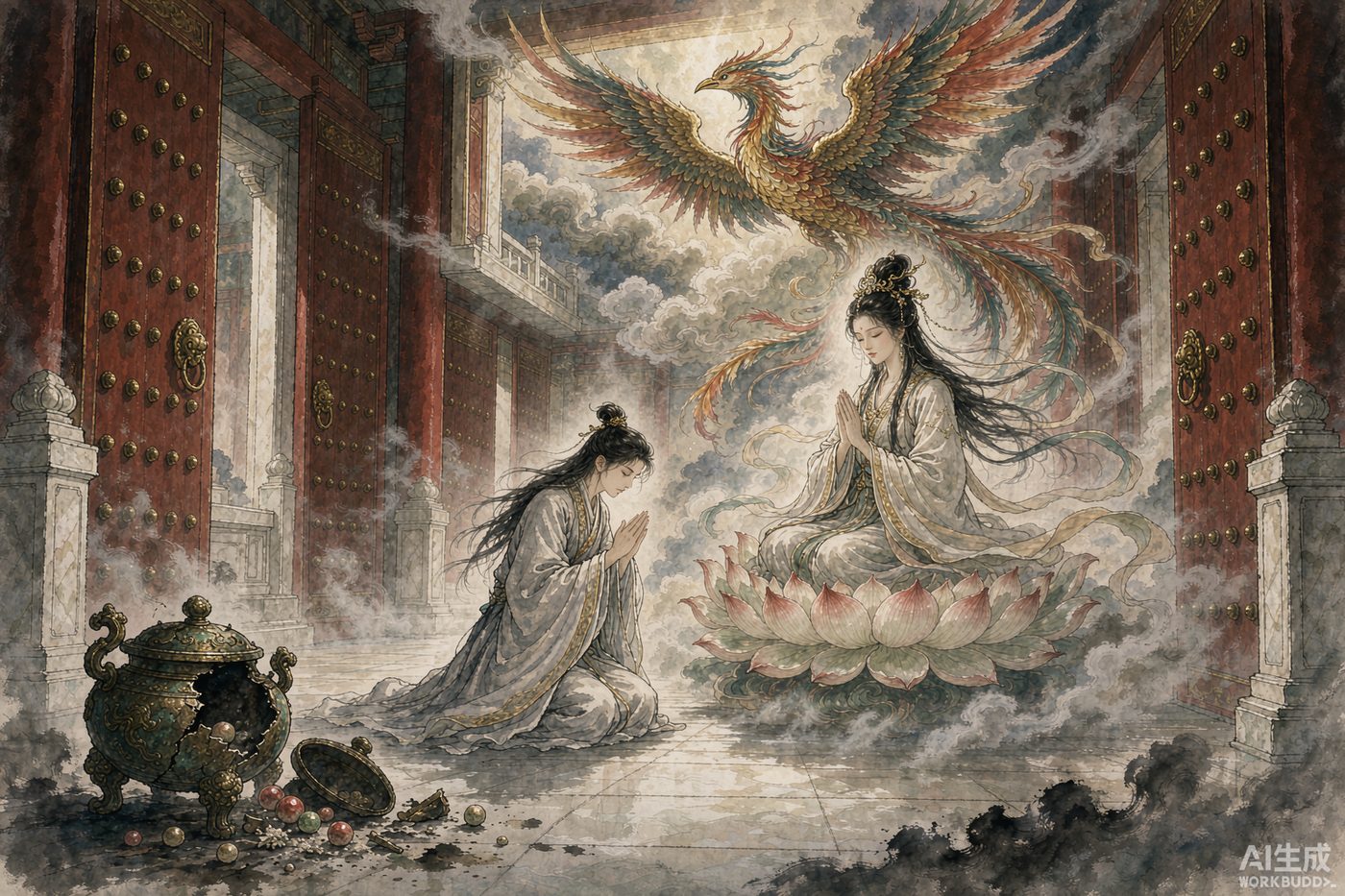
She flared up. “You have the heart of a lover but not the nature of a son; you are not immortal material. Even if the elixir matured in the furnace, changing your bones would not help.” And she smashed the furnace on the spot.
“Then though I dare not touch you,” said Peng, “I beg you to help me up to the immortal court.”
She looked at him with anger and said nothing. Then, turning for a moment to ask something of the maid, the maid became a coloured phoenix; the woman mounted it and rose, sighing: “This boy has no heart or liver at all. Is the Great Lofty Heaven a country without fathers?” She rose slowly into the clouds and was gone.
Flowers, trees, rooms and houses vanished in an instant; the boatman too had disappeared. Peng repented at length, and found his way home.