In his youth, Wang Kuipu went with two or three close friends to see Huangshan. They climbed by creepers and vines as far as the middle of the mountain, where the slanting sun was about to drop and the dusk came on grey, and his friends would go no further. Wang, in a fit of pique, climbed on alone. A few dozen paces on, the sky went suddenly black: the moon smothered in heavy cloud, thunder driving a hard rain. By the flicker of lightning he hunted for the path upward.
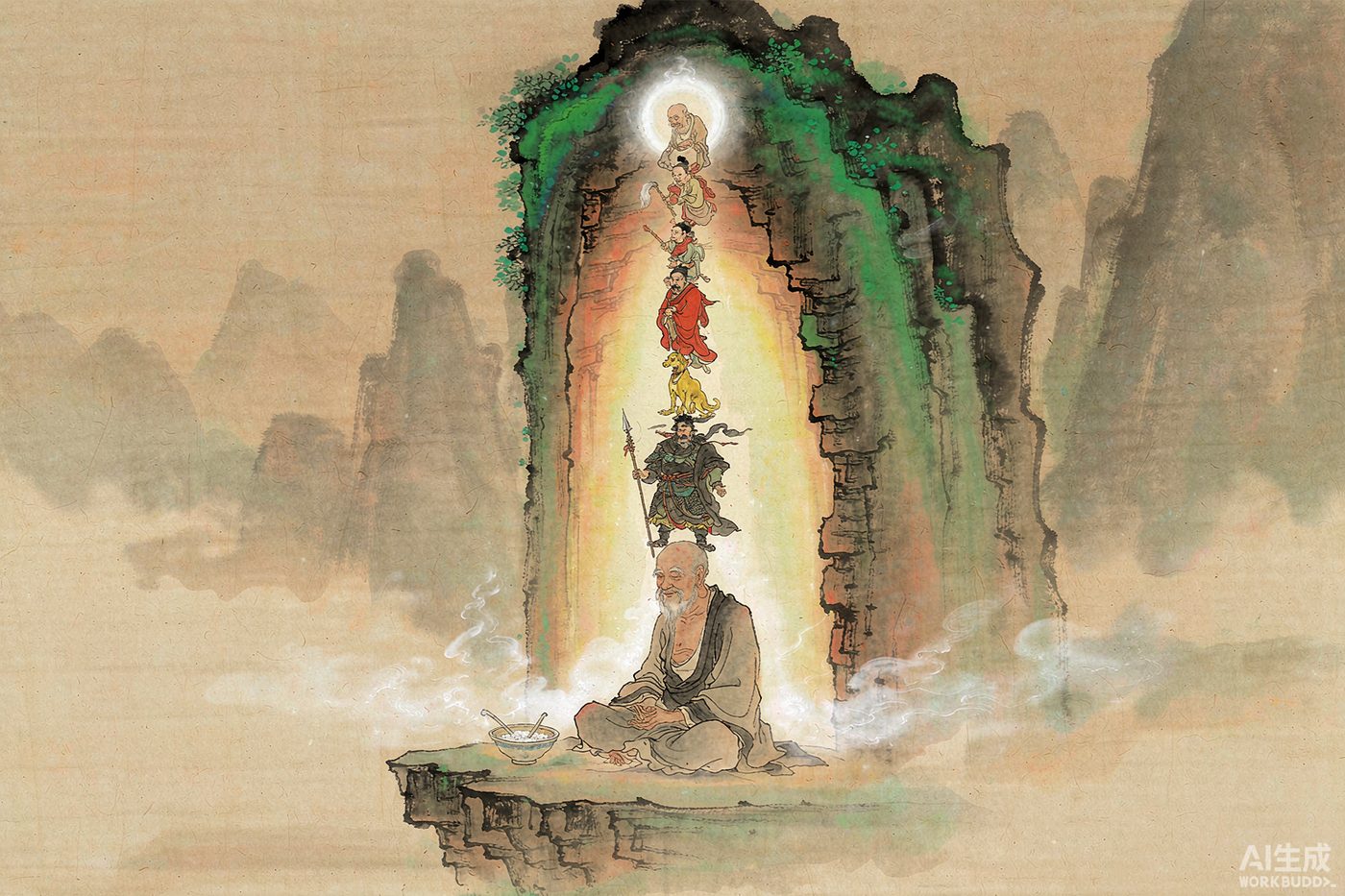
He came to a stone cave, some ten zhang deep, several tens of xun high, its two walls bright as though lit by candles. An old monk with drooping brows sat alone in it. Wang hurried forward to pay his respects; the monk inclined his head slightly, shut his eyes, and entered contemplation. Wang set himself against the wall to wait.
Then he saw the halo on the monk’s crown rise — and within it a figure appear: gold helmet, iron mail, a long spear held crosswise, hung with innumerable small severed heads. Even as he marvelled, a yellow dog appeared on the crown of the helmet, its hind legs folded as a man kneels, its forelegs pressed together as if in salutation, wholly like a thing at prayer to the Buddha. After a long while the dog lay down tired.
On the dog’s head appeared an official — ivory tablet, crimson robe, high cap, broad sash — and out of both his sleeves gold and silver came pouring, and he seemed pleased. Presently on the official’s head a woman appeared: painted brows, painted eyes, by no means a decent householder’s wife. She loosened her apricot-dyed jacket, showing a loose robe beneath, took a whisk in her right hand and a rosary in her left, and spreading a meditation cushion on the official’s head sat down cross-legged and straight.
On the woman’s head there appeared a baby, with jade rings and gem ear-plugs, like a fine child of an official house. And on the baby’s head, with a rending sound, there appeared a man, bald and gap-toothed, whose face closely resembled the old monk’s.
Shoulder on shoulder, footprint on footprint, like a pagoda of seven storeys, they stood layer upon layer. Wang gazed up. After half a cooking-pot of time, the one who so resembled the monk shrank to the size of a bean and dropped into the baby’s fontanel; the baby turned a somersault, fell into the woman’s Daoist crown, and quietly vanished. The woman rose with her whisk, lifted the cushion and struck the official full on the head, boring into his brain like a bee into a hole. The official at once set his dog on; the dog butted with its head; the official stroked its crown three times, stretched out a foot, and went down. The dog rose on two legs, and its feet came down on the general’s helmet; it seized his head and went in sideways too. The general’s hair stood up in rage; he took his spear and drove it at the monk’s crown, which opened with a cry, and he bored through and was gone. The halo above the crown folded away entirely.
The old monk opened his eyes and smiled.
“Demons troubling me in contemplation. Another kalpa of a thousand years gone through.”
Wang described all he had seen.
The old monk said: “This is my own cause from former lives. In my first life I was Bai Qi, Lord of Wu’an. At the battle of Yique I beheaded two hundred and forty thousand; breaking Zhao at Changping I took four hundred thousand and killed them every one, and buried the surrendered soldiers besides — tens of thousands more. King Yama was greatly angered and turned me through the six paths of rebirth, to suffer every terror. By Tang times I was at last born again on the same day as Li Linfu — he as an ox, I as a dog. Because I bore in mind the retribution of my former life, even fallen into the path of animals I turned my whole heart to the Buddha. Yama was pleased and let me appear again in an official’s body; and so in the Song I was saved into the life of Jia Sidao.
“But once I had put on the court robe, I lost my original nature. I raised the Pavilion of Many Treasures, took bribes far and wide, and ruined the state. After I was killed at Mummian Hermitage I was flung back into the courts of the dead, and the King said in great anger: A greedy officer who hunts for gold — how is he different from a harlot who loves cash? Let him be punished by being made one. And in the late Ming I was Bian Yujing.
“Afterwards I met the wise finger of a high monk, washed my heart and changed my ways, and was a woman of the Dao for seventeen years. In the kalpa of powder and pollen I awoke one morning, and was granted leave to turn into a male body. But because I had been unclean in life, I had to pass one more gate on the path of those who die young: I was born into the Gu household of Jiangdong, a family of the Revenue Ministry, named Ashou, and died at seven. Only now have I crossed into the gate of the Buddha, to cultivate good fruit in earnest.
“To circle so through several generations, following a man like his shadow — do not mistake it for a game of heavenly demons played beside the five-vehicle cart.”
Wang was amazed and appalled. He took leave of the monk and went down the mountain. He told his close friends, and they went back together to look for the place — but the stone steps were sealed in cloud, and they lost it entirely.
The Duo comment: The scholar in the goose-cage — the thing is strange enough, but what has it to do with waking the world? This is surely the sixteen-foot golden body showing itself, making a transformation-picture of the eighteen layers of hell, to preach the bodhi-law of the city of Gaya to a good man.