Stories/ 夷坚志/ The Green-Furred Turtle

The Green-Furred Turtle

呂氏綠毛龜

SourceYijian Zhi (Record of the Listener)
AuthorHong Mai
EraSouthern Song dynasty · 12th century
Writtenc. 1160–1200
AnimalMarvelsTransformation
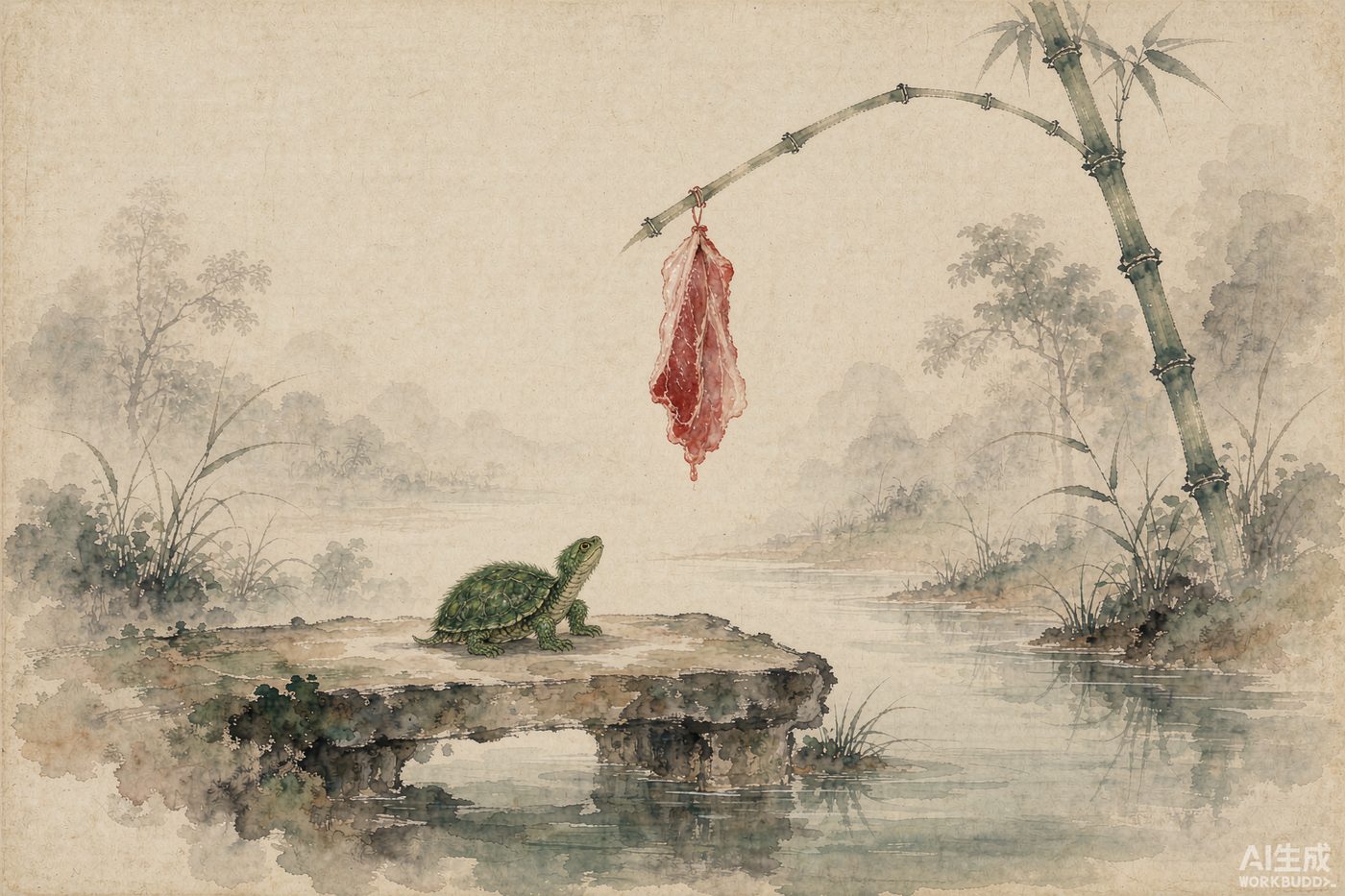
A small green-furred turtle on a garden stone at noon with a bamboo rod offering a slice of pork above a still pond, ink-wash painting
Illustration generated by AI, based on the ancient Chinese text.

Lü Deqing kept a green-furred turtle in a basin pond at home; in time it grew very tame. Every day at noon, if he struck the water surface with a small bamboo rod, it would come out at the sound, and he would impale a few small slices of raw pork on the rod-tip and feed it; when it had eaten its fill it would go back in. So it went for two whole years without fail.

A child, wanting to play, struck the water at that time and brought it out and put it in a fixed basin, returning it the next day; at noon it would not come out, and after six or seven days, when a boy plunged his arm in to search, it was dead. That a tiny creature, slight as an insect, should resent a broken trust and rather starve than eat — strange indeed!

Then too: Lu Zili reared a white turtle in the dendrobium by his study; it was only as big as a small coin, its shell-pattern all golden-yellow with a lustre, its two eyes like lacquer; later, because he fed it shrimp paste, the golden pattern flaked off and it died.

At a temple fair in Xiuzhou a man had a turtle like a medicine-gourd; asked about it, he said that from the time he got it he had bound its belly and back with iron hoops, and that was why it was so. And a Daoist reared two turtles in a basin who went about begging; they were shaped like soft-shelled turtles but with turtle markings, their beaks like a parrot’s, their tails as long as their bodies, their scales mottled.

These four were all different from the ordinary.
Original classical Chinese text · 原文

呂德卿家畜一綠毛龜于盆池中久而甚馴每至日午以小竹杖擊水面必應聲而出即就杖頭插生猪肉數小臠飼之食盡復入凡如是兩歲未嘗少差稚兒欲為戲用此時擊水出而取之寘于定盆次日歸之至午不復出經六七日使童子没臂求索則死矣此一介蟲之微慍於失信寧不食而死異哉又魯子禮書室石斛中育白龜僅若小錢大背文皆黄金色有光采雙目如漆後因以鰕醢與食金文脱落而斃秀州市民社會有一龜若藥瓢然詢其人云自始得時以鐵捲束其腹背故如此又一道人盆養二龜行丏皆狀如鼈而龜文喙若鸚鵡尾之長與身等鱗甲斑斑然此四者皆與常異也

From 《呂氏綠毛龜》, Yijian Zhi. Translated in full. 綠毛龜 is the green-furred or moss-backed turtle, a real curio prized in classical China; 盆池 is a basin-pond; 鰕醢 is shrimp paste; 藥瓢 is a medicine-gourd. The entry is one of Hong Mai's cabinet-of-curiosities pieces, four strange turtles rather than a single narrative.

Source. From Yijian Zhi (Record of the Listener) (夷坚志), by Hong Mai , c. 1160–1200. The original text is in the public domain; this English rendering and the accompanying notes are original work.

Keep Reading

Related Stories

Southern Song dynasty · 1192, the guichou year of Shaoxi · 夷坚志

The Judge of the West Lake

西湖判官

A three-foot crab caught at a city gate turns out, in a dream, to be the Judge of the West Lake — an underworld official begging not to be boiled. The general wakes too late: his sons have already eaten it, and the curse falls on the household.

UnderworldJusticeAnimal
Southern Song dynasty · 12th century · 夷坚志

The Monk Ghost of Yunmen

雲門僧鬼

A monk hanged himself at a temple in the Mayuan valley. Left alone one night, the caretaker hears a knock, looks up, and sees the dead monk enter with his tongue hanging to the floor. A lacquer-worker, it turns out, has seen him too — night after night, calling for his disciple.

GhostBuddhistHorror
Jin occupation · c. 1140s, the Huangtong era · 夷坚志

The Four Generals and the River Dragon

陽武四將軍

A Yellow River dike fails again and again. A diver is sent down with a sword to kill the dragon sleeping in the deep — and returns with the monster's head, a settled river, and a godhead of his own.

DragonRiver GodSacrifice