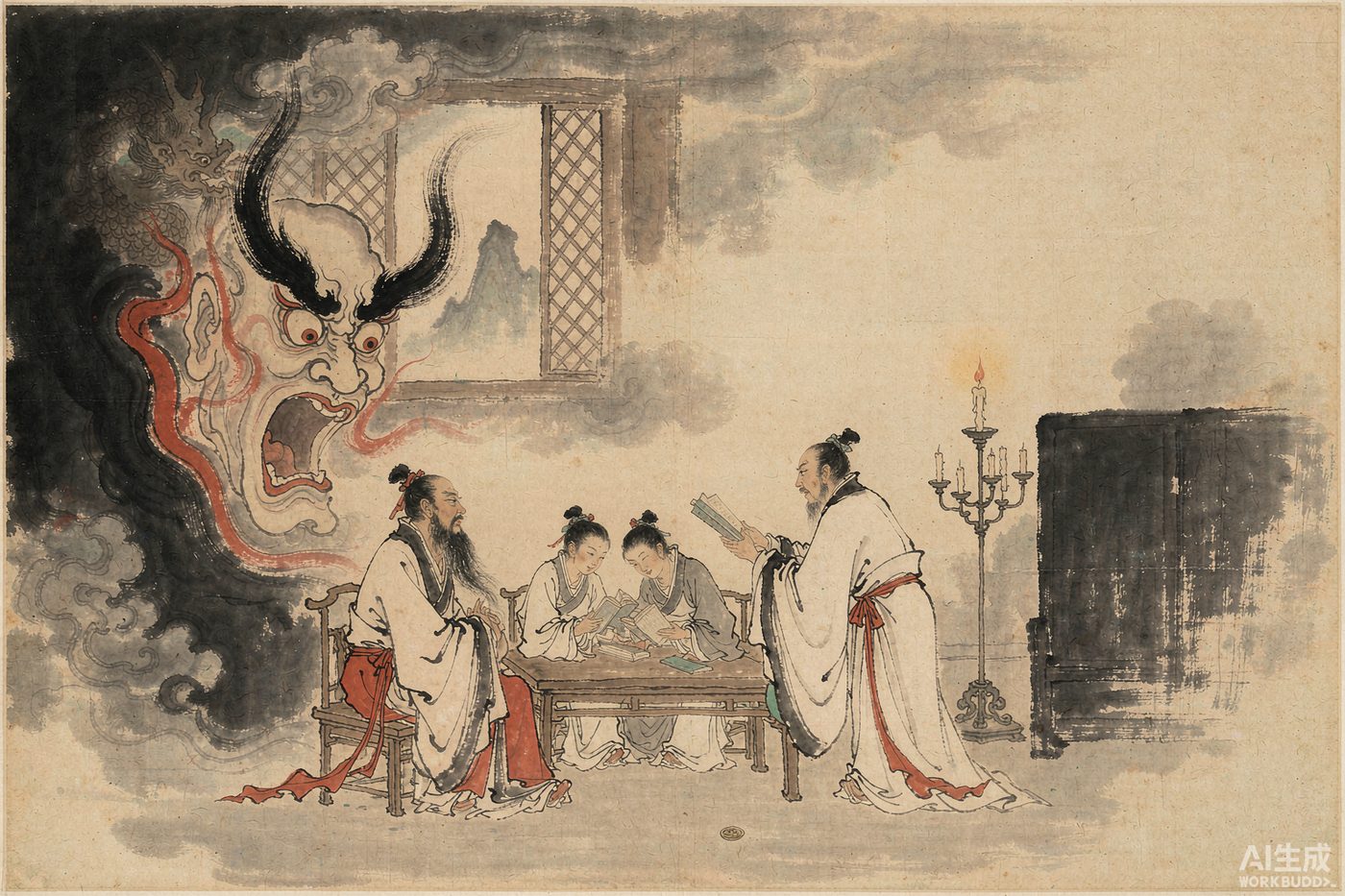
At the northern and southern weaving bureaux of Wu commandery there is a Machine-Hall, and beside it stands an image called the Eye-Covering God.
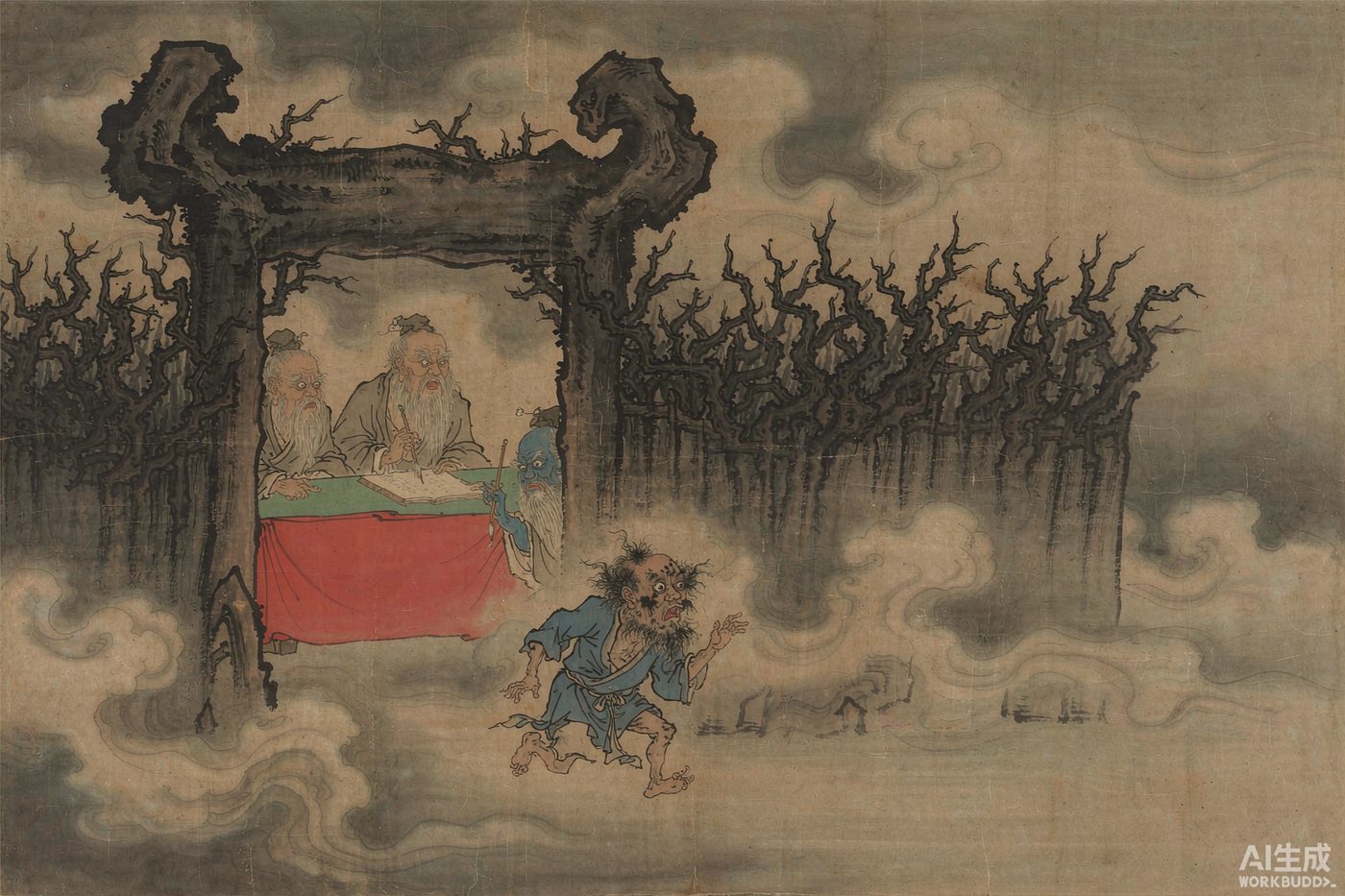
One night the man who kept the bureau saw the god go out in a swarm, with cap on head and sash at waist. Some days later, sleeping in the hall, he saw the god come back — in blue clothes, bare-headed, and his face black as if smeared with charcoal.
The one in the upper seat questioned him.
“Someone has just stripped the cap and sash off me.”
“Who?”
“I do not know.”
“What was the charge?”
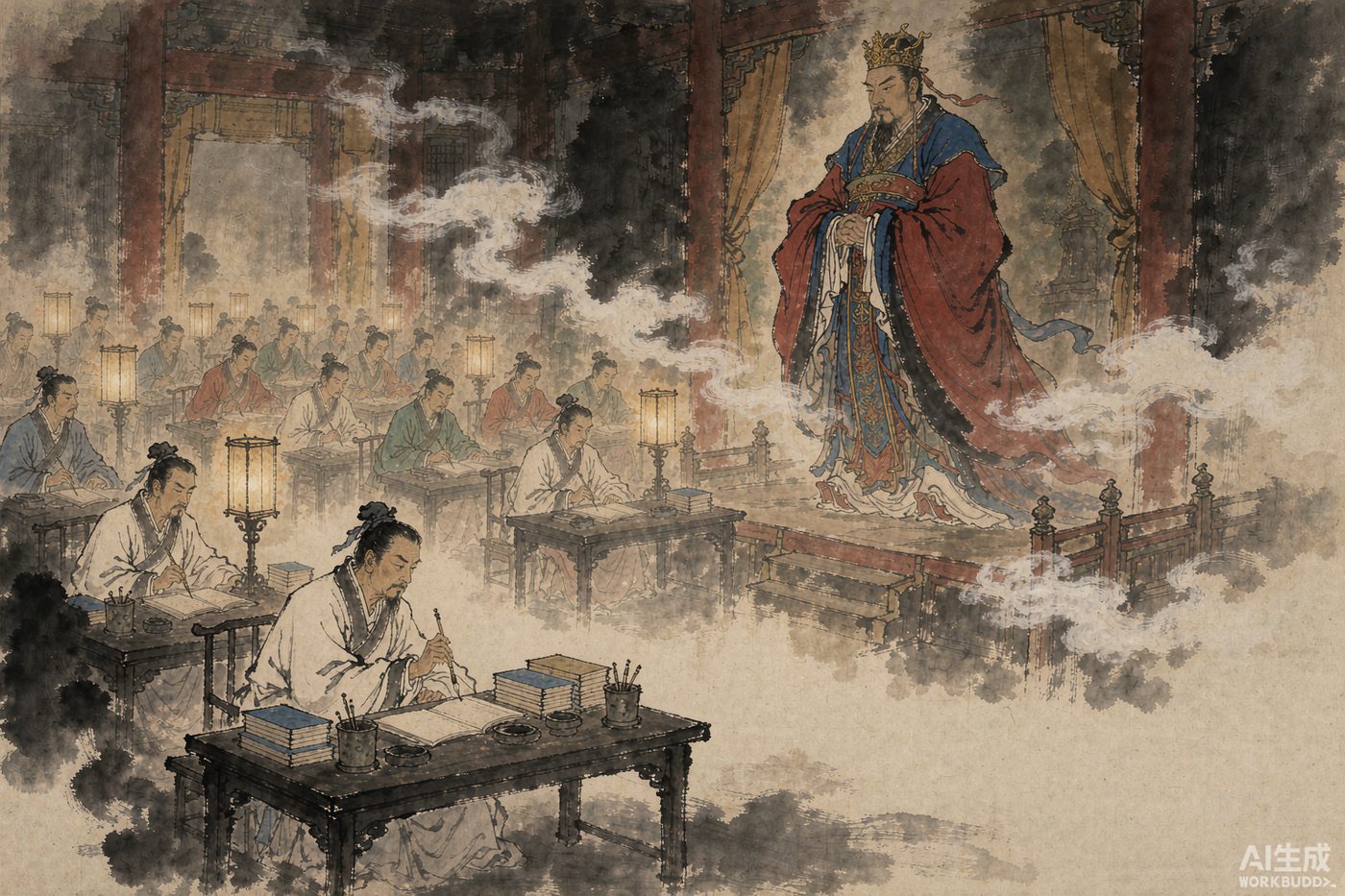
“That too I do not know. Earlier, under the corridor of the hall, I fell in with several dozen men in blue, who made me a present of a thousand in gold and led me to a place where the outside of the wall was all overgrown with thorns, with red silk hanging over the gate and a gold-lettered plaque set across it. The men in blue took me in. On both sides were several hundred low rooms, with bells being rung and numbers being called out — what business it was I could not tell. Presently we went up two flights of steps to a hall of a very severe and solemn scale. Above, two elders sat left and right; below were set two long tables spread with red felt, and heaped on the felt things I could not make out. A crowd sat round, disputing in a hubbub.
“The men in blue pressed me to cover eyes, so I put out both hands — the left to screen those on the dais, and the right to cover those below. Presently a man in a blue robe came up and asked, Who are you?
“I answered: The Eye-Covering God of the Machine-Hall.
“The blue-robed man said in anger: Your blinding tricks are quite enough winnowed about the marketplace. How dare you come here? Besides, the sun now stands at its height, and every officer on duty here holds a mirror of ice. How should the likes of silk-pedlars and cloth-dealers be allowed to move their hands up and down?
“He ordered a man in red to strip off my cap and sash. Then a blue-faced ghost came with a brush, dipped it in ink, and painted my face over several times, and drove me out of the gate. I hurried to find the men in blue — they had vanished. I came home in a wretched state and threw myself down under the veranda.”
The one in the upper seat thought about it for a long while.
“A strange business. I do not understand it either. The man and the place — let them be looked into.”
At this the man keeping the bureau gave a great sneeze, and the voices ceased. He told the matter afterwards to his fellows; they argued about it every which way, and not one of them could identify the place.
The Duo comment: It is plainly a place that we ourselves have frequented — and yet the one who asks does not know it, the one who answers does not know it, the one who relates it does not know it, and the one who listens does not know it either. The men of old called not reading books a happy immortal; this is where he pays for it.
Cheating in the examination hall is punished by the law of the land without fail. That his person was only in the marketplace is why he was let off lightly. As for dipping the brush and smearing the face — one stupid face, and it gains rather more letters than it had — the blue-faced ghost may be said to have rewarded evil. Some say: he who falls by corruption is called ink. It is meant as a warning.