Stories/ 谐铎/ The Ghost Who Shrank Before a Soldier

The Ghost Who Shrank Before a Soldier

正士驱邪

SourceXieduo (Miscellaneous Bell)
AuthorShen Qifeng
EraQing dynasty · c. 1790
Writtenc. 1790
GhostCultivationMorality
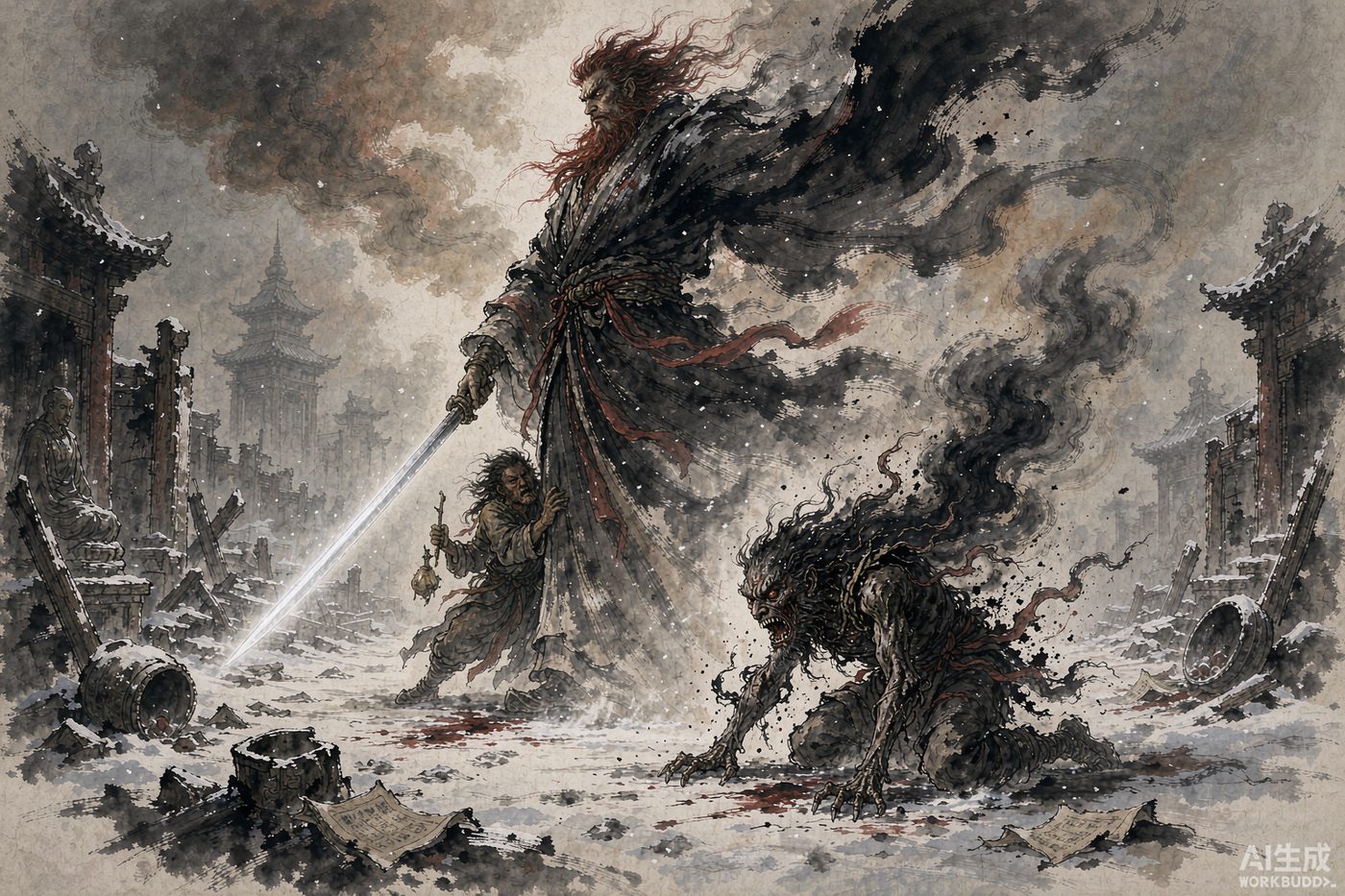
A red-bearded scholar with a sword growing enormous in a snowy ruined temple while a snarling ghost shrinks and kneels before him, his servant clutching his leg, ink wash painting
Illustration generated by AI, based on the ancient Chinese text.

Lord Han of Qiaoyang had a refined face but a taste for martial pursuits, and spent his days galloping and trying out swords for pleasure. Before he rose to office he took a sturdy servant and travelled to the Five Peaks.

Caught in snow midway, he put up in a ruined temple. After the first watch the snow and moon shone together; Han went and stood under the eaves, and looking round at the white world said, “A very world of glass.”

Suddenly a dark wind came from all sides, and a ferocious ghost strode in with its head high. Han drew his sword to meet it. His servant was terrified and dropped to the ground like a dog, hugging his master’s left leg with both hands.

The ghost began to grow: at first level with the eaves, then some three zhang above them. Looking up, the servant saw his master’s appearance change too — a black face and red beard, standing erect — and his body grew as well, three zhang above the ghost again.

The ghost shrank at once and fell to the ground in obeisance. “My lord is a true hero. Every man’s spirit stands ten zhang tall, rich or poor; but commit one shameful act and it shortens by a foot. So among the shapes that people the visible world, the best fall short of five feet, the next three or two, and the worst lie flat like three-inch awls. You alone have kept your original spirit. The one who will stand on the earth and prop up the sky hereafter — who else but you? Take heart!”

With that it was gone. The servant saw his master as he had always been, and described what he had witnessed; Han himself was entirely unaware.

Later Han rose to commander-in-chief, and died in battle suppressing bandits; he is worshipped as a martyr to duty. The portrait he left, Subduing the Ghost, shows a scorched, curly-bearded figure that was not his real face — yet when villagers have a haunting they bring it out to suppress them, and the ghosts invariably flee. To this day he is called a second Zhong Kui.
Original classical Chinese text · 原文

樵阳郡韩公,貌文秀,而性好武事,日驰马试剑为乐。未贵时,携一健奴,出游五岳。中途遇雪,投止枯庙。一更后,雪月交辉,公起立檐下,四望皎然,曰:"真琉璃世界也。"忽阴风四袭,一狰狞恶鬼,昂首直入。公拔剑相迎,健奴大惊,犬伏地下,一以两手抱公左足,见恶鬼渐长,始犹高与檐齐,继则出檐者约三丈许。仰见公状貌亦变黑面赤髯,挺身而立,身亦渐长,高出于恶鬼者又约三丈许。鬼身顿缩,伏地而拜曰:"公烈丈夫也。人无富贵贫贱,神气俱高十丈。自作一亏心事,神气即短一尺。故眼前之赋形宇宙者,上者长不满五尺,次者三二尺,下者塌地如三寸锥。而公独保其元神,异日之立地顶天者,非公而谁?勉之勉之!"言毕而逝。健奴见公亦如故,起述所见。公竟茫然。后公位至总戎,平寇阵亡,崇祀义烈。所遗《伏鬼图》一卷,焦而虬髯,非其本相。而里中有鬼祟,请其像镇压之,辄遁去。故至今有赛钟馗之名。 铎曰:"百尺楼头,元龙豪气;旦旦伐之,则扫地尽矣!塌地如三寸锥,犹非充类尽义之论也。"

From 《正士驱邪》, Xieduo. Translated in full. 樵阳郡 is in modern Fujian; 丈 and 尺 are units of roughly 3 and 0.3 metres; 总戎 is a regional commander-in-chief; 赛钟馗 means a second Zhong Kui, the demon-queller of popular religion. 铎曰 is Shen Qifeng's closing comment. The tale's cosmology — that moral stature has a literal, measurable height — is the most compact statement of the principle anywhere in the library.

Source. From Xieduo (Miscellaneous Bell) (谐铎), by Shen Qifeng , c. 1790. The original text is in the public domain; this English rendering and the accompanying notes are original work.
Where this fits in the universe: Cultivation: How Beings Change Their Nature · Ghosts

Keep Reading

Related Stories

Qing dynasty · c. 1790 · 谐铎

The Ghost Tutor of Broom Village

扫帚村钝秀才

A rich man cannot choose a teacher for his son, until a voice in a dream tells him to go to Broom Village in Wu commandery and ask for a certain licentiate. The old man who comes is strict, brilliant, and — as he explains at the farewell banquet — has been dead for three years.

GhostExaminationsKarma
Qing dynasty · c. 1790 · 谐铎

The Lotus Immortal Who Tested a Son

芙蓉城香姑子

A young man who dreams of an immortal's love fishes a petal from the lake with a poem on it, and is led to a city of lotus. The immortal who receives him will share his bed but never his body — and when his mother's letter arrives, the test he has been failing all along finally comes due.

ImmortalsFilial PietyTemptation
Qing dynasty · c. 1790 · 谐铎

The Poets Through the Wall

隔牖谈诗

A young poet quarrels with Shen Qifeng over the lineage of verse and storms out. Alone by the lamp, Shen hears a laugh in the dark — and is harangued at length on four-character and seven-character poetry by the dead of a ruined garden.

GhostPoetryScholars