Stories/ 夷坚志/ The Ghost-Seer of Genshan Gate

The Ghost-Seer of Genshan Gate

潘見鬼理冥

SourceYijian Zhi (Record of the Listener)
AuthorHong Mai
EraSouthern Song dynasty · 12th century
Writtenc. 1160–1200
GhostJusticeSmall Gods
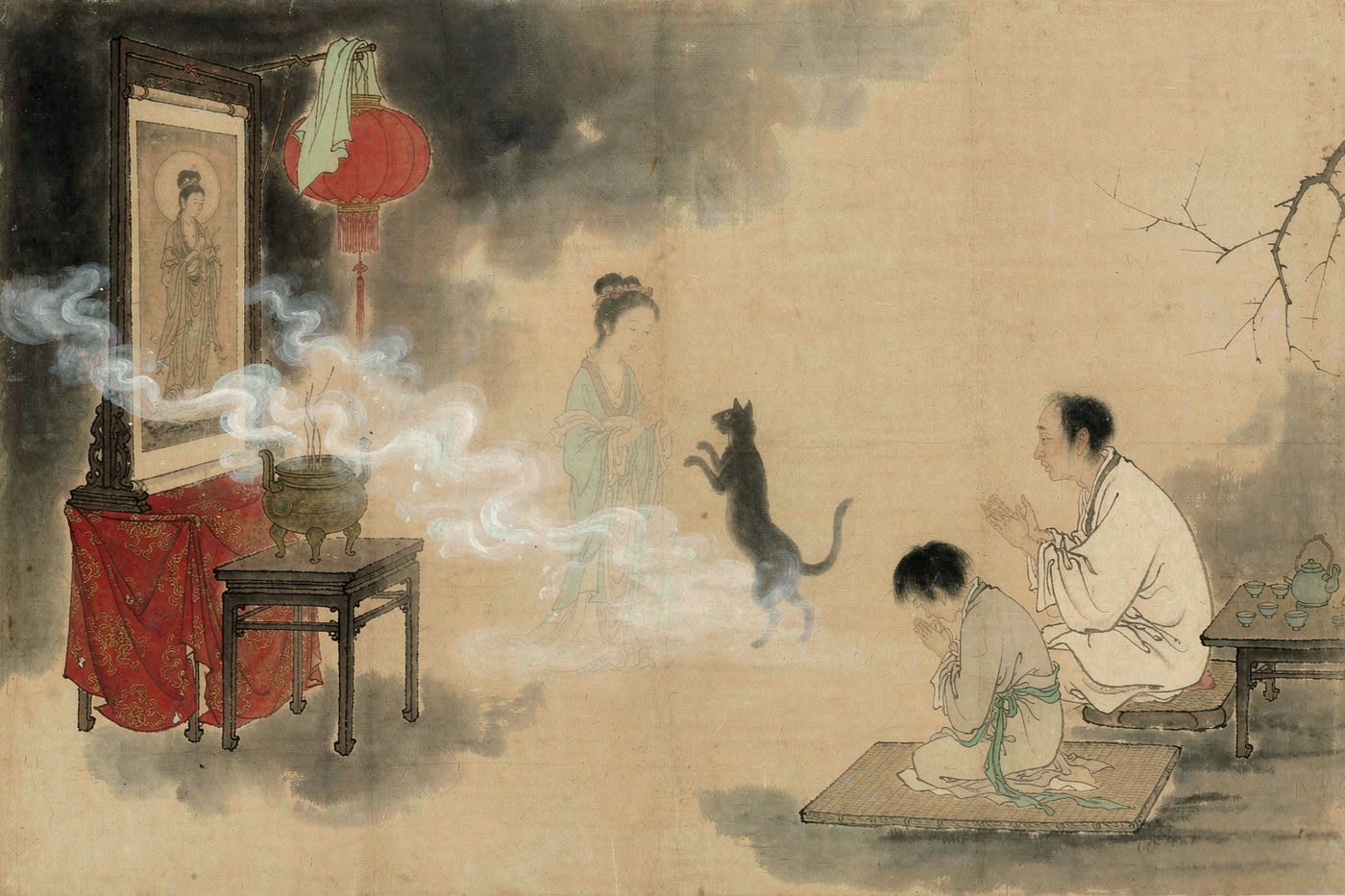
A tea-shop shrine with an incense burner and a handkerchief on a lamp before a god-image, the faint figures of a maidservant and a black cat in the smoke, a medium and a boy in trance beside them
Illustration generated by AI, based on the ancient Chinese text.

The business of Qingxi and the cat is recorded in the bing division of this work.

Twenty-two years after her death, in the summer of the renzi year of the Shaoxi era, her old mistress fell ill of dropsy and grew daily more desperate. The steward of the house, Wang Fu, said: “I have heard the second Mr Qian, who keeps the tea-shop in Tianjing Lane, say that there is a Master Pan outside Genshan Gate who is good at managing affairs in the dark. People call him Pan Who Sees Ghosts.”

They thought it worth trying. Wang took Qian with him and they went to Pan’s house.

Pan burned incense and paper money, and spread a handkerchief on the lamp before the image of the god he serves — and plainly saw a woman and a cat standing facing one another.

“There is a wrong on both sides,” said Pan. “But I do not know what is behind it.”

The two men took the handkerchief home and told the mistress what they had seen. She was greatly alarmed.

“It is true that I lost my temper with that girl and had her beaten,” she said. “But she died of her injuries. I did not take her life. Why should she plague me like this?”

She sent them back to him. Pan had a boy go into trance and held a summons, and the boy at once spoke in a woman’s voice:

“My name is Qingxi. I died a violent death and to this day I have not been allowed to be reborn. It is true my mistress did not kill me — but it began from her. In the old days her good fortune had not yet declined, and so I waited all these years.”

Pan offered her fasts, offerings and scriptures. She would accept none of them. She made the noise of a cat several times, and the boy went into a swoon; and when he came to, he remembered nothing at all.

So Pan transferred a writ to the City God, directing that she be placed in the palace at Fengdu. He also charmed a date into water and gave it to the sick woman to drink, and she seemed a little better. In a few days she sank again, and did not rise after all.

Qian went to the funeral. That night he dreamed of the woman, who said: “I was righting my own wrong. What had that to do with you? You had Master Pan throw me into prison. There is no help for it — you must come down below and give evidence.”

He took a burning fever, and died within a few days.

Alas. The reckonings of the dark road are vast and hard to call to account. That Qingxi, who died in the first place over a cat, should have brought disaster on her mistress and on Qian too — that was going too far. Or was it simply that their allotted numbers fell out together?
Original classical Chinese text · 原文

慶喜猫報已載志丙中。既死二十二年,當紹熙壬子夏,其主母得水蠱病,日就危困。幹僕王富云:「嘗聞天井巷間茶店錢君二郎說,艮山門外潘先生善理幽問事,俗呼為潘見鬼。」試往禱之。王遂拉錢造其居。 潘焚香爇楮鏹,施手帕於所事神像前燈上,正見一婦人一猫對立。潘云:「俱有寃枉,吾亦不解其由。」二人持帕歸,為主母道所以。母大驚曰:「往歲實怒責此婢,然其死也自因損傷,非我隕厥命,何緣作祟如此?」 復使往見。潘乃命童子附體考召,即作婦人聲曰:「我名慶喜,以死於非命,到今未得託生,固非主母殺我,但却自渠而發。向者其福未衰,故等守多年耳。」潘許以齋醮經卷,皆不應,而作猫叫數聲,童即昬眩。及覺,不能畧省。 潘移牒城隍,令放置酆都宫,且咒棗治水與病者服,似覺小愈。纔數日,復沈篤,竟不起。 錢往弔喪,是夕夢婦人來曰:「我自報寃,何與爾事?顧令潘法師囚我於獄,非屈來地下作證不可。」旋抱熱疾,少日亦亡。 噫,冥途業報茫茫,理難致詰。慶喜之自死緣猫故,乃貽禍主母及錢生,則為太濫矣。豈命數相值,偶然若是乎?

From 《潘見鬼理冥》, Yijian Zhi, 丁志卷五. The opening line cross-refers to an earlier entry, 慶喜猫報, in the bing division: the maid Qingxi and her cat have already appeared once in this collection. 艮山門 was the north-east gate of Hangzhou, the Southern Song capital.

Source. From Yijian Zhi (Record of the Listener) (夷坚志), by Hong Mai , c. 1160–1200. The original text is in the public domain; this English rendering and the accompanying notes are original work.
Where this fits in the universe: How a God Gets a Post · Filing With Heaven: How to Send a Document to a God

Keep Reading

Related Stories

Qing dynasty · Qianlong era, c. 1736–1788 · 子不语

The Magistrate Who Went Down the Well

酆都知县

A county magistrate abolishes the annual tax that his people pay to Hell. The town tells him to explain himself to the gods. So he has himself lowered down a well — and meets Bao Zheng, and Guan Yu, and makes one fatal mistake.

UnderworldJusticeDeity
Qing dynasty · Qianlong era, c. 1736–1798 · 子不语

The City God Was Drunk

城隍神酗酒

A clerk writes a colleague's name upside down in red ink as a joke, and burns the paper. That night the City God's bailiffs arrive. The rule is that whenever a living document names a man, the underworld arrests him.

UnderworldJusticeDeity
Qing dynasty · Qianlong era, c. 1736–1798 · 子不语

Poor Ghosts and Rich Ghosts

穷鬼祟人富鬼不崇人

A thousand coffins heaped like a mountain behind a convent, and the monks say the place is peaceful all year because these are all rich ghosts. Yuan Mei asks how a city can produce so many rich ghosts.

GhostUnderworldJustice