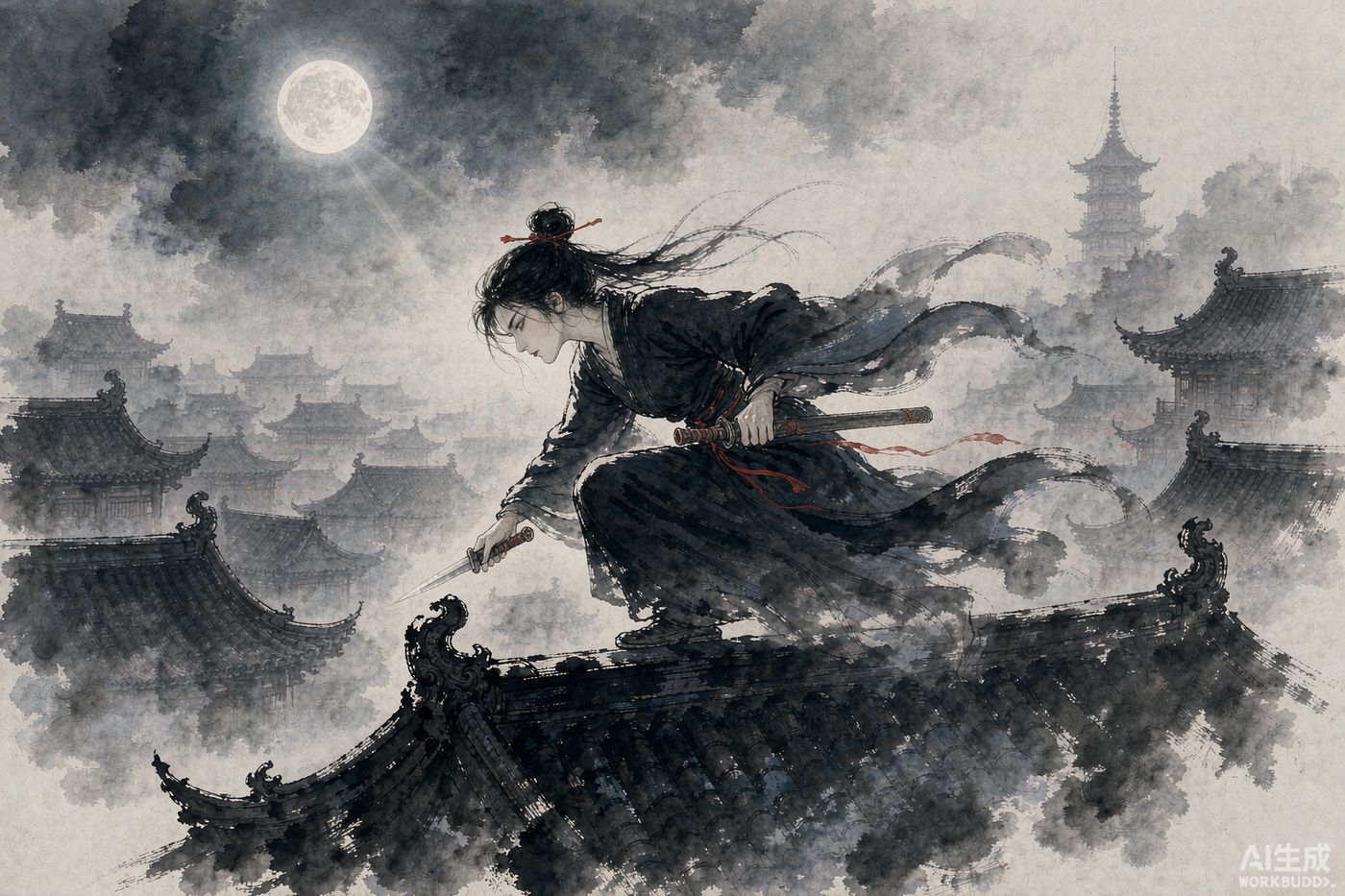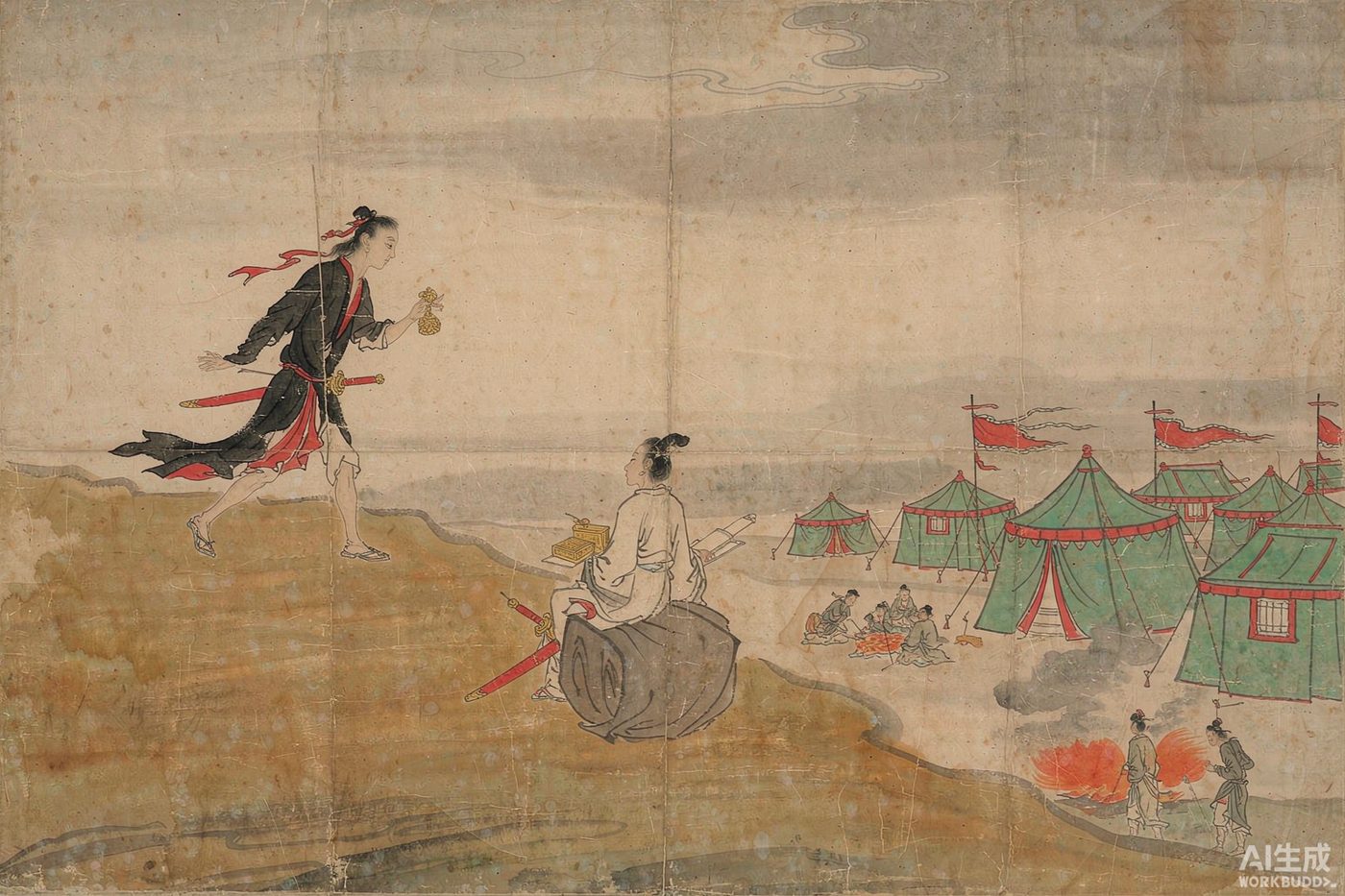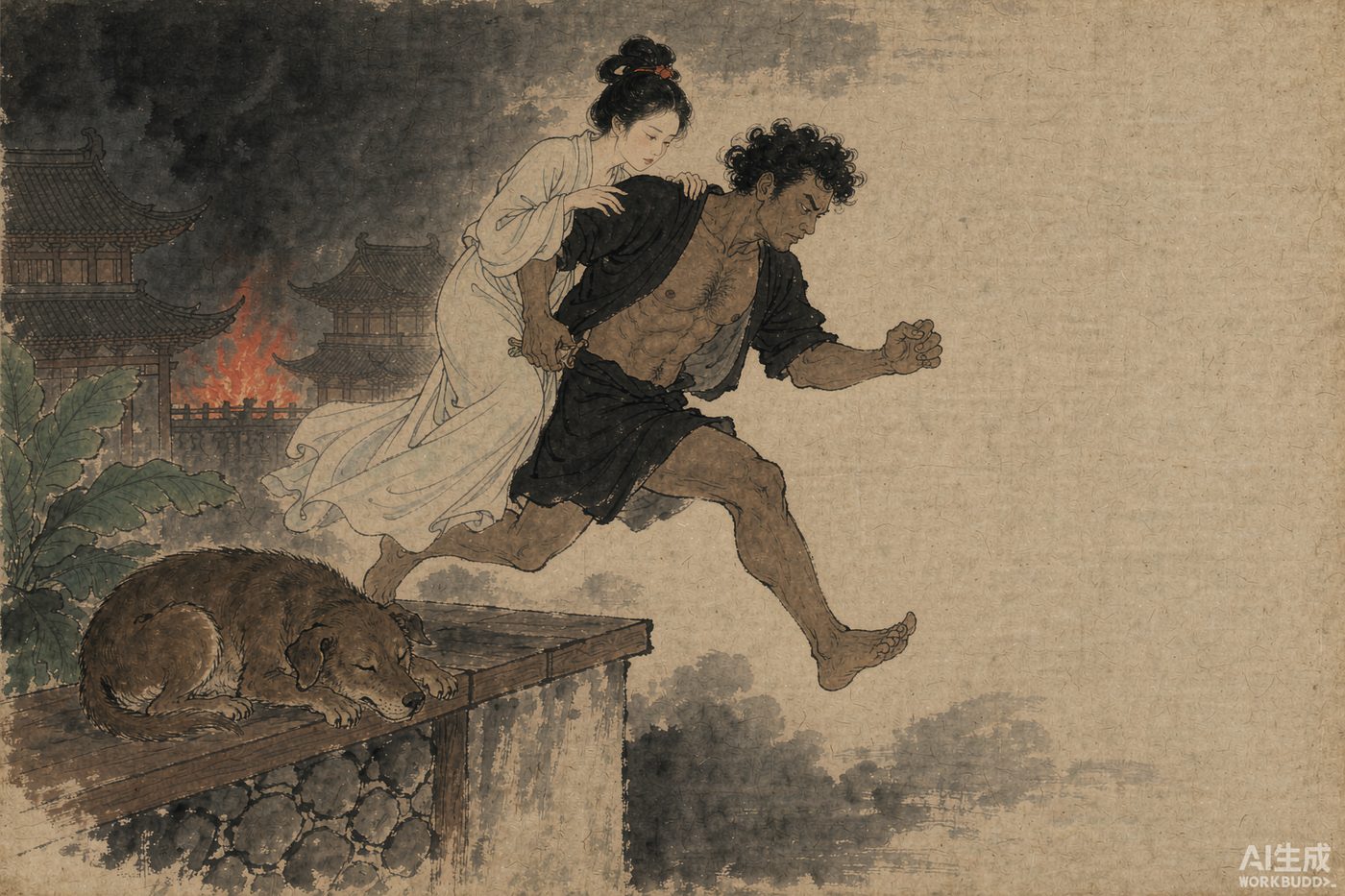
Lu of Zhijiang had an elder cousin who was a vice-prefect at Didao, and went out to join him — only to find that two months earlier the cousin had been promoted and moved on to be governor of Zhenxi. Lu had no travelling money. He lodged at the Shani post-station and, having learned something of the fighting arts as a boy, taught boxing and staff-work for a living.
In front of the station stood two jujube trees, each as thick as a man could circle with both arms. It was the season when the fruit was ripe, and every day hundreds came to knock it down.
Lu laughed. “Fitting hooks and cutting poles — surely that is the long way round. Let me show you how it is done.”
He stripped off his coat, walked up to the left-hand tree, took hold of it and shook it. It was as soft as a handful of weeds; the dates came down in a hiss on the ground. Everyone marvelled.
A bearded man standing by said, smiling: “What is there to marvel at in that?”
He too stripped off his coat, went to the right-hand tree, and took it in both hands — and not a twig of it stirred. Lu sneered at him.
“What you practise is external work,” said the bearded man. “I practise internal. Once a tree has been touched by it, it withers and dies within the turn of an eye.”
Lu thought he was boasting. Then the leaves yellowed, the branches dropped, and the dates came rattling down with them, and the trunk stood stiff and bare, like a thousand years of deadwood. Lu was appalled.
“You are teachable, at least,” said the bearded man. He asked Lu’s family, and whether he was married.
“I am poor,” said Lu. “For most of the year I am dependent on other people. There has been no time to take a wife.”
“I have a foolish daughter,” said the bearded man, “who would suit you well. I do not know whether you would stoop to her.”
Lu said: “I am duckweed on the water. To be sheltered by a father-in-law is exactly what I want.”
The man was pleased, took him home, and had his daughter dressed and brought out. They were married that evening.
The next day he was presented to the women of the house. There was an old woman, lame, leaning on a stick — the girl’s grandmother. There was a tall one in a barbarous collar and short sleeves — the senior wife. There was a short woman in tight breeches with feet like laundry baskets — the girl’s birth-mother. And there was one with wild flowers piled in her hair and no powder on her face — her widowed elder sister.
Lu found his wife gentle, and settled well enough.
After half a year he had seen enough of the bearded man’s comings and goings to know they were not honest, and while his father-in-law was away he said to her:
“I know what your family does. But killing men and taking goods ends in destruction. When the fire comes and burns the jade and the stone together, where will you put me?”
“Wherever you go, I go,” she said. “How should I decide it?”
“As things stand, there is only one course. Ask leave of your elders, and come home with me to my own village. That way there will be nothing to regret later.”
“Say so to them, then.”
Lu put it to the old woman. She thought about it a long while. “The father is not back; in order you should wait quietly for him. But since you have set your heart on going, tomorrow we shall hold the farewell feast.”
Lu was delighted and told his wife. Her face fell.
“My family’s customs are not yours. What we call the farewell feast is this: from the bedroom to the inner room, to the hall, to the gate, someone stands at every one with a weapon in her hands. If you can fight your way out at every door, you are free to go home. If you cannot — under the blade there is no such thing as family feeling.”
Lu was aghast.
“I have thought it through,” she said. “My sister is short and fierce, but she is not my match. The senior wife has a bad arm these days; I can hold her. My birth-mother could fight ten thousand men, but she bore me and will not press too hard. It is only my grandmother’s iron crutch, coming down like a mountain on your head — one moment’s carelessness and your skull is pulp. I will protect you as well as I can. What heaven has decreed, I do not know.”
They sat facing each other in dread and did not sleep.
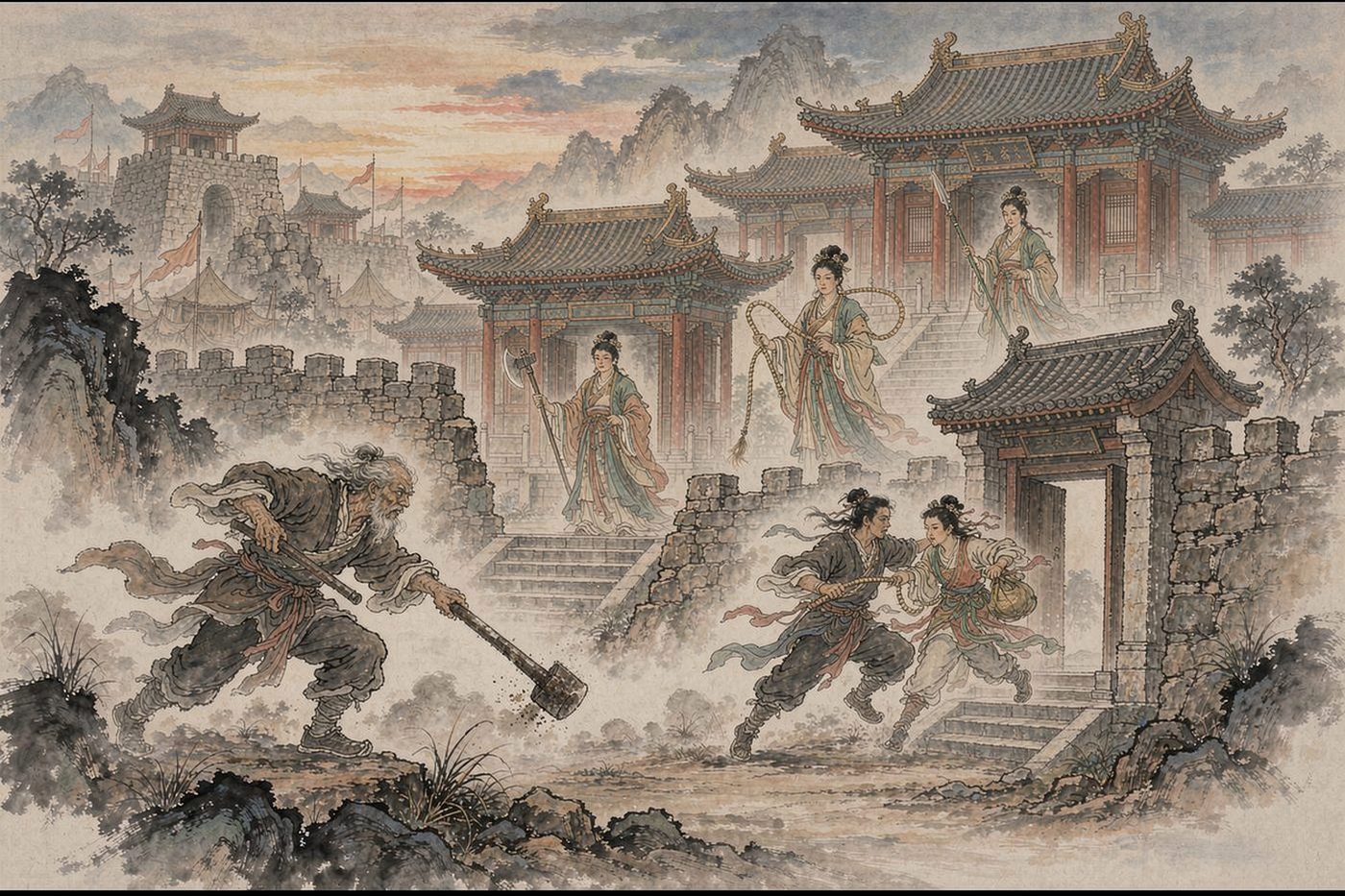
At dawn they packed, hid weapons in their clothes, and set out. They had hardly left the women’s quarters when the sister stepped in front of them with an axe.
“Brother-in-law is leaving, is he? Then take this silver knife and be off!”
The girl said: “Sister, no cruel games. Remember when your husband died, and I kept your back warm through three winters of lonely quilts? Today, for my sake, spare us a little face.”
The sister shouted: “You stupid slave! Running from your father, and still you dare plead for him?” and swung the axe at her head.
The girl drew a mace from her sash and turned it. Three passes, and the sister was streaming sweat and gasping, and threw down the axe and ran.
In the outer room the senior wife met them, smiling. “A guest going so far, and nothing to send him with. Let a jointed bamboo whip stand in for travelling money.”
The girl knelt. “Mother grieved all year when your daughter lost her husband. I am of a different womb, but I ask you to think of me too.”
The senior wife flew into a rage. “You little witch, so much talk. You first.” She struck with the whip, and the mace came up to meet it. They fought for a while, and she flung the whip down cursing: “Vicious child! Taking advantage of my bad arm, pressing me with the Sha family meteor method. Get out!”
Then, in the middle hall, the birth-mother stood waiting, weeping. The girl came out weeping too, and pulled Lu down beside her to kneel.
“Child, how can you bear it — you would throw away your mother?”
Two sentences, and she could not get her voice out. Lu tugged at the girl to go; the girl clung to her mother’s clothes and sobbed.
“A wife follows her husband; that is the rule. I will not keep you. But the old custom of the send-off cannot be dropped.”
She took a green-shafted spear down from the rack, with several coins threaded on it and a string of bright pearls, and thrust it at her daughter’s breast. The girl caught at it as it came — and the head came away in her hand, for the spearhead was pewter, made up to look like silver.
“Too arrogant, this boy!” the mother cried, for the house to hear. “He has broken out of the lady’s city!”
The girl understood, and dragged Lu out at a run.
They were nearly at the gate when an iron crutch came down out of the air at his head. The girl put out everything she had, catching it on both maces, and Lu rushed out beneath the crutch and through the door.
She knelt long, asking to be punished. The old woman threw the crutch down and sighed.
“A daughter is born facing outwards — now I believe it. Go with your man, and quickly. And stop this clever play-acting.”
The girl went home with Lu to his village, sold the gold and the pearls, and set up a small trading business, and they got their living well enough.
Later the bearded man’s affairs came to ruin and he was taken, and the whole household was beheaded in the market. Only the girl’s birth-mother got clear away alone, shaved her head in a nunnery of medicinal herbs, and lived to eighty. A letter came from her after her death. The girl and Lu traced it to the nunnery, and found laid across the bed a staff — the shaft of that same spear.
They wept, and buried her coffin on the south slope of the eastern hill, and kept a hut by the grave for three years, and then went home together.
The Duo comment: Heaven blesses the compassionate and the filial first. The daughter loved her mother, and so would not be an egg in an overturned nest; the mother loved her daughter, and so would not be a duck with its neck wrung. Only — she who doted on her daughter, why did she not follow her husband? She who pitied her mother, why did she not extend it to her father? The gentleman says: this is precisely what makes them thieves. Alas — there are many in the world who are not thieves, and yet the thieves did this much.