Lu of Lanxi lost both his parents in middle age. His wife, a Leng, was deeply dear to him, and they had a son and a daughter; but the children were barely out of swaddling when she wasted away and died.
He married again, an Ouyang, beautiful and fierce, most cruel of all to the children. She scolded them at every turn, and at the least displeasure the whip came after. If Lu let a flicker of anger show, she would chatter back at him for days and nights without tiring.
Lu could not bear it. He went out in a rage, was caught in rain, and ran for the wooded valley.
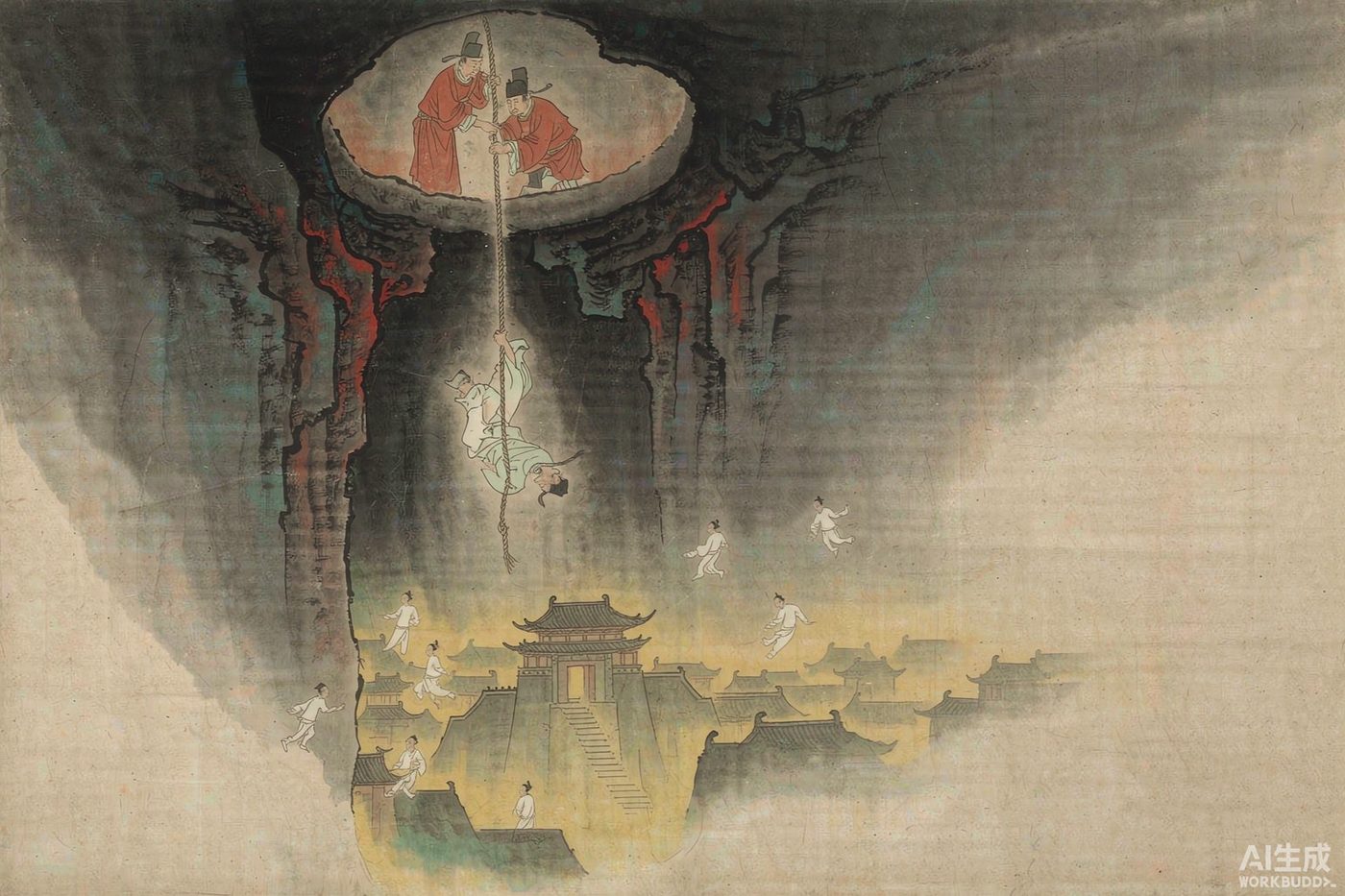
Suddenly the ground gave way under him and he fell into a hollow, as though he had dropped onto a roof ridge. There was a shout of thief! and a man tied him and brought him down.
It was his dead servant, Miao Yi.
“I thought — who is it? It is the young master.” He loosed the bonds and hurried inside to report.
Before long his father and mother both came out and took him in their arms, weeping.
His father said: “That you have come here is itself a marvel. Let us at least have half a day.” He led him into the house, and there at the window was his dead wife, drawing thread, embroidering a pair of slippers.
Lu went straight to her and took her thin wrist, and would have poured out all his longing.
She tore free and backed away. “What rude guest is this, so violent?”
He stared, not understanding.
His mother said: “Have you married again?”
He said: “I have.”
His mother said: “When a man takes a later wife, the bond of the wedding hair with the earlier is gone. So when they meet they no longer know each other.”
She went in and spoke in the wife’s ear. The wife then understood, and wept, and asked after everything at home.
Lu said: “The fields are, happily, still sound. But the children at my knees drink poison every day. What is to be done?”
The wife turned to the wall and wept, and he too cried out.
His father said: “You already have children, and yet you gave no thought to the phoenix chicks and foolishly brought home an owl. No wonder the nest is wrecked and the young taken. The evil is of your own making. Why do you regret it now?”
His mother said: “He is not worth pitying. But we must think of the ancestral line.”
His father said: “To preserve the succession rests with my good daughter-in-law.”
His mother said: “The new wife has long been on the ghost register. How can she reach out a hand to our son?”
His father said: “The unworthy wife — I will have her seized and brought. Morning and evening you will give her a little instruction. Then let the new wife go back with our son, and borrow her hands and feet to manage the house. When the children are married off, she shall come back here.”
The wife said: “I am daily in my father- and mother-in-law’s hall. How can I bear to speak of leaving?”
His mother wept bitterly too.
His father said: “You came here as a filial daughter-in-law. You go back as a loving mother. In both the duty is whole. Why this clinging?”
He had Lu take his wife out, set a ladder against the corner of the house, and the two of them climbed. Looking down into the hollow, they could still see his parents at the eaves, craning to watch. Reluctantly he took his wife’s hand and went home by the road.
Just at the gate the wife drifted in first.
The children came running and crowded round him, both talking at once: “After you went out, the stepmother was beating us with an iron rod. Suddenly her face changed horribly and she dropped down stiff.”
Before they had finished, Ouyang came slowly out. The children shrank and grabbed their father’s gown.
Ouyang went to Lu’s side, stroked him again and again, and sobbed into her sleeve: “I left you not three years ago. I did not think you would have worn so thin.”
The voice was exactly the first wife’s.
Lu was overwhelmed with joy and said to the children: “This is your own mother. Do not be afraid.”
The children stared.
She asked the daughter: “Once I took gold from my dowry box and had an armlet made for you. Where is it?”
The girl said: “The pin in mother’s hair is what she had my armlet melted into.”
The wife said: “What would I want with that?” She pulled the pin from her own temple and set it in the girl’s hair.
Then she asked the boy: “I picked out three feet of hundred-flower phoenix brocade for a sash for you. Why are you not wearing it?”
The boy said: “Father had it cut into leggings for mother.”
The wife said to Lu: “A foolish man loves the later wife. No wonder the children are broken on the wheel.”
Lu bowed his head and owned his fault, and they went in together hand in hand.
She saw the medicine stove, the tea brazier, the place where she had painted her brows and set her mirror — all moved from where they had been.
She said with a long breath: “A person steps down from her post for a single morning, and everything is handed over to her successor. It is truly painful.”
She unlocked the chest. There were the apricot-yellow gown and the purple gauze drawers, piled in finery; and of her old clothes not one thing remained. She demanded an answer from Lu.
Lu said: “The new clothes become you. Do not think about the old ones.”
She said: “A man’s heart is visible in his words.”
He regretted the slip and made it up to her again and again.
Then she leaned at the window and gazed out. “Where has the green peach tree I planted been moved to?”
Lu said: “Since you turned your back on me, she hacked at it every day. The tree withered and died.”
The wife sighed. “If even the tree is treated so, how are people to bear it?” She looked round at the children and the tears came in spite of her.
Then she took up the jar and went for water, and set her hands to the cooking. Lu begged her not to labour.
She said: “This is the body and hair of the one who came after. It is what you were supposed to cherish. Otherwise — since the day I entered your house, when did I ever once sit idle and burn incense?”
Lu’s face went ashamed, and he held his breath and made no answer.
She said: “I came at your father’s command. Must I pick out your faults for you? But to hide resentment and make merry would wound a wife’s virtue further. I have to spit this anger out once.”
Lu said yes, yes.
From that day they were as husband and wife, and morning and evening she ran the household. Twelve years passed, and she had brought both children up to standing.
The daughter married a Zheng of the village, a successful candidate; the son married the daughter of a Qian. The household was harmonious, and there was never a cross word.
One evening she set out wine in the inner room, and when they were deep in drink she said to Lu: “Last night your father summoned me in a dream. Now I must say goodbye for good. The bond of husband and wife ends here.”
Lu wept: “The house was scattered and broken, and it was you who rebuilt it. This is when we should grow old together. Why will you still leave me?”
She said: “I came to raise your children. I go to serve your parents. If you insist on holding me, that is you being unfilial.”
Lu sat in the corner and wept aloud.
In the space of a moment the wife was on the bed, stretched out, the breath gone.
Even as he stood marvelling, she sat up again and said: “The elder sister has come home. I am to take her turn.”
The voice was Ouyang’s.
Lu paled.
She said: “Do not be afraid. I have been with your father and mother twelve years receiving their instruction, and only now do I know that everything I did before was a failure of a wife’s way. From this day on I will follow the elder sister’s established rules exactly, and help you for a few more years, to buy back my former fault.”
Lu was overjoyed and called the son. The son was grieved and glad at once.
She said: “I have been away these ten-odd years. You are nearly grown and married. Do not remember the old evil — I still have to keep this house for your father.”
The son said: “The toil of the former mother was the very body of the later mother. What old evil is there that I would presume to remember?”
She was greatly pleased. From then she helped her husband and taught the children, with kindness and duty both complete, and the village and the whole clan called her a good wife.
The Duo comment: “An old man takes a young wife; and because he only studies her face and follows her will, he rears up arrogance in her, and she will not stop until the nest is wrecked and the young taken. To his parents he is unfilial; to his children he is unkind. If the nine springs could be opened up again, where would he find a hole to crawl into? Ah.”