Xun, whose courtesy name was Xiaoling, had the fragrance of thoroughwort over his whole body, and the reputation that his scent stayed three days in a room.
Once he took passage on a merchant ship and floated out to sea. A fishy wind rose suddenly and carried them to an island.
Xun left the boat and went ashore. He felt a foul steam that choked his throat and pricked his nose, quite unendurable. He was on the point of turning back when he saw an old man coming with a short-haired boy, talking and laughing.
At the sight of Xun they were aghast.
“What filthy boy is this, peeping at the pure land? Is he not afraid of frightening the people on the road to death?”
Xun, thinking them the stinking ones, gave back three or four paces, and bowed from a distance and asked their names.
The old man likewise held his nose with one hand and answered from a good way off.
“I am Old Man Bronze-Stink, of the Kong family. This is the child Little Milk-Stink. Because we admired the blessed land of the grotto-heaven we moved here from the Village of the Five Turbidities. The master of the Salted-Fish Shop took a liking to us, said our smell was not unlike his own, and recommended us to the Grand Master Who Chases Stench, who gave us charge of the keys of the north gate of the City of Dung Beetles. Your whole body is vile vapour. If you do not hide yourself away quickly, you will spread infection through the villages and gather into a plague of the season. What is to be done with you?”
Xun would have explained. But the old man and the boy began retching and could not stop, pulled their sleeves over their faces, and hurried away.
Xun was amazed beyond measure, and wished to prove it. He pinched his nose between two fingers and went on.
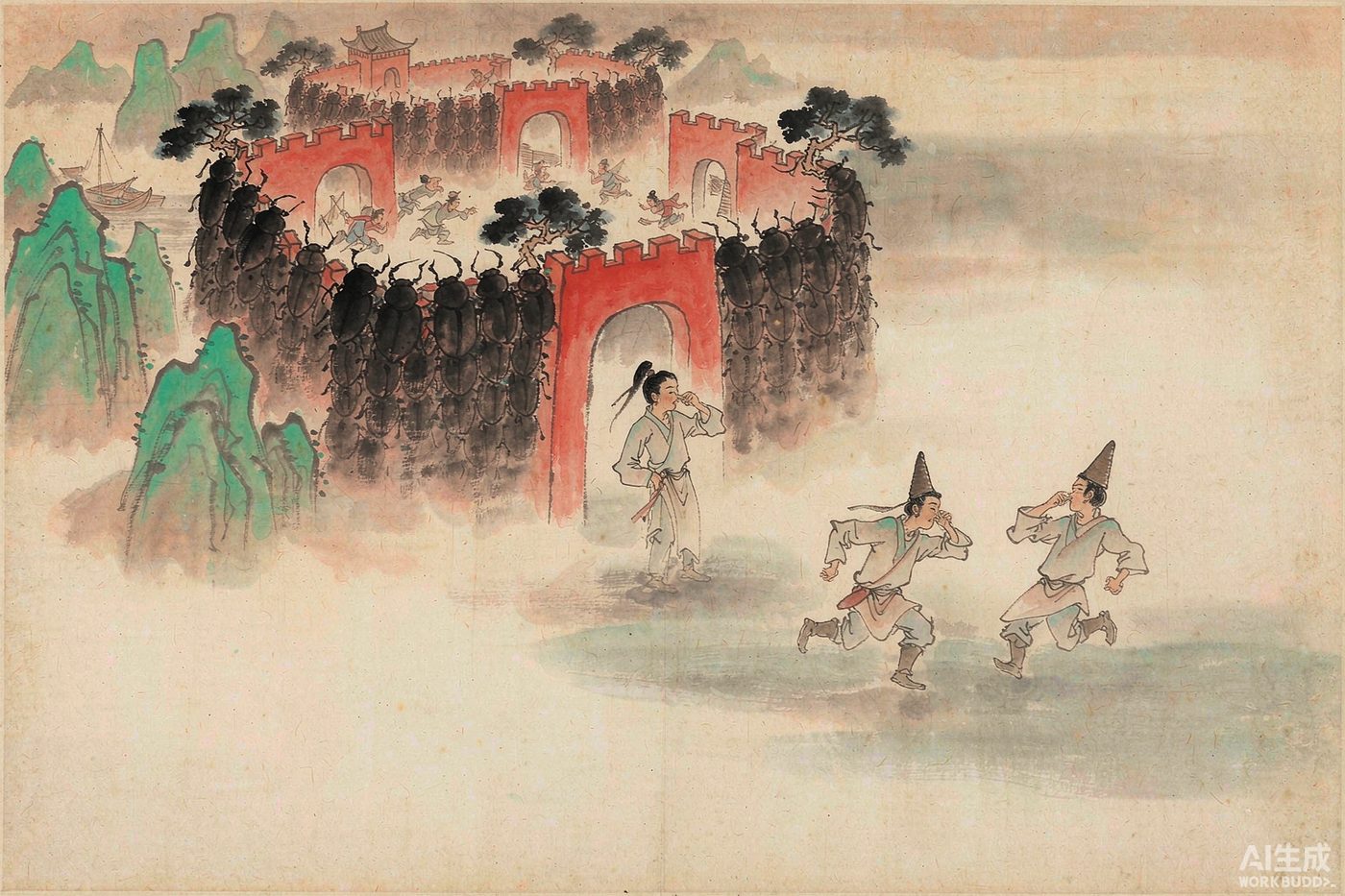
He came to a place where the walls were plastered with dung and earth, and a million dung beetles clung all over them, standing firm as a Great Wall. Xun shook out his gown and meant to go in.
Then he heard a great uproar inside the city: “Miasma! Quick — fetch famous incense and drive it off outside the gate!”
Xun peered. Cow’s piss and horse’s turds were heaped outside the gate like hills. He understood less than ever. He held his breath and went in.
Everyone who saw him ran for their lives, spitting over their shoulders.
Xun too was sickened by their filth, and turned and ran.
The crowd shouted and chased him. He lost his footing and fell into the mire, struggled up, and stood there wretched, wishing himself dead.
But the crowd had caught him, and were about to tie him — and then one of them smelled him all over, from the crown of his head to his heels, and cried out in astonishment:
“How is he so suddenly fragrant? This is truly turning the rotten into the marvellous!”
They apologised at once, and took him to the guest-house. The steps were made of privy stones, the walls plastered with ditch mud. In the courtyard was a pool black as ink. Xun took off his clothes and bathed — and the more he washed the more he stank, and the smell began to soak in through the flesh.
He got out in a hurry and put his old clothes on again.
Next day a rich merchant named Ma Tongjia invited him to drink. He was led into a hall called Like Orchid, with a side chamber called Hiding Filth, and behind it a Studio That Takes in Dirt.
On the mat there was nothing else: rotten fish, spoiled meat, onions, leeks and pickles.
Xun, after his bath, no longer noticed the stench, and ate hugely. Then he probed his throat, and the foul gas spurted out.
The host clapped and laughed. “Fine vapour indeed! The thoroughwort and the stinking weed may share one dish now.”
Old Man Kong heard of it and did not believe it, and came to the guest-house to see. At the sight of Xun he was startled.
“You are truly one who scrubs himself clean. The old goaty conduct is all swept out.”
And they swore to be fast friends for life.
Xun feared the merchant ship had been waiting long, and went to Old Man Kong to take his leave. Kong spread a feast, and led him into a back room.
Thirty-six dung pits stood there in grim rows, and the pits were full of gold and silver.
Kong took several ingots of red gold as a gift. Then he called out a woman — hair unkempt, face dirty, and yet a beauty such as nature makes.
Kong laughed. “This is A-wei. She is the later body of the Western Beauty, after she was defiled. You have no wife. Why not take her with you?”
Xun bowed his thanks, took the gold, took the woman, said farewell and went back to the boat.
The merchants had lost Xun half a month and were lying at anchor waiting. They were overjoyed to see him coming.
The moment he set foot on board the stench was unapproachable. He laid the gold out on the table and it was fouler still. But when A-wei came aboard, all the ten thousand stinks were driven off, and the men’s hearts were quiet again.
After he got home, whenever Xun walked in the market people held their noses as he went past. Only in the room with A-wei did he not notice the smell.
He took out the gold that had been given him and tried to change it in the market, and the men there grew angry and threw it back at him.
In three years A-wei died.
Xun fitted in nowhere. He died gloomy, still clasping his gold.
The Duo comment: “The dung beetle hugs its dung, and men hate it for filthy. Yet turn it into gold-faced and thick incense and you have only hastened its death. By this know that he who is born of fragrance must also die of stench. The red powder long buried, the yellow gold gone out of colour, and all that is left is one stinking bag of skin with no way to wash it. Alas.”