On the fifteenth day of the third month of the fifteenth year of the Shaoxing era I sat the decree examination at Lin’an. The third session was finished, and it was still early when we came out of the hall. Two other candidates, He Shan (Boming) and Xu Bo (Shengfu), proposed a walk through the markets. My uncle Bangzhi (Yingxian) and a man of my own district, Xu Liangzuo (Shunju), had finished the provincial examination and came along with us. In this way we came to Baojian Street.
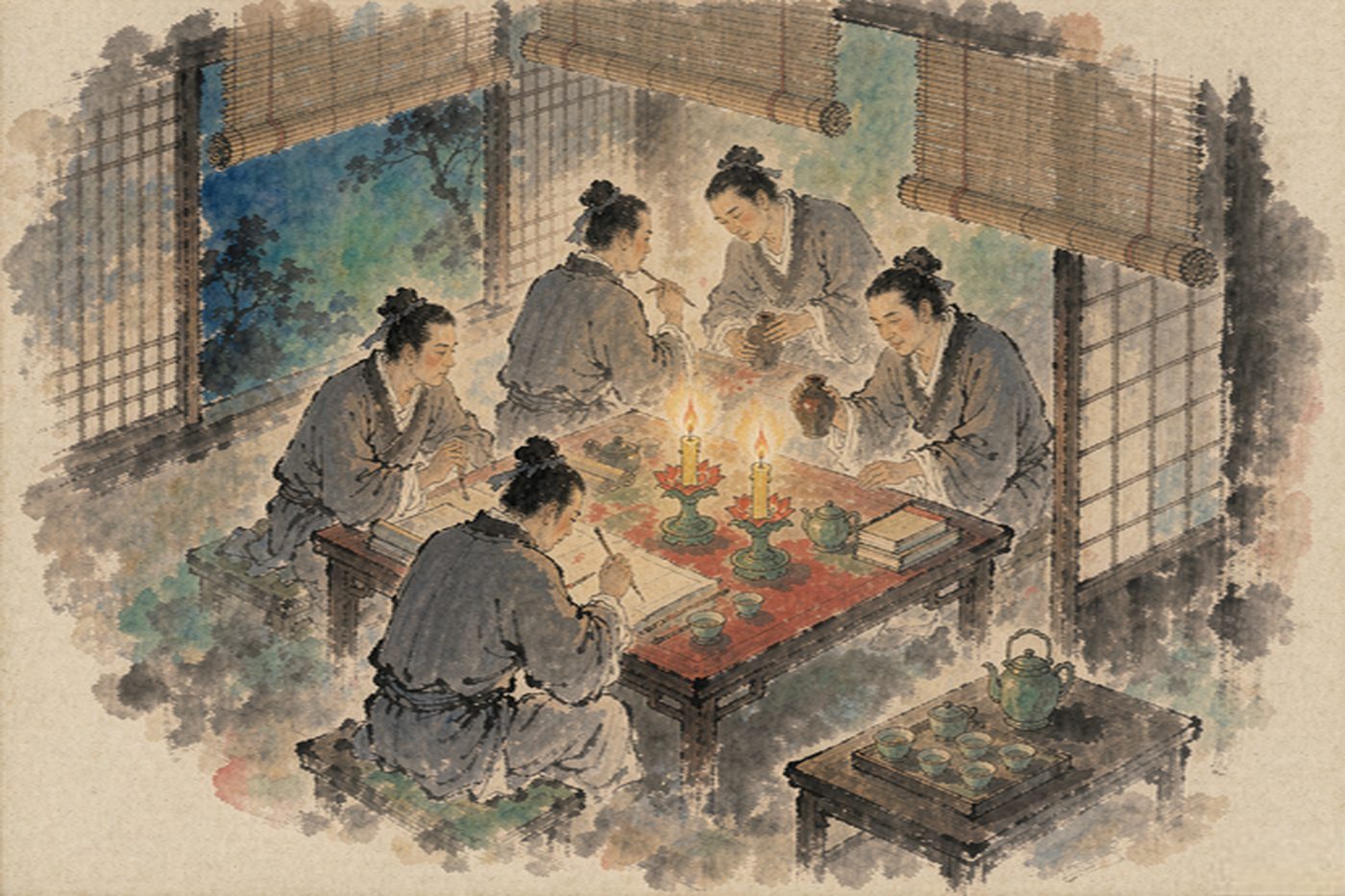
Boming had been in the habit of visiting a courtesan called Sun Xiaojiu, and he dragged us off to call at her house. Wine was set out in her upstairs room. The night moon was bright as day and fell straight across the rail and the table. The two candles by the inner partition had knotted into flower, brilliant as a string of pearls.
Sun was shrewd by nature and knew how to handle an occasion. She addressed the company:
“Tonight the moon is pure, the candles show a lucky sign, and you five gentlemen have all matched your skill at the secretariat. That you will be entered on the high list admits of no doubt. Let each of you compose one song-lyric to record the fact, so it may be a good story another day.”
And she fetched five sheets of Wu paper and laid them on the table.
Shengfu, Yingxian and Shunju all excused themselves. Boming, bright and quick, took up the brush and wrote a Huanxi Sha:
A hasty cup and plate, calling on a girl of jade; the lamp has flowered for luck, and spring comes to the seat. She asks her gentleman for a line — and wants it strange and new. Eyebrows faint, eyes tender, the feeling flows and flows; cloud-light, willow-soft, the intent entirely true — from now on wind and moon belong to an idle man.
They passed it round and admired it. The only regret was that the last line conceded too much.
I followed with a Linjiang Shuixian:
The bright mats hold their pleasure, and pleasure is at its height; the tall house is layered with excellent air. At the hairpin’s head, in small seal-script, the candle-flower is red: it must carry good news, and bring it to the master of the house. The cassia moon at the full, the spring just at its half; the Broad Cold palace deep and green; the Lady of the Moon facing us, east of the curved rail. The cloud-ladder, I know, is not far — on level feet I mount the east wind.
Sun filled a cup to the brim and pressed it on me.
“You will certainly be placed high, sir,” she said. “This omen was arranged for you alone.”
And in the event I was indeed reported by name and granted a degree. The other four were not one of them successful.