Wen Deng, courtesy name Dao’an, was a man of Wukang in Zhejiang. At seventeen he entered the district school; he was betrothed, and the girl died before the wedding, and he went about grey with it. He took to wandering, meaning to look for a wife elsewhere.
At Fengyang he met a Daoist on the road who asked where he was bound. Wen told him. The Daoist said: “If you want a good wife, go fifteen li to the south-east and ask there. You will meet someone.”
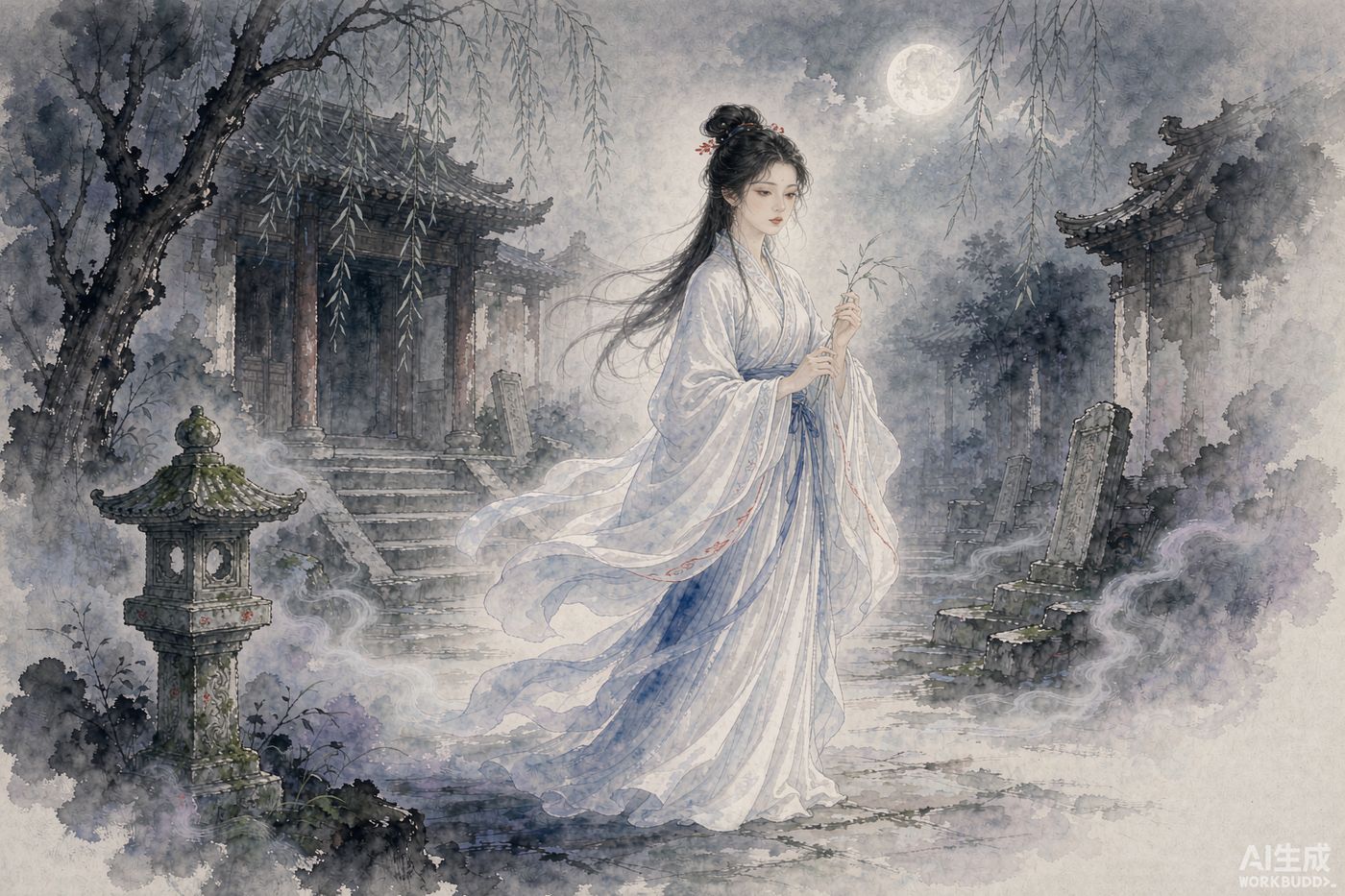
Wen believed him and went as directed. He arrived in the middle of an opera at the spring stage, the crowd packed like bees and ants, nowhere to set a foot. Looking round, he saw below the drooping willows the corner of a little red tower, and a woman holding the curtain aside, half-turned, peeping sideways. Powder and dark brows struck his eyes. He circled and stared, hardly master of himself; and when the sun slanted west and the singing ended he was still gazing up at the empty tower, not noticing that the crowd had gone.
Suddenly a hand clapped his shoulder and a voice roared: “What sort of fool is this, peeping into a woman’s rooms?”
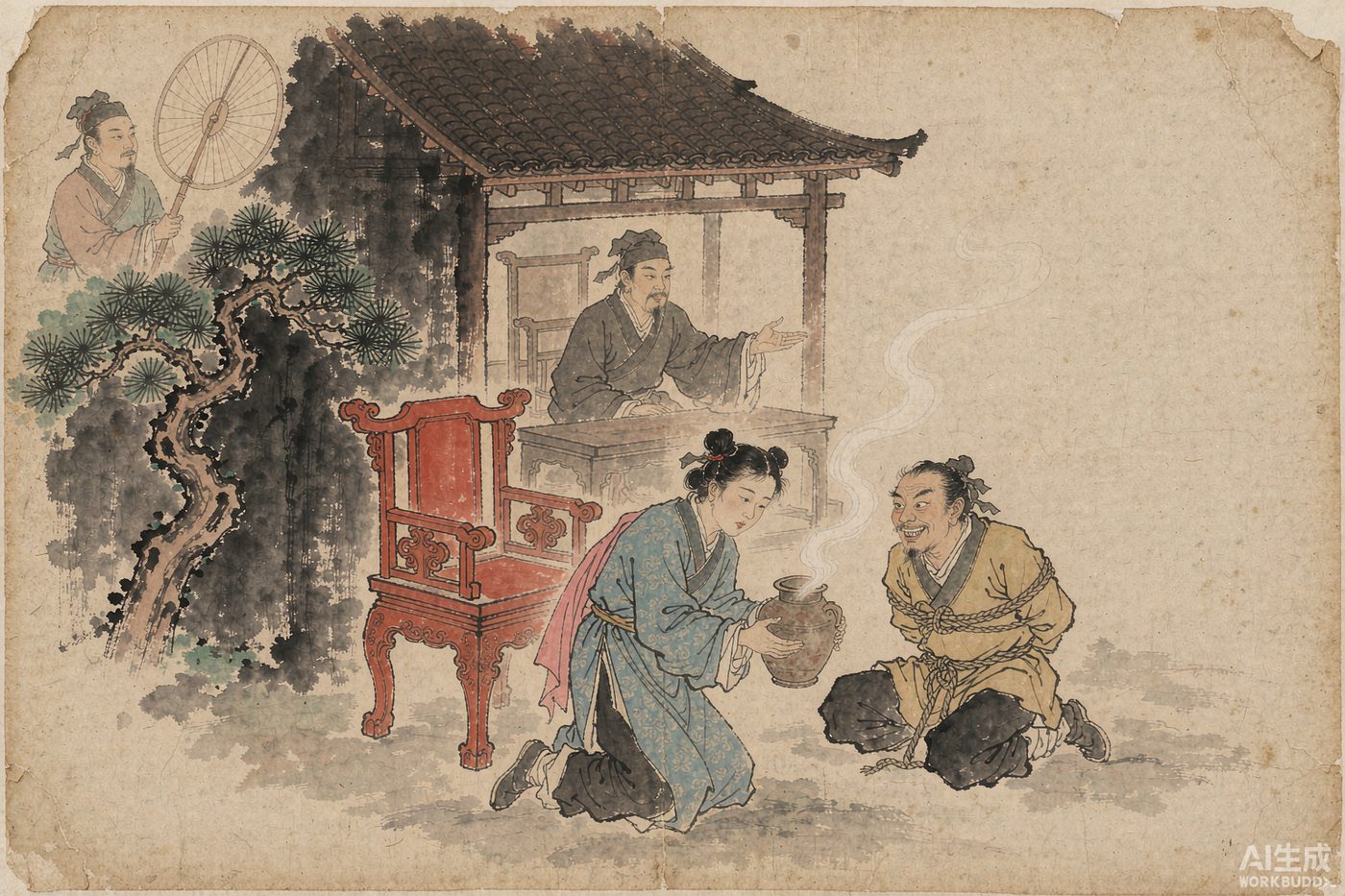
Wen turned. It was a tall, imposing man, who took his arm and dragged him into the hall. Wen’s legs shook; he changed colour and tried to run. The man laughed.
“So faint-hearted, and yet you play the mad gallant. I will tell you plainly. The girl in the tower is the pearl of my house. If you have no wife at home, I am willing to make a marriage of it.”
Wen’s fear turned to joy, and he agreed to everything.
By candlelight the girl was dressed in full, the two of them bowed to each other, and he was pushed into a side room. Then her mother called her away. Wen sat alone under the lamp. At the second watch the girl came by herself from the east of the painted screen, and at the mirror took down her kingfisher phoenix pin and her two gold sparrow flowers, and loosed the hibiscus cape and the hundred-fold mandarin-duck skirt, leaning against the bed-rail, and slipped on soft red sleeping-shoes of three inches, and smiled with her head bent, and the light went into the inner curtain.
Wen burned. He could not stop himself; he leapt onto the bed and caught at her — and there was no one. Only an embroidered pillow lay across it, and a heap of brocade quilt. He was terrified and could not begin to account for it, and lay awake all night hugging the quilt. At dawn the girl came. He questioned her. She was silent.
That night Wen hid first in the bed-curtains. Late, the girl came in a short red jacket with a gold-phoenix purple cord over it, her hair loose, a black kerchief, and she put aside the curtain and got onto the bed. Wen grabbed her arm — and she turned under his hand like a ball of crimson snow and was gone, silently, without a trace. Immortal or ghost, he could not guess which.
The girl’s younger sister Yinggu happened to pass his room. Wen, in his misery, was wetting a brush by the mirror to write. Yinggu looked and said: “You can read and write, then?”
Wen said: “Poor as I am, I entered the school at fifteen. What scholar’s house has a man who cannot read?”
Yinggu gave a cry and a sigh. He pressed her, and at last she said: “I pity you — a young man of talent, with your death already close, and you do not know it.”
Wen knelt to be taught.
“My father and mother live by the left way, taking people’s goods by force. Before every job they must kill one man, to sacrifice and open the road. They hang my sister out as bait — it is called marriage, but she is never actually touched. Ever since I could understand anything, I have watched young men go from that bed to the chopping-block — I do not know how many hundreds. Tonight, when the bright stars blaze, it will be your turn.”
Wen was desperate and knocked his head for help.
“I cannot save you. To loosen the noose you need my sister herself.”
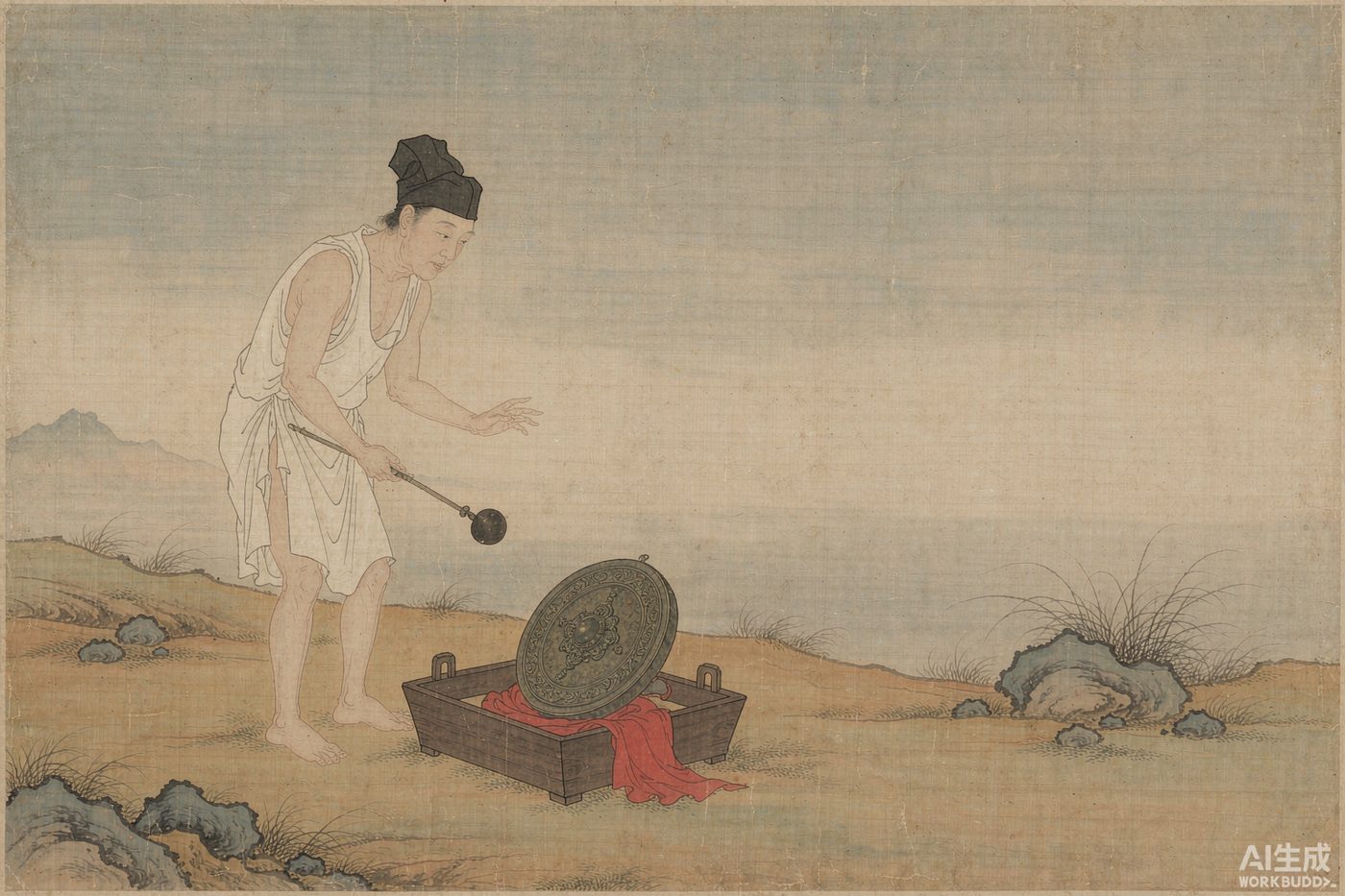
She told him the trick: “The reason she vanishes the moment she is on the bed is that a liujia talisman is pressed under the mattress, wound about with thirty-six strands of lamp-green silk. Search it out and throw it away, and she will not be able to get free. If you become man and wife in truth, and then plead with her out of that bond, she will get you out of this.”
Yinggu slipped away. Wen lifted the mattress. It was exactly as she had said. He threw the thing out.
That night the girl came. He waited until she had undressed and got onto the bed, and held her; and she seemed to know.
“That chattering child has ruined my family’s business. And yet — it is heaven’s will too.”
Afterwards Wen knelt naked at the bed-head and begged her to save him. She said: “A hundred years of marriage, and I follow you through ten thousand deaths. Why did you need to ask?”
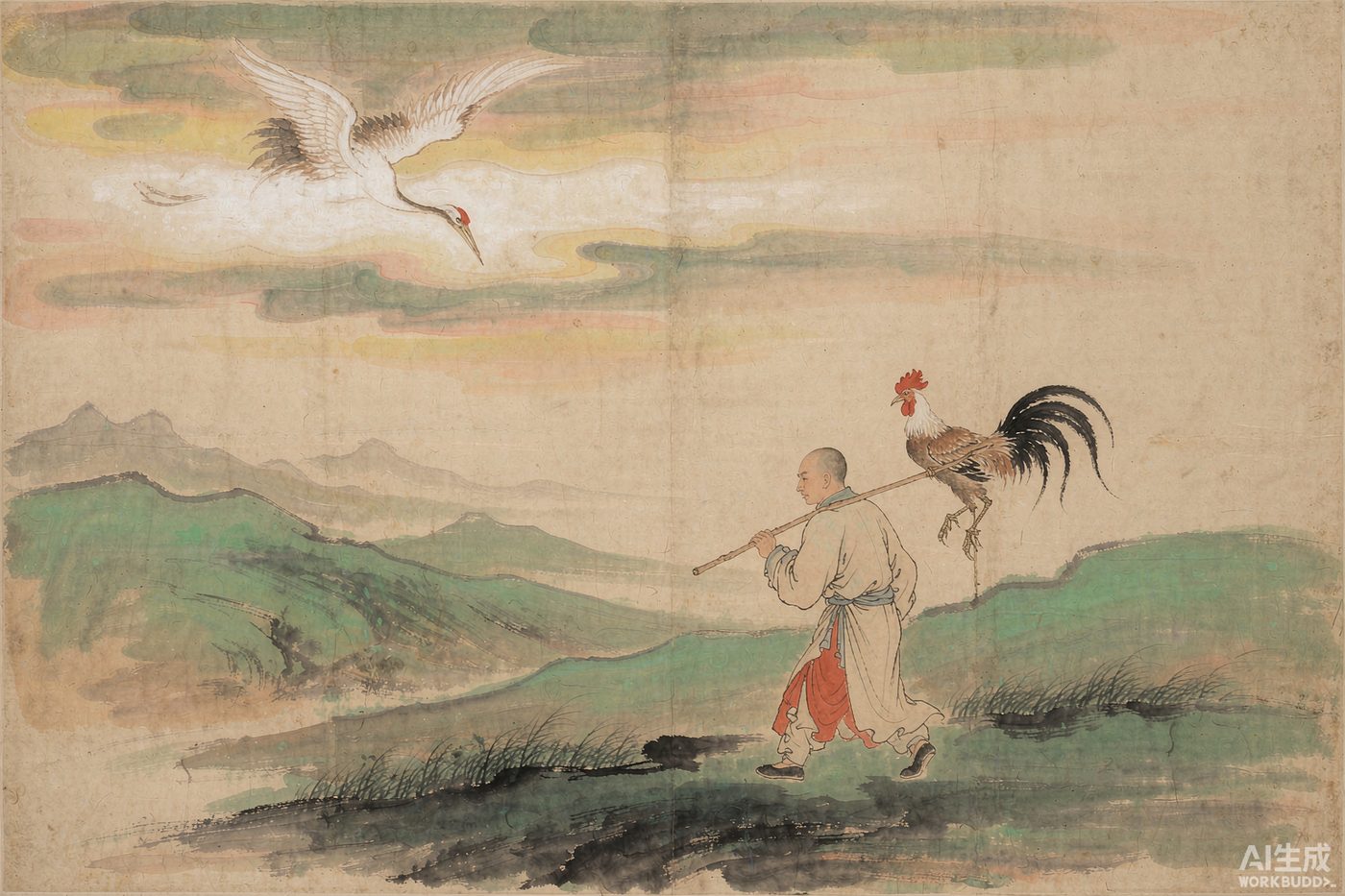
She rose, tied a rooster to the end of a staff, and told him to carry it on his shoulder. “Go north about thirty li. The moment the rooster crows, drop it and run on. Twenty li further, wait for me, and we will go on together.”
She then told her father, pretending alarm. Her father flew into a rage and mounted to pursue. She said: “You will not catch him. Better to cut him down with the flying sword.” He took her advice and flung the sword into the courtyard; it went out like a white ribbon.
Wen had left the north gate and gone some thirty li when the rooster on the staff crowed loudly. He threw it down. A white light stabbed downward, and the rooster was silent. Another twenty li and his strength failed; he rested under a tree, and saw a crane fall out of the cloud with the girl on its back. Folded up, it was a paper crane.
She laughed: “The great calamity is past. Let us go home.”
Wen said: “But what of your father?”
She said: “The left way has no long reach. Beyond fifty li it cannot touch us.”
Within the month they were back in his own country. He locked his door and read; in his leisure he played guessing-games with his wife.
One day a girl burst in. It was Yinggu. They asked why. She said: “After my sister left, my parents forced me to take her place. I would not, and it angered them, and I was whipped daily. Luckily my father went off to a demon assembly, and I escaped in the interval. I am alone and weak, with no kin to turn to, so I came all this way to you.”
The wife was overjoyed. Wen said: “Your sister coming is well. But neither crow nor phoenix — how shall we place her?”
His wife smiled: “I am not the jealous sort, and you owe her a debt. The precedent of Ehuang and Nüying is there to follow.” She brought out hairpins and did Yinggu’s hair for the wedding.
Yinggu blushed and refused: “I came to be a cold swallow at a quiet gate, not a wild duck joining the mandarin flock.” It took plain arguing before she agreed.
They were just about to make them bow to each other when a Daoist came in from outside, smiling: “My word about finding a wife — has it proved out?”
The two girls looked at each other and said in alarm: “This is our father’s master.”
He said: “It is. Your father failed at studying immortality and slid into the left way, and then borrowed the flying-talisman and遁甲 arts of my teaching to serve his wickedness every day. I corrected him sharply; he has not repented in the least, and one day he must be wiped out. I grudged that the girls, who are innocent, should be slaughtered too. So I drew this young gentleman into the net, and by roundabout means pulled you both out of fire and water.”
The girl asked: “Are my parents unharmed?”
The Daoist said: “In this very moment of idle talk, your whole family is being bound.” The two girls wept. He said: “It is their own evil coming home. Why weep for them?” And he shook his sleeve and left.
Wen afterwards quietly enquired, and indeed on that day the family was hunted down by government troops and beheaded at the western suburbs.
The Duo comment: In the city of the transformed there are many demon-gates; but the ghost-mother’s children end in the great bodhisattva’s lotus bowl. One day they turn their heads, and both rest on the shore of the Way. That the two girls got free was by a immortal’s subtle finger, lifting them out of a bitter kalpa. To run such risk and win — how many, in any age, have managed it?