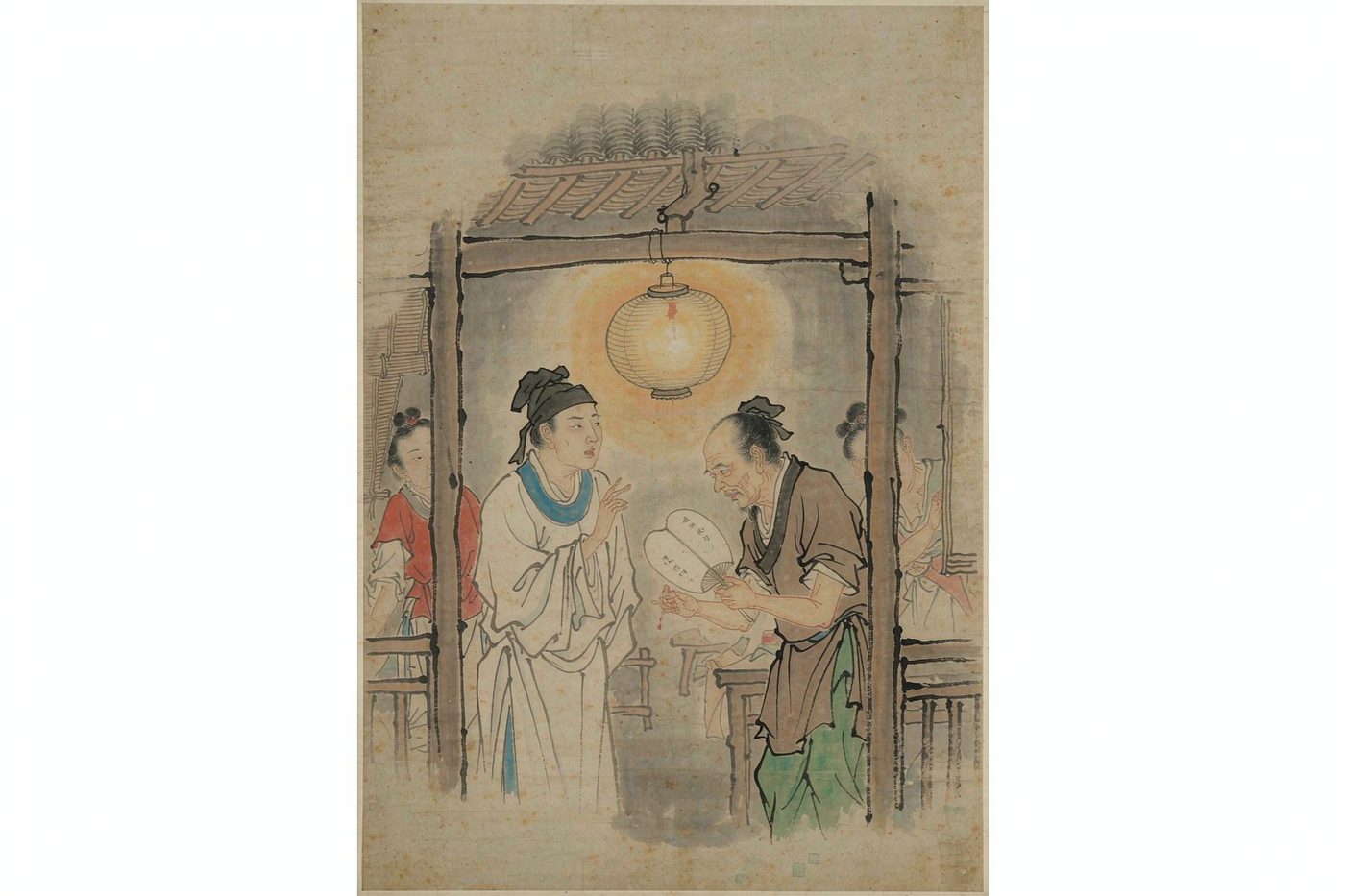
A certain Cao of Shanyang had a reputation as a writer and an extremely arrogant temper. Going to Nanjing for the examination, he lodged in the shrine of Patriarch Lü.
He rose early to study, and first burned a stick of incense before the image of Lü and addressed it: “This disciple is of muddy bone, and lodges unworthily under a god’s roof. Morning and evening his droning disturbs your ear; I hope you will not take offence.”
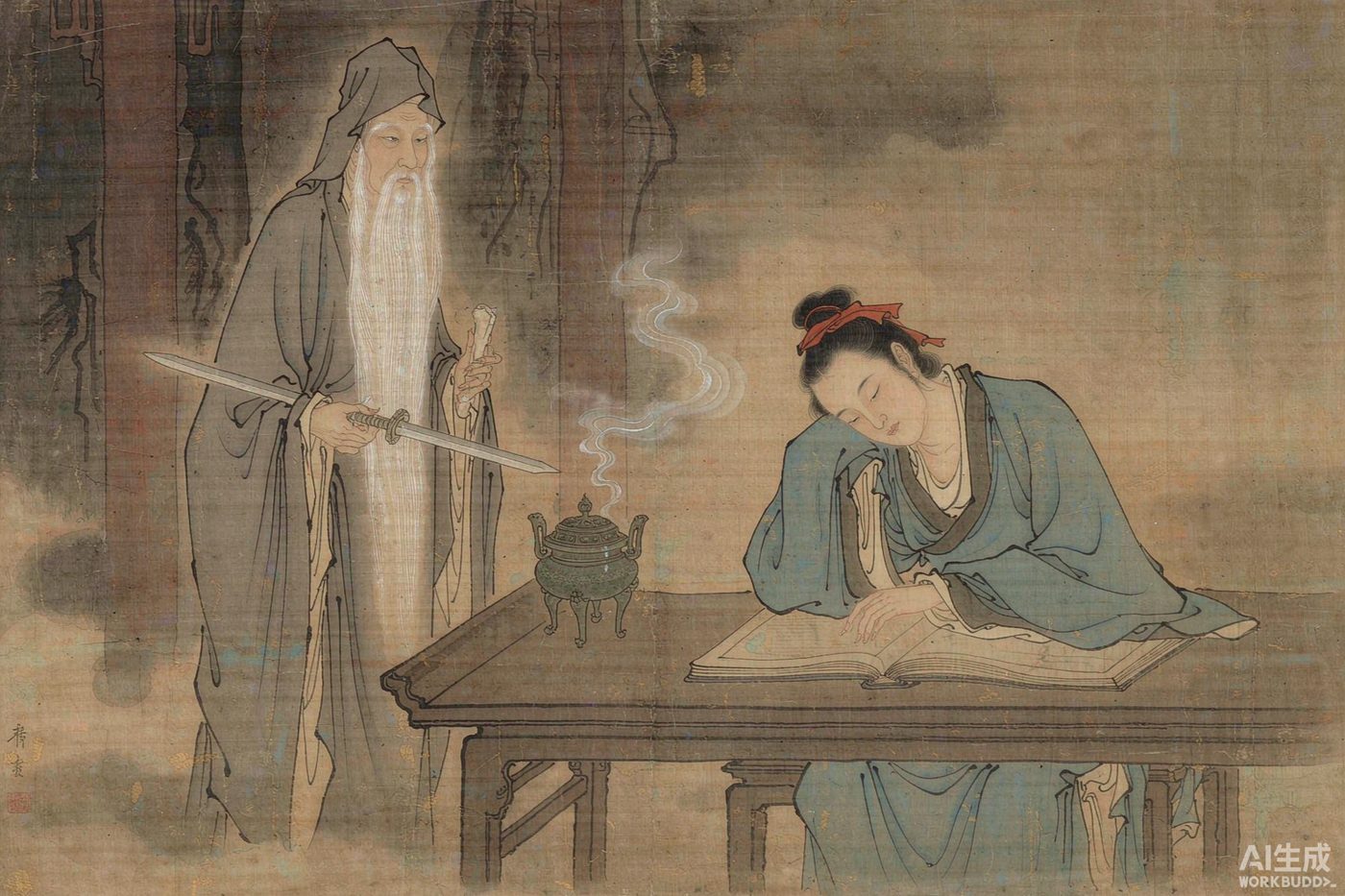
One evening, tired, he fell asleep over his desk, and saw a Daoist come in. “The scholar studies too hard,” the visitor said. “This time you have thrown away the lucky robe.” Cao made him sit.
The Daoist talked with great spirit, pouring out the Five Classics and the Histories like water from a jug. Cao was astonished. “When I worked at examination prose,” the Daoist said, “I too shut myself up to read, and shamelessly became a presented scholar; and I gave it up. When I look back to those nights of holding a book, the wind cold enough to split a robe, the lamp low and my head knocking against the pillar, it all seems like a dream of yesterday.”
Taking him for a senior, Cao produced his own essays for correction. The Daoist had read two lines and put them down. “Do my writings soil your eyes?” Cao asked. He answered with a laugh: “Precisely because they cannot soil my eyes am I unwilling to read them. Your writing has the air of the two Han capitals — at the least of Han Yu’s tide and Su Shi’s sea. But to hunt office with this is like trying to sell a Shang ritual vessel or a Xia cauldron in the market of a great city: not that it is not precious, only that few are there who can tell.”
Then he took a volume from his sleeve. “This is the raft of treasure for examination success. Study it respectfully.”
Cao snatched it up. It consisted entirely of the things he had always despised and refused to write. He was furious: “When we write, if we do not outlast our age we mean at least to be named in it. To pick up a degree with this, I would sooner drown myself in the Eastern Sea. I cannot obey you.”
“Ah,” said the Daoist. “You have an arrogant bone. Unless it is pulled out, you cannot be saved.” He whipped out a sword, cut into the back of Cao’s head, found a bone, and took it away.
Cao felt the pain keenly, and woke with a start. On the desk a volume was lying. He left it alone.
Next day he looked over his old drafts and liked none of them. He picked up the book from the desk, read it, and was delighted. He studied it morning and evening, and rejoiced to find it worked. Then he went into the examination compound, and every essay he wrote was modelled on the book’s patterns. When the list went up he had taken the highest place.
One night the Daoist came again in a dream, put the bone back at the back of his head, and went away. Waking, Cao looked at the essay that had won him his place — and his face burned red and his back ran with sweat like rain.
He went back to the ancient writers and studied them. In the end he died a provincial graduate and nothing more.
— The author’s comment: those who fail console themselves by saying that mediocrities take the prizes; the immortal’s method is to let the critic taste the prize himself, so that he shuts his mouth and loses his nerve. Pulling out the arrogant bone is better than pulling out the tongue.