Zhang Yuan, the great merchant of Wenzhou, came of a family of sea traders. For several decades he had gone back and forth, and never once missed his season.
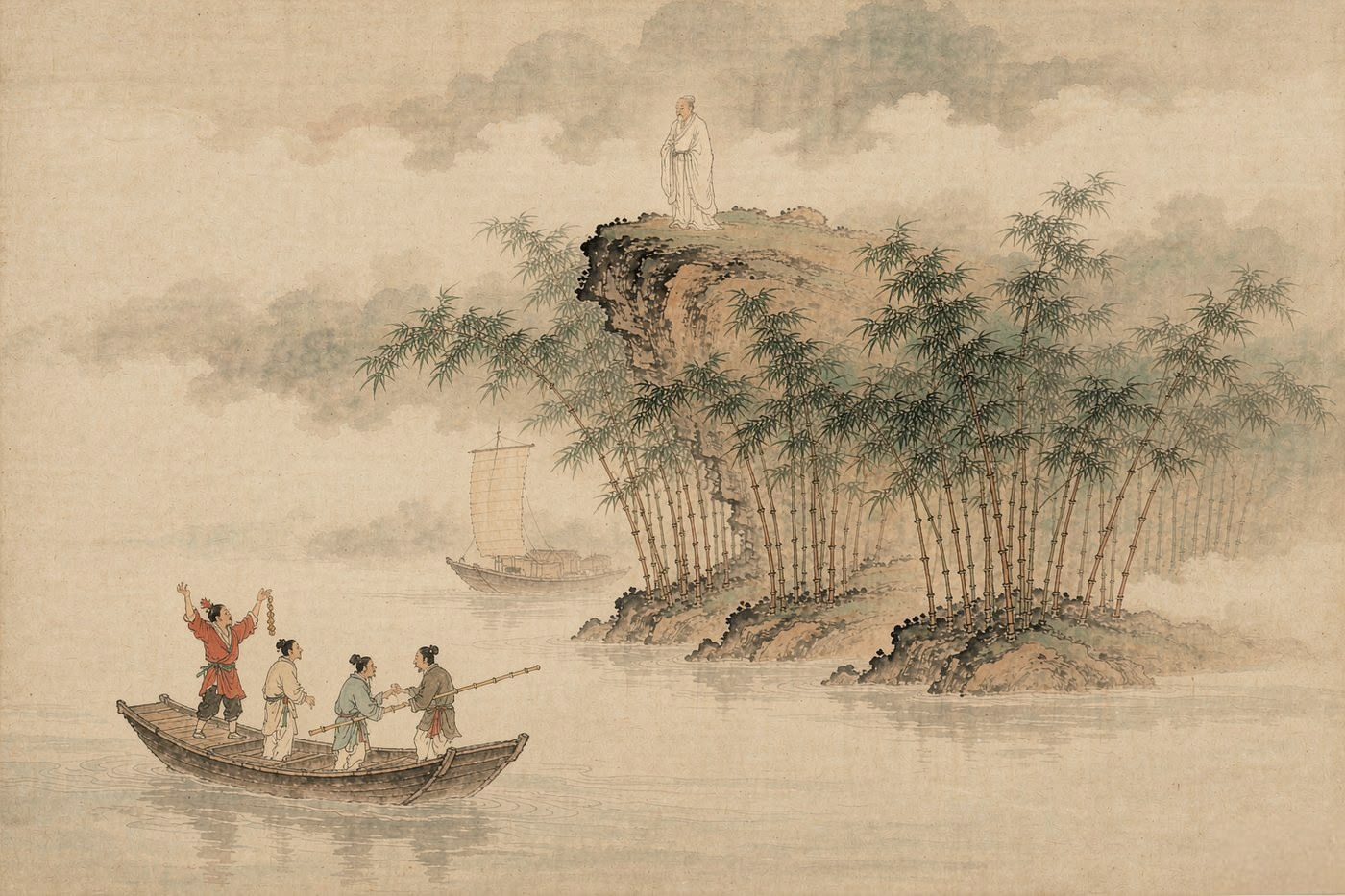
In the seventh year of the Shaoxing era he was crossing the open ocean when a wind took his ship and drove it he could not tell where. After five or six days he came to an island: tall bamboo scraping the clouds, filling the eye as far as it could reach. He went ashore and cut ten canes, meaning them for poles and sweeps.
He had just finished when he saw an old man in a white coat.
“What age do you think this is?” the old man said. “This is no place for you. Go back at once. Do not be slow about it.”
The crew folded their hands to him. “We have lost our way,” they said. “We are about to be buried in a fish’s belly. If the immortal sir would be kind enough to tell us how to reach our own village —”
The old man pointed to the south-east, and in the end they got safely home.
Nine of the ten canes had by then been used up for one thing and another. As they were coming alongside, there were Japanese traders and Kunlun seamen on the quay who saw the mast, beat their breasts and cried out — what a waste, what a waste — without stopping.
Once the hawsers were made fast, they crowded to stare into the boat. They saw the one remaining cane, and they all wanted to buy it.
“Name any price,” they said.
Zhang saw they were set on having it, and tried them at two thousand strings.
“Good,” they answered, all together, and fetched the money then and there.
“This is a treasure,” said Zhang. “I was only joking. Five thousand strings, or let us not discuss it.”
The Kunlun man was the more delighted of the two. He paid the sum, had the cash carted over, and only then did they draw up the contract.
When it was settled, Zhang said: “The bargain is struck and cannot be gone back on. But the truth is that I do not know what treasure this is, that you should compete to buy it like this. Tell me.”
“It is the treasure-gathering bamboo of Mount Potalaka,” they said. “Stand the pole up in the great deep, and every kind of treasure gathers to it without being fetched. I have spent my whole life going down to the sea in ships. I look on towering whale-waves as if they were flat ground. But I knew only the name of this bamboo. I had never seen one. For a thousand, for ten thousand, I would not have grudged the price.”
Then Zhang sighed, and handed it over.