Qinger was a girl actor of the Liang family troupe in the Pearl Market. Liang’s wife had been a Wu singsong-girl, skilled at the pipa; after she married Liang she bought young actresses and taught them opera to live. Qinger disdained it and often ran from lessons. The foster-mother beat her daily; the sisters urged her. Qenger said: “If you follow me, you must change from the female lead to the painted-face.” Asked why, she said: “I was born a girl, with grievances I cannot vent. If I play the painted-face, I can borrow a hero’s face to pour out the blockage in my chest.” And so in the 千金记 cycle Qenger alone topped the cast.
The successful candidate Zhan Xiangting, awaiting appointment at Baimen, lodged with friends at Liang’s. At night they performed the 千金记 through to the Farewell-My-Concubine scene; the girls all favoured Yu Ji, but Zhan alone found the Chu double-pupil — Xiang Yu — charming, and all laughed at him. When she removed her makeup, the old King Xiang’s looks indeed surpassed the beauties under the canopy, and Zhan sighed in admiration.
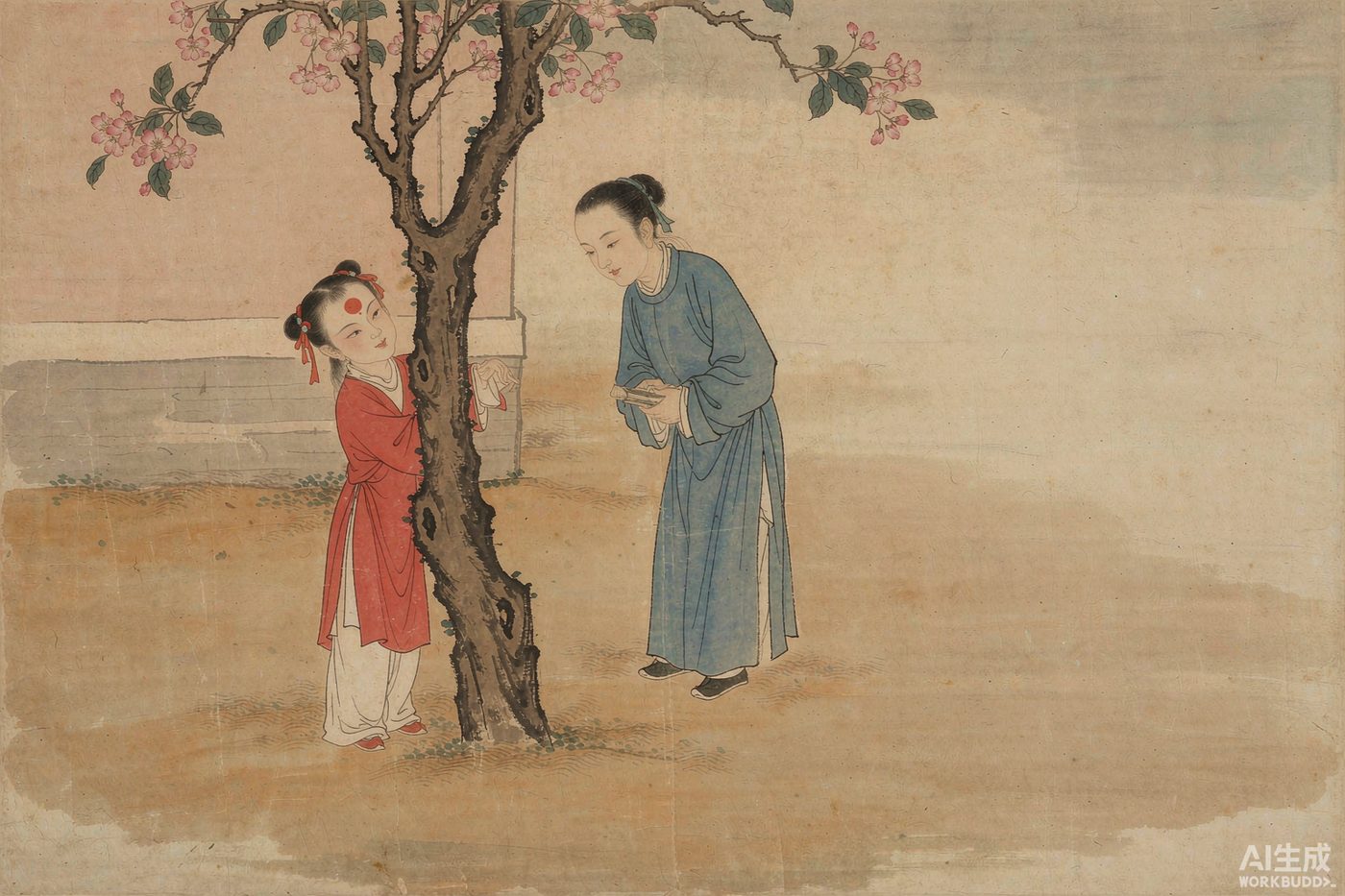
Next day a feast was spread beneath the crabapple; blue-robed and red-powdered sat intermingled. Qinger was from She, Zhan from Wuyuan; the two spoke their own dialects, telling of their admiration, while the friends only smiled, not understanding a word. Then Zhan, with brow and eye, could not win a mid-rank post, and the friends left the table; but Zhan had not packed, his heart still with Qenger. He thought to buy a peach-leaf boat and take her home. But the Liang family held her as a rare commodity and wanted to keep her as lead — nothing short of a fortune in tips could move them. They faced each other in tears, no plan.
Qenger whispered: “Why so clumsy? The reason they hold her dear is that I am their cash-cow! If you leave, I surely will not live. Keep the fine bones and buy her — it will not cost a thousand.” Zhan was grieved; reluctantly, they parted with ceremony.
Less than two months later, word came that Qenger was ill and dying. Zhan said: “The promise before the flowers — as faithful as holding the pillar! You did not fail me; how dare I fail you?” He rushed to Jinling, bought her coffin for three hundred taels, and brought it home, burying her north of Tongjing Bridge. Lady Wang Cao Moqin wrote her epitaph; famous men sent elegies; I myself wrote the 千金笑 legend for the troupe. Alas — could not live together, but returned in death. Is this not the extremity of a passionate heart? And Qenger, from this, never died.
The Duo comment: A man with a seven-foot frame, dull and without noble conduct, ends rotting with the grass — why in the inner chambers is there one who transmits her name? Only by not failing the death-promise and living can one embrace life and die. At the same time there was a He’er who gave a portrait of Ma Xianglan to a Zhao of Wujiang — also a wise-hearted girl — and later followed a wastrel, widowed in half a year, still leaning on a foster-mother to sell the pipa. Alas! The peach has fallen on Xue Tao’s grave, the swallow returned empty to Guan Pan’s tower. He’er’s life is not as good as Qenger’s death.