Min Chu, a monk of the Fayun Temple in Guangling, was often on close terms with a merchant named Zhang of Zhongshan. Zhang died, and Chu held fasts and recited scriptures for him for several months.
Then one day he met Zhang in the market. Chu had not eaten, and Zhang invited him into an eating-house and bought him some sesame cakes. When they had eaten, Chu asked: “You are dead. How can you be here?”
Zhang said: “I had some small sins and did not avoid them. Now I have been assigned as a ghost who seizes surplus in Yangzhou.”
“What is a ghost who seizes surplus?”
“The profits of officials and merchants all have a fixed amount. Whatever you gain beyond the fixed amount is the surplus, and I seize it and hold it. There are many of my kind in the world of men now.” And he pointed at people in the street. “So-and-so and so-and-so are all of us.” Presently a monk passed, and Zhang pointed: “This monk is one too.” He called him over and spoke to him a long while, and the monk also vanished.
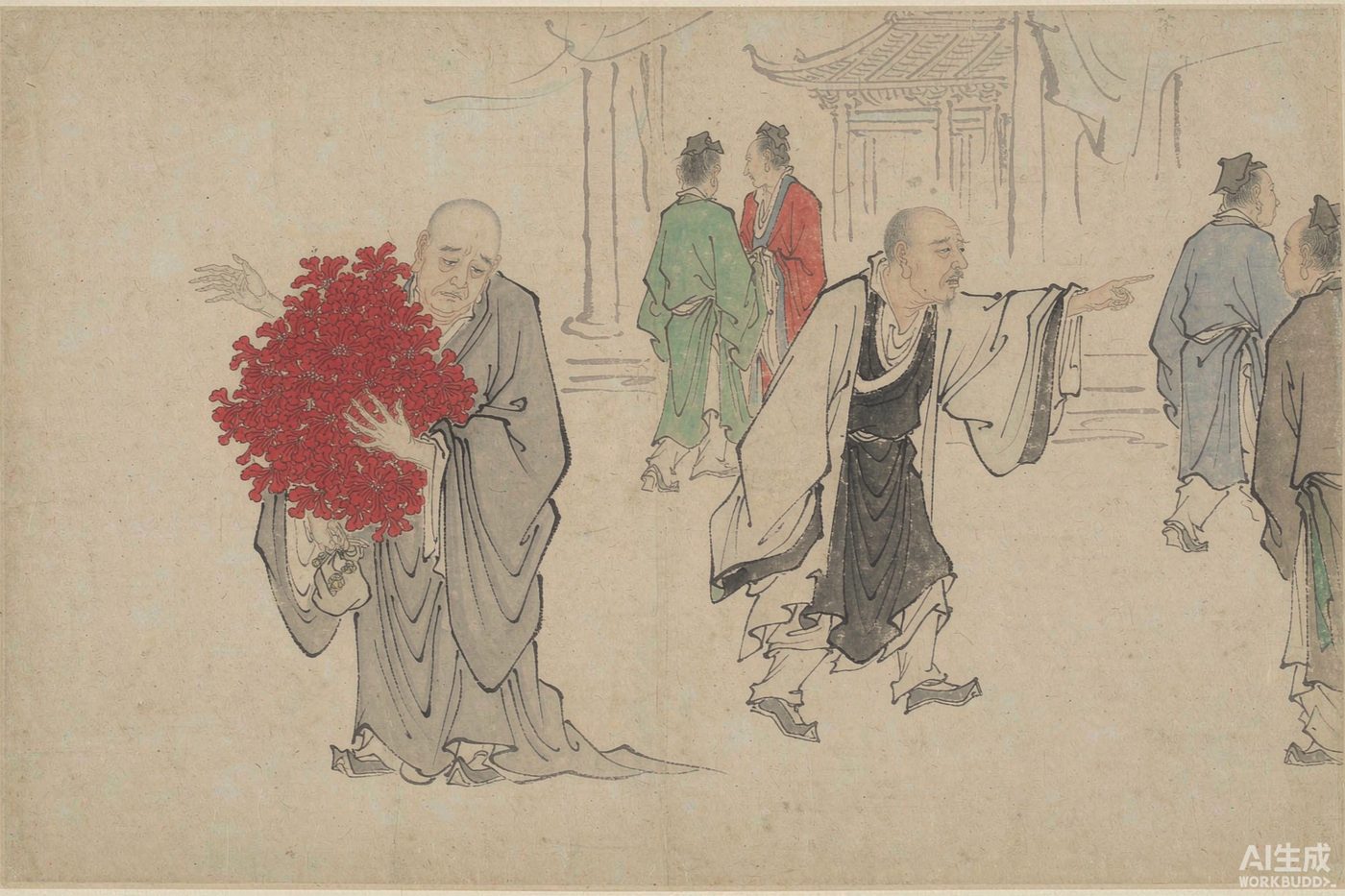
Chu and Zhang walked south. They met a woman selling flowers, and Zhang said: “This woman is a ghost too, and the flowers she sells are flowers for the use of ghosts. People have no use for them.” Zhang took out a few cash, bought them, and gave them to Chu. “All who see this flower and laugh are ghosts.” Then he took his leave and went.
The flowers were red and lovely, but very heavy. Chu also went home in a daze. People in the street who saw the flowers laughed at quite a few of them. At the north gate of the temple he thought to himself: I have walked with a ghost and carry ghost flowers; this is distinctly unlucky, and he threw the flowers into the ditch, and there was a splash.
When he got back, the monks of his own courtyard thought his colour was very strange, took him for possessed, and vied to save him with soups and medicines. After a long while he came round and told them everything, and they went together and looked at the flowers again.
They were a dead man’s hand.