Ma Dian of Wu could write verse and was a master of song and aria, but his name had never got beyond his own lane. Hunger drove him out and down; he drifted to Yangzhou and presented his poems to every man of consequence there, and in three years met with nothing at all.
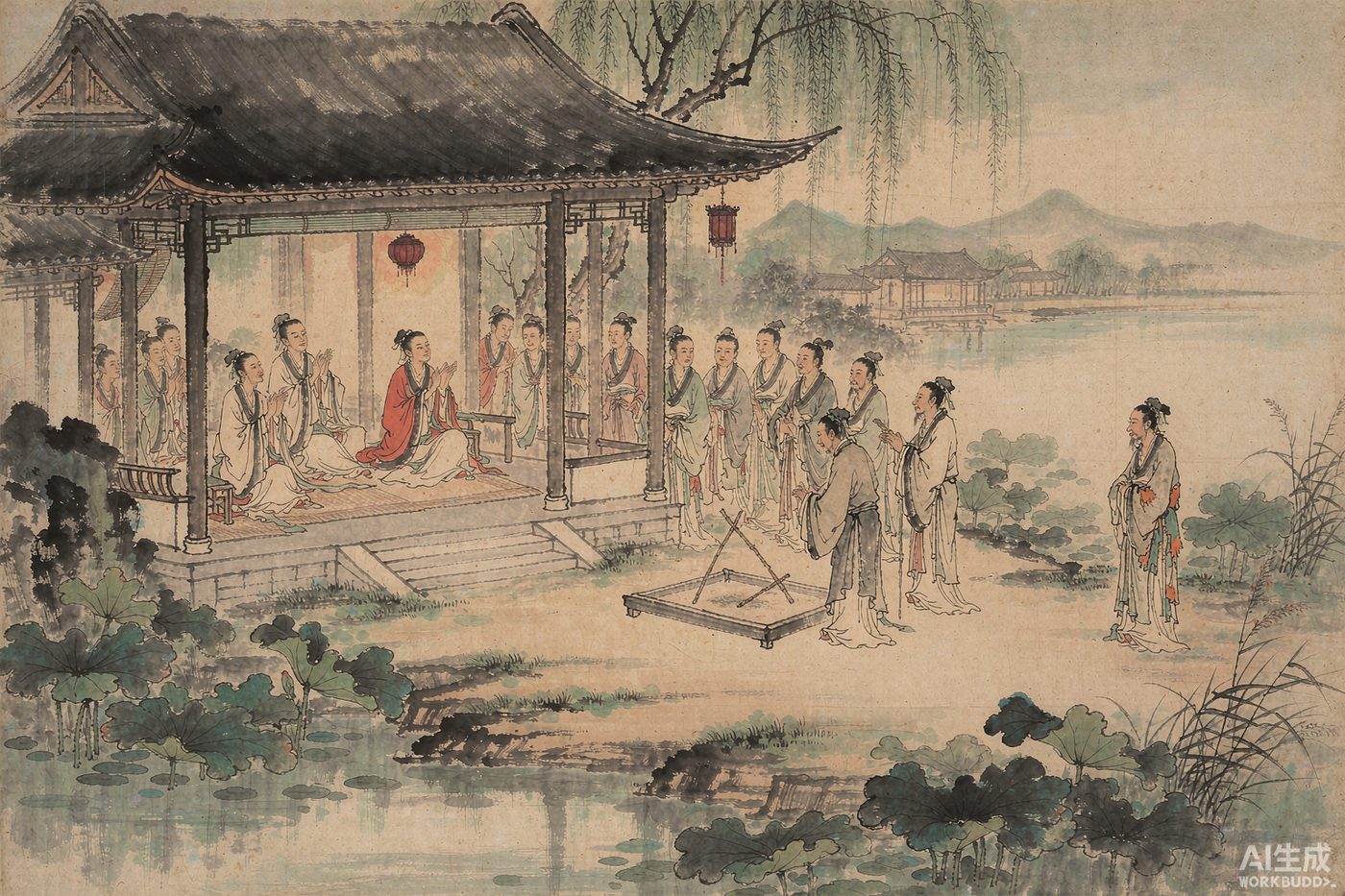
It happened that the lotuses were in full bloom at Rainbow Bridge, and a salt merchant laid on a feast in his garden and invited every famous scholar then staying in Yangzhou. Ma took his manuscript under his arm and went. The gatekeeper tried to stop him; Ma pushed the gate open and walked straight in.
The company clamoured to know who he was.
Ma said: “A poor scholar of Wu. In youth I learned the planchette. Now that your noble guests fill the hall, let me offer my small skill.”
Planchette-writing was then at its height in Yangzhou. They borrowed a sand tray and the rest of the apparatus from a neighbour and set it out in the courtyard. Ma wrote a talisman and burned it and chose a servant to hold the other arm of the fork.
The planchette suddenly flew into motion and wrote out twenty-eight characters:
Through the scent of lotus the road runs far; I had meant to set a poem to the jade flute. I have walked all of Pingshan and found no man there — I turn back to my small table and cross Rainbow Bridge.
They asked for a signature. It wrote: “I am Kang Duishan. I came by chance to call on a poet, and idled as far as this.”
The salt merchant threw himself face-down on the ground. “The zhuangyuan has come!”
The others knelt too. “Your eloquence has long been before our eyes. We have seen one spot of the leopard; let us see the whole.”
The planchette wrote: “I have forgotten more than half of what I wrote in life. I have four New Music Bureau songs on Yangzhou. Correct them for me.”
The first ran:
Borrowing from the god
Borrow from the god, bow to the god — the God of Wealth has promised me a thousand in gold. I take no idle office, I keep no shop; I buy children and teach them to sing and dance. The child sings one song and yellow gold heaps the house full; the child dances once and Shu brocade stands higher than the terrace. The red candles waver, the spring night is short, and a thousand houses and ten thousand are poured away. Pour out your wealth, ruin your house, and do not fret — you have the God of Wealth for creditor.
The company applauded; the salt merchant clapped in time. Ma looked away and smiled.
Then someone noticed a little pottery monk sitting cross-legged among the wine cups on the table, and asked the spirit for a verse on it. The planchette wrote:
In youth I wore the scholar’s cap; I was never practised in the inner canon. I came here with Master Wugou of Wugong. Let him take the brush.
After a pause it wrote again:
I am Wugou, guest-monk of Wugong Mountain. The zhuangyuan invited me. What do the laymen want?
They pointed at the cup.
I took the barque of mercy by mistake and came back over the sea; wind and wave rose and cut away the preaching terrace. Years of expounding the law have come to an empty form — I would charm the lotus pool into a wine cup.
Bodhi dew drips into the tavern vat; drunk, I fall across the meditation couch, the breath not yet subdued. With a sober eye I laugh at all you sons of the Buddha: could any one of you swallow the Western River in a single gulp?
And then: “The zhuangyuan has brought a singing-girl. This little monk withdraws.”
They asked her name. It wrote: “Bian Shuniang — the one I meant in my Invitation by ‘the kingfisher skirt at the Qin tower.’ She learned the lute from Chao Siniang; she is exceedingly musical, and she also loves to study the amorous manner of the Golden Quince, and does not disgrace good taste.”
Now it happened that two men of the company had been circulating thirty lyrics to Green Spring and asking every poet south of the river to match their rhymes. The scholars brought out the original sheets and begged for an answer.
The planchette wrote: “You are all men with names, and yet you are brought to a halt at the seventh pace, and come begging inspiration from dancing skirts and song fans? Very well. I will chant them for you.”
West wall of the Ruan house, east of the Song house, a strip of thin blind, like a dream. In the deep court the turtledove-wife rain brews the flowers; at the painted rail the peony wind stirs the willows. She finds the vase too plain and adds mountain purple; she hates the screen for its cold and changes it to sea-red. The sweet grass goes green at the south shore year after year, and turns the grief of parting into an annoyance to Jiang Yan.
Seven of them it wrote before the scholars were scrambling for brushes and inkstones, copying by hand and memory at once, while the fork ran on like flying and the rest could not be caught entire. Only fragments survived:
The hooked latch is fastened against the dew-damp eye; the private hand is taught by stealth to try the amorous mood. How many nights of flower-wind before the night-closing tree; morning after morning the grain rain passes the spring equinox.
My friend Liu Dongli was present, and brought out his painting Gathering Lingzhi and asked for a song to it. The planchette ruled: “This child’s wrist is already lame. Why will you not be reasonable with her? Besides, it is not her strength. Your play The Wolf of Zhongshan is famous in every theatre — why not trouble him again?”
Silence for a long while. Then:
Ridiculous child, forever running out on your literary debts. Very well — I will spend my last courage on Mr Liu.
And it poured out a long dramatic song: a hermit on the mountain with a boy to sweep the path, gathering mushrooms, refusing the elixirs of immortality, laughing at Ji Kang who tried to nurture life and at the Yellow Lord who gave up grain, and ending — call it Gathering Lingzhi and it is the very stuff of becoming an immortal. When it finished, Liu knocked his head in thanks.
The salt merchant said the zhuangyuan’s carriage must not be kept waiting, and had Ma write a sending-talisman. Then he marshalled his guests to table and placed Ma at the side.
At the table they praised one another without end. Some threw back their throats and beat time and chanted the verses aloud.
Ma could not bear it. He said: “There is not one line in what the spirit wrote to startle a man like Xie Tiao’s. Why are you all prostrate before it?”
They shouted at him: “A well-frog dares slander the sea. This is merely a madman.”
The salt merchant said: “He plainly does not understand. How could anything written by the zhuangyuan be wrong?”
Ma said: “Do you take me for a man outside the gate? I have a wretched manuscript here. Let me lay it before you for the axe.”
The scholars barely glanced into it. “This is the sour stuffing of a poor Confucian. It does not deserve the name of poetry.” They read on through several pieces and said all were bad.
The salt merchant said: “A cold beggar’s verses — where would the excellence be? Gentlemen, do not dirty your eyes.”
And they all set to with mouth and hand, tearing it to pieces as thoroughly as they could.
They read on to the back of the volume. The quatrain he had written in the sand, and the four New Music Bureau songs, were there in the book.
They said nothing. They looked at one another, and their faces changed.
Ma struck the table and stood up.
“You are all of you mediocrities — the well-frog slandering the sea, in very truth. I have no talent, but I have been foolish enough to pride myself on my writing, and I did not think that three years of wandering would not bring me one man who could hear it. I judged that the famous of our day look for poetry only beneath the gauze official’s cap. So I married my work to the name of a zhuangyuan, to make the writing rise in price. And indeed: a black-robed monk of a square fathom, a pretty thing from the blue houses — let them set brush to paper and everyone cries prodigy; let them find a rhyme and everyone calls it a masterpiece. So I counterfeited a beauty’s name and falsely marked it with a Sanskrit word, so that the eyeless crowd might echo along and not presume to pass judgement. To judge a poem by the name attached to it is an accumulation of ages. Without a Jiufang Gao, how is a horse to be known past mare and gelding, past black and yellow?”
The scholars sweated, and their breath failed them, and they turned their faces to the wall.
The salt merchant held his belly and roared: “The Wu trickster — now I believe it.” He hurried to seat Ma at the head of the table, and they vied to fill great cups for him, and asked him as a favour to say nothing of it.
Ma laughed. “The monthly judgement of the poetry world — the whole age is like this. Why should you be singled out?”
They toasted and were toasted and parted in great good humour.
Afterwards the scholars of Yangzhou pushed Ma forward as their leader. The salt merchant’s household competed to have him as a guest, and gave a thousand in gold to support his family. But once his ability was known to be great, his calculations grew coarse, and he could never sing “Weicheng” again.
The Duo comment: “Duishan rescued me — even a man with ambition has his regrets; how much more when he is borrowed as a scheme against poverty. First they despise, then they band together. When the poetic gut is filthy, when is it to be washed clean? I should like to take up the Kang family drum and beat the Three Strokes of Yuyang.”
Condensed from the original: the full tale also contains three further satirical ballads on Yangzhou, thirty matching lyrics, and a long dramatic song for the painting — roughly a third of the whole has been omitted here.