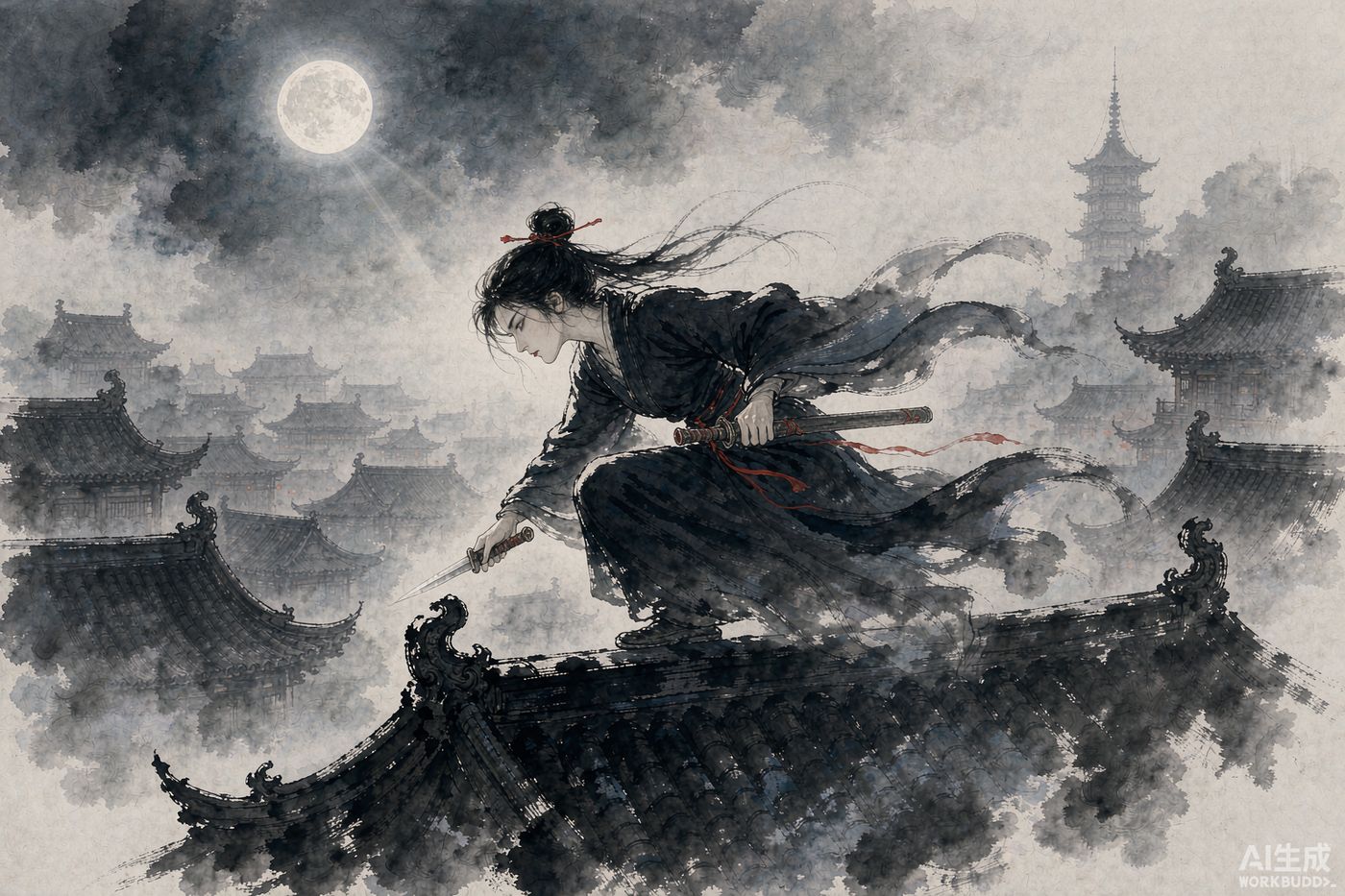
Nie Yinniang was the daughter of Nie Feng, a general of Weibo, and in the Zhenyuan era, when she was ten years old, a nun came begging at the gate. She saw the girl, and something in her face pleased her. “Give me your daughter,” the nun said to the general, “and I will teach her.”
The general roared at her and drove her off. The nun only said, “Keep her in an iron chest if you like — I shall steal her all the same.”
That night Yinniang vanished. They searched the province and found nothing, and her parents wept for her, and five years passed. Then one morning the nun returned the girl to the gate, said “Her teaching is finished — take her back,” and was gone before anyone could speak.
They asked the girl what she had learned. “At first only scripture and charms,” she said. Her father would not accept that, and pressed her until at last she told him the truth, and the truth was this: the nun had taken her to a cavern high in the mountains where two girls her own age already lived, and had fed her a pill, and put a short sword in her hand. First she had climbed after monkeys, until she could run up a cliff as lightly as they. Then she had been set to killing — tigers and leopards at first, then hawks on the wing, until her dagger could take a bird out of the air and no one below would see it fall. In the fourth year the nun had taken her to a city, pointed out a man, and named his crimes; and Yinniang had brought back his head before the guards turned round, and no one had seen her come or go.
By the fifth year she could pass through a wall of guards like wind through a fence, and fold herself so small she could hide in a fold of her master’s sleeve.
The general heard all this with terror and wonder, and when she asked his leave to go out into the world, he dared not refuse her. She chose her own husband — a mirror-polisher, a quiet tradesman who could do nothing but sharpen bronze — and the general, who had imagined her married to a marshal, gave her to the man without a word, being afraid of her.
The years after are the years that made her name. The great warlord of Weibo heard of the girl-assassin and paid her to kill his enemy, the governor Liu Changyi. Yinniang crossed into Liu’s territory, watched him for a day, and came to his bedchamber at night — not to kill him, but to warn him. “I was sent for your head,” she said, “but I have seen you, and I have seen my employer, and I will serve you instead.” Liu, who was no coward, asked what protection she could offer, and she answered that she needed no salary, only rice.
Her old master, learning of her defection, sent killer after killer. First came a swordsman on a white falcon — Yinniang turned herself into a red krait and met him in the dark, and what was left of him by morning the servants buried. Then came a greater one, a master named Miao Miao, who could become a kite and fold through keyholes. For that fight Yinniang hid inside Liu’s own sleeve, waiting; and when the assassin struck, a dagger two inches long flashed out of nowhere and took him, and the household never saw either of them move.
After that no one came again.
Years later, when Liu was summoned to the capital, Yinniang would not follow him into the maze of the court. “I am a creature of the mountains,” she told him, “and your road now runs where my skills cannot guard you.” She asked one favour — a living for her mirror-polisher — and rode away. They say that in later years, when Liu died in harness, Yinniang came once more out of the mountains, alone on her white mule, and stood a while at his tomb, and was seen no more.