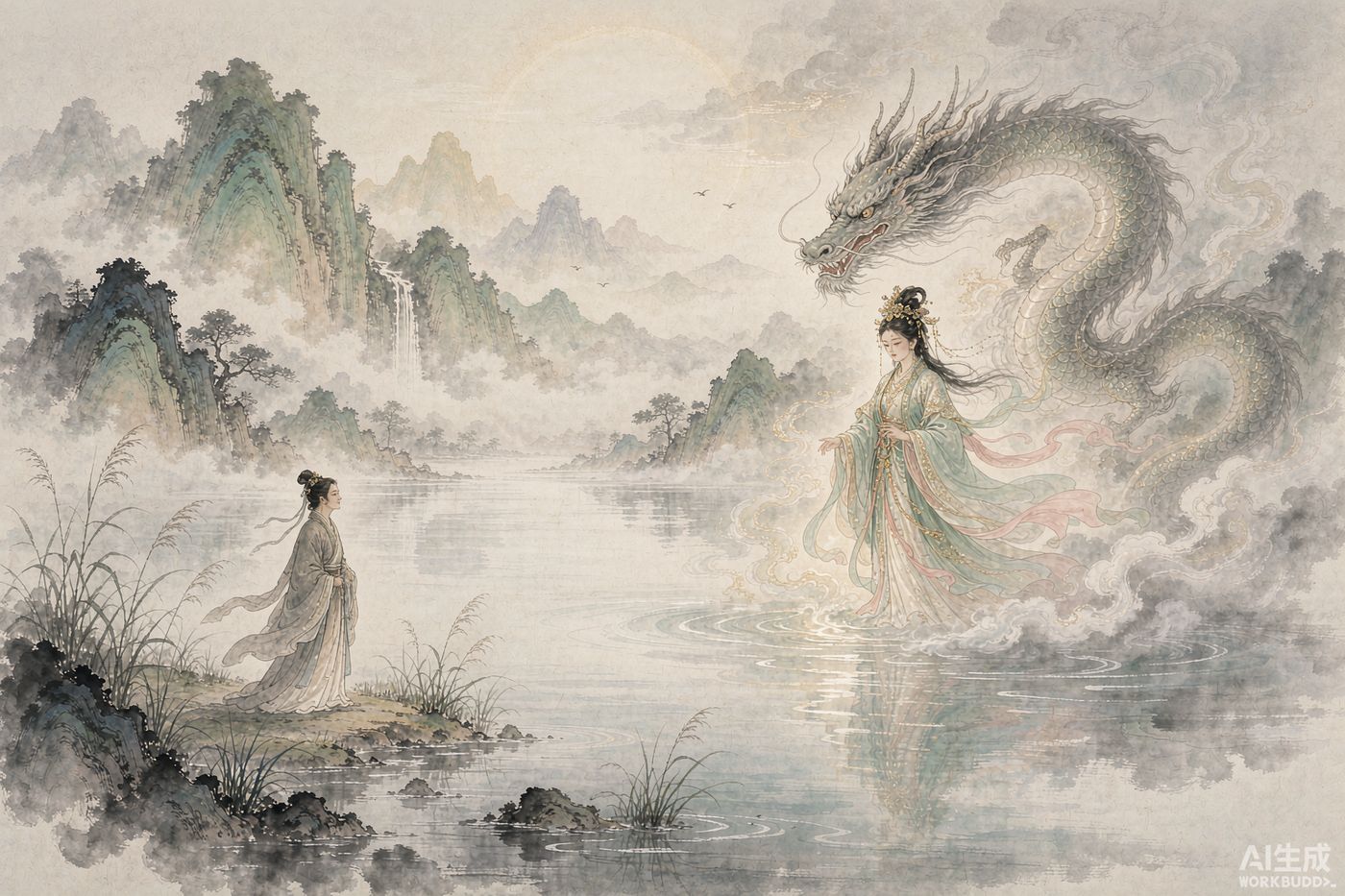
In the Yifeng era a scholar named Liu Yi, having failed the imperial examinations, was travelling home to the Xiang river when he turned aside to say farewell to a friend. On the road his horse shied at a bird and bolted, and when it stopped at last, Liu Yi found himself looking at a woman tending sheep by the roadside.
She was beautiful, but her face was drawn with misery, her clothes dull and torn, and she stood as though listening for something far away. Liu Yi asked what trouble had brought her to this. At first she only wept; then she told him.
“I am the youngest daughter of the Dragon King of Lake Dongting. I was married to the second son of the Dragon of the Jing river, and he despised me. His servants slandered me until my husband’s parents cast me out, and now I herd the rain-flocks here in the wilderness, and there is no one under heaven to carry word to my father. The lake is a thousand li away and the sky is wide — will you laugh at me if I ask a stranger to be my messenger?”
Liu Yi, whose blood was quick to injustice, answered that he would carry the letter himself, and asked only how a mortal man was to reach the bottom of a lake. “On the south shore of Dongting grows a great orange tree the shepherds call the Altar Tree,” she said. “Tie your sash about it and strike the trunk three times, and someone will come for you. Follow where you are led, and do not fear the water.”
So Liu Yi rode to Dongting, found the orange tree, and knocked. In a moment a warrior in scaled armour rose out of the lake and asked his business, and then, telling him to shut his eyes, led him down through the water. When Liu Yi looked again, he stood before a palace such as no earthly emperor had ever built: its pillars were white jade, its steps were crystal, its curtains strung with pearls, and light moved through the hall as it moves under water. There the Dragon King of Dongting received him and read his daughter’s letter, and the old king covered his face and wept, and the sound of weeping ran through the palace like wind.
It was then that Liu Yi heard the thunder.
A dragon a thousand feet long, red-scaled, fire-eyed, dragging a golden chain, burst up out of the courtyard through the roof, trailing lightning and rain, and was gone. The palace shook; Liu Yi fell to the floor. When he dared to ask, the attendants told him: that was Qiantang, the king’s brother, the Dragon of the Qiantang river, chained at court for drowning nine provinces in a fit of temper — and he had heard the letter read.
Qiantang returned before the day was out, still smelling of the storm, and reported to his brother with terrible cheer: the Jing river palace was burned, the worthless nephew was eaten, and six hundred thousand of his people and fields lay drowned. “I did perhaps overdo it,” the red dragon admitted, “but the girl is safe.” And he had brought her home.
Liu Yi was feasted for days on treasures no human had seen. The dragon princess herself he glimpsed only through curtains, though once, at the height of a banquet, the red dragon Qiantang — drunk and blunt — proposed outright that Liu Yi marry her. Liu Yi refused. He had carried the letter for justice, he said, not for a bride; and he would not have it said he had sold his errand. The red dragon, astonished, apologised for the insult to his honour, and the two parted as friends.
Liu Yi went home rich with dragon gifts and married, and was widowed, and married again and was widowed again. And then, when he had moved to Jinling and married a third time, his new wife — gentle, beautiful, strangely familiar in her laughter — bore him a son and only afterward told him the truth. She was the princess of Dongting. She had waited, she said, until she was sure he loved her for herself and not as the prize of a good deed; and Liu Yi, who had refused a dragon’s offer out of stubborn honour, found he had married one after all.
In the end the dragons gave him more than gold: a place among the deathless. But the part of the story people remember is smaller and human — a failed scholar on a dusty road, stopping for a stranger in rags, and keeping his word all the way to the bottom of a lake.