Stories/ 夷坚志/ Listening for the Omen

Listening for the Omen

婆惜響卜

SourceYijian Zhi (Record of the Listener)
AuthorHong Mai
EraSouthern Song dynasty · 1187, the dingwei year of Chunxi
Writtenc. 1160–1200
ExaminationScholarFateComedy
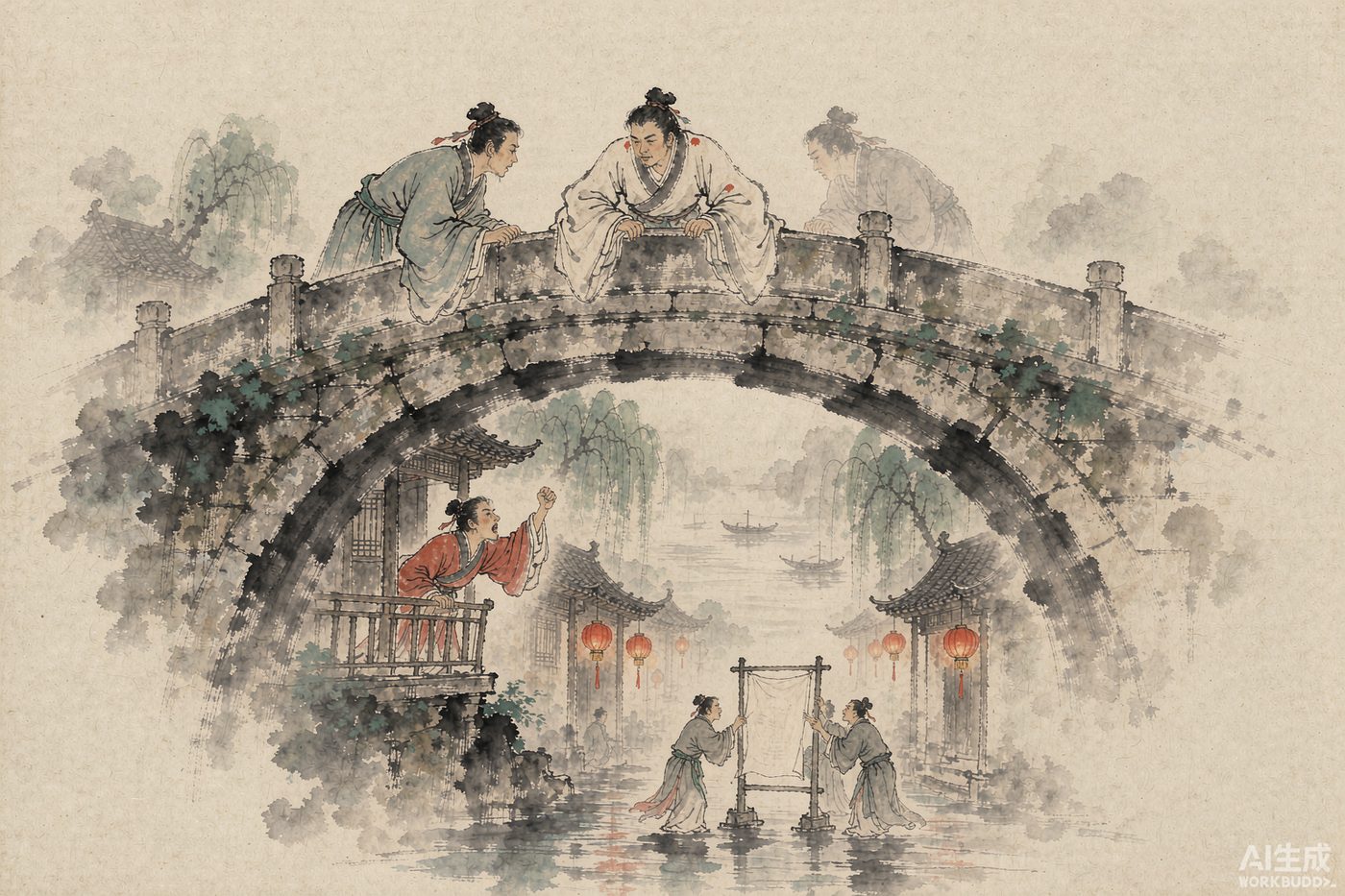
Three examination candidates leaning over a bridge parapet at night listening, a woman shouting from a riverside tenement below, and the examination results board glowing in lantern light further down the street, ink-wash painting
Illustration generated by AI, based on the ancient Chinese text.

He Zhan, whose courtesy name was Shucun, was a man of Kuocang, a great-grandson of the Prince of Qingyuan.

In the dingwei year of Chunxi he went up to the metropolitan examination and lodged at an inn by the Three Bridges. On the night the pass list was to be posted he sent his servant to watch for it. The servant was gone a long while, and Zhan grew anxious; so he took his fellows up onto the bridge to listen for an omen.

They had hardly come to a stop when they heard a woman by the riverbank shrieking: “Posi — you’ll get it!”

Now this is the form of words used in the Wu country when a person is angry and about to beat or curse someone; the common people call it “being given a reckoning.” It is no lucky omen.

Zhan alone was delighted, and hurried back. “Congratulate me,” he said.

“Shucun,” said his fellows, “you went out on purpose to listen for an omen, and you got the word get four times running. What doubt can there be?”

“It is not only that,” said Zhan. “My childhood name is exactly Posi.”

They were all delighted. They were just buying wine to drink when the servant arrived: he had indeed passed high on the list.
Original classical Chinese text · 原文

括蒼何湛叔存清源王曾孫也淳熙丁未赴省試館于三橋旅邸掲牓之夕遣僕探候久而不至有憂色因率同輩登橋聽響卜駐足未定聞河畔婦人叫呼曰婆惜你得蓋吳人愠怒欲行打罵之詞俗謂之受記非吉兆也湛獨喜亟還曰可賀我矣同輩曰叔存作意聽響卜而連四得字夫復何疑湛曰不特此也吾少名正為婆惜衆皆喜方買酒欲飲而僕至果中前列

From 《婆惜響卜》, Yijian Zhi. Translated in full. 括蒼 is Kuocang in Zhejiang; 清源王 is a Song princely title — He Zhan was a descendant of the Prince of Qingyuan; 淳熙丁未 is 1187; 省試 is the metropolitan examination held at the capital; 掲牓 is the posting of the pass list; 響卜 is a form of divination by the first words overheard at a chosen moment; 婆惜 (Posi) is a name; 受記 is the Wu-dialect term for the scolding formula that precedes a beating; 前列 means among the top ranks.

Source. From Yijian Zhi (Record of the Listener) (夷坚志), by Hong Mai , c. 1160–1200. The original text is in the public domain; this English rendering and the accompanying notes are original work.
Where this fits in the universe: The Underworld Examination · Reading the Fate: The Doom Is Fixed, the Address Is Not

Keep Reading

Related Stories

Qing dynasty · Qianlong era, c. 1760–1800 · 谐铎

Top of the List by Accident

泄气生员

A dull-witted candidate named Xia Qitong is told by a diviner that he will come first. He does — because a minister happened to break wind while the new examiner was asking him for instructions, and the examiner, hearing 下气通, wrote the name down as 夏器通.

OfficialdomSatireFate
Qing dynasty · Qianlong era, c. 1750–1795 · 子不语

Master Crane Stillness

鹤静先生

A planchette spirit joins a Hangzhou poetry circle and is wonderfully useful — he dates the rain, he stops fevers, he matches the rhyme for wild goose sixty times over. Ask him about great matters and the brush simply lies still. Asked to show himself, he hangs himself from an archway on Solitary Hill.

GhostPoetryDivination
Qing dynasty · Kangxi era, 1688 and 1714 · 子不语

The Planchette Showed the Questions

乩仙示题

Examination candidates beg the planchette spirit to leak the paper. It writes two characters — 'Don't know' — and when they laugh at its ignorance, writes again: 'Don't know, don't know, and again don't know.' That year's question was on the Analects verse about not knowing the Mandate. Twice.

PlanchetteExaminationTrickster