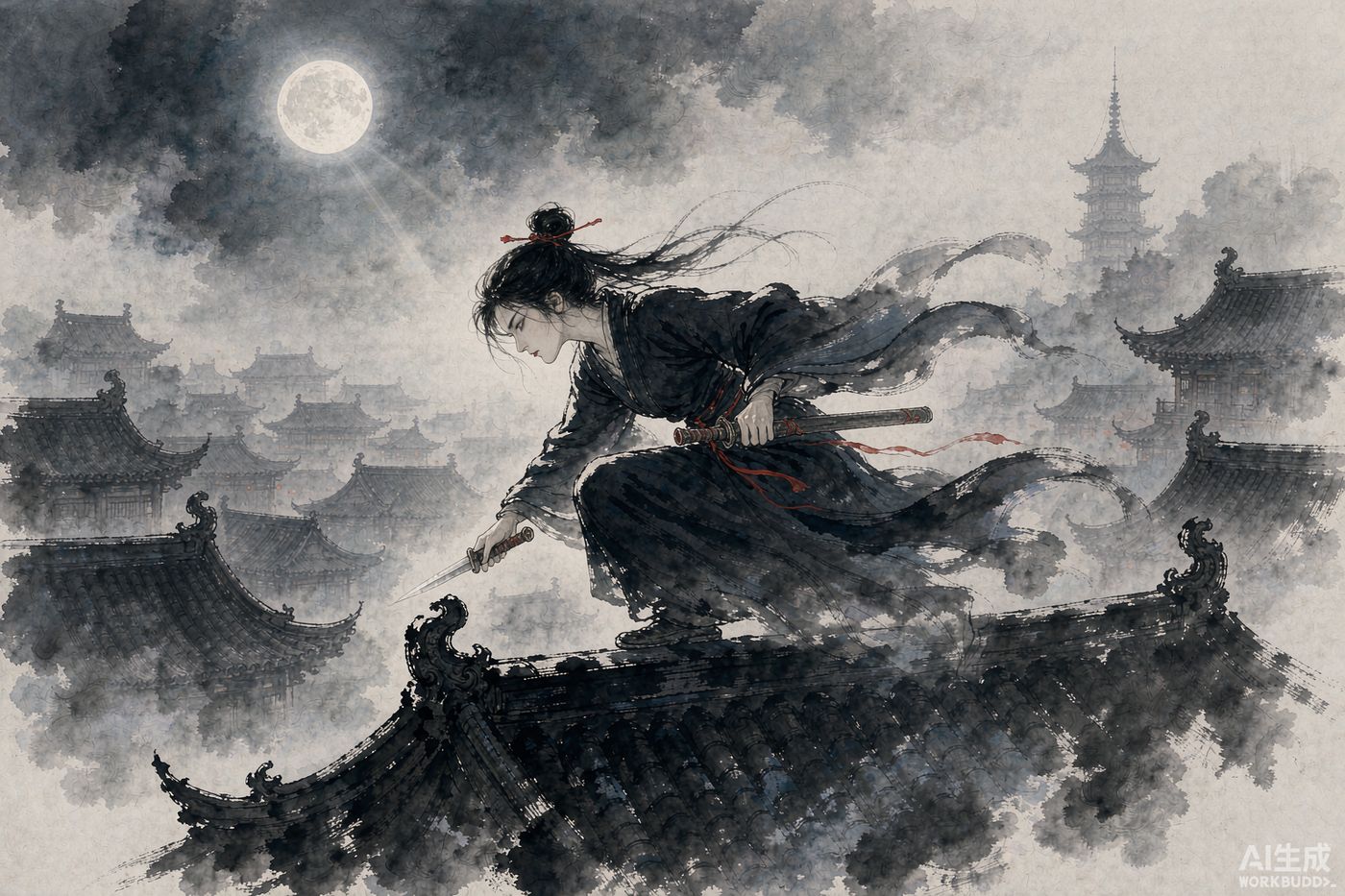
In our county there was a young man named Wang, the seventh son of an old family, and from boyhood he had been possessed by the idea of becoming an immortal. Hearing that Mount Lao was full of them, he shouldered a book-box and set off to look.
At the top of one peak he found a temple, small and deeply quiet. On a rush mat inside sat a Taoist, white hair falling over his collar, but with eyes so bright and quick that age seemed like a costume he was wearing. Wang knelt and talked with him, and the old man’s reasoning was so fine and strange that Wang begged to become his disciple. The Taoist looked him over. “I doubt a soft young gentleman can endure hard work,” he said. “I can,” said Wang.
The master had many disciples, and they all gathered at dusk. Wang bowed to each in turn, and so he was allowed to stay.
The next morning the master handed him an axe and sent him out with the others to cut firewood. Wang did it, day after day, for over a month. His hands blistered and split, and slowly a thought crept in: I came here for the secret of eternal life, not to be a woodcutter. He was on the point of leaving when, one evening, the master called for wine and shared it with two guests in the courtyard. It grew dark, and there were no lamps yet. The master cut a piece of paper into the shape of the moon and pressed it to the wall, and at once the whole room was lit as if the moon itself had come indoors.
The disciples crowded round to serve them. One guest said, “A night like this, and we are drinking alone. Why not share with everyone?” So the master dipped a brush in the wine and flicked it toward the paper moon — and a figure no bigger than a bean came down out of the light, growing as she descended until she stood on the floor, a beautiful woman in fluttering sleeves, singing and dancing like Chang’e herself. When the song ended she spun round and shrank back into a brushstroke. The three men laughed and applauded, and drank, and somehow the little pot never emptied no matter how much was poured, and the candles that were brought were snuffed out by the brightness of the paper moon.
Wang stood in the corner and watched, and his heart, which had been leaning toward home, swung back.
The next month was the same: the axe, the firewood, the aching back. But Wang endured it for another stretch, and then he could endure no more. He went to the master and said, “I came hundreds of li to learn from you. If you will not teach me the great arts, teach me one small one to repay my labour.” The master laughed. “I knew you could not bear the hardship. Very well — what would you like?” Wang thought of the times the master had passed through a solid door as though it were mist. “Teach me to walk through walls.”
The master gave him the words of the spell and made him repeat them, then pointed at the courtyard wall. “Go on, then.” Wang backed up, shut his eyes, and walked at the wall — and passed clean through it. He stood on the other side, hardly believing it, and turned to find the master smiling at him through the open gate. “Remember,” said the old man, “the art only works for a heart that is quiet. Use it for mischief and it will fail you.” Wang swore he understood, took his travelling money, and went home a happy man.
His wife was less happy. “You disappear for months, and this is what you bring back — a parlour trick?” Wang told her she did not understand, and set out to prove it. He stood in the middle of the room, recited the spell, and charged at the wall with his eyes closed and his mind full of triumph.
The wall, being a wall, stopped him.
He sat down hard on the floor with a lump rising on his forehead, and his wife laughed until the tears came, and Wang, rubbing his head, could only mutter darkly that the old Taoist had cheated him after all.