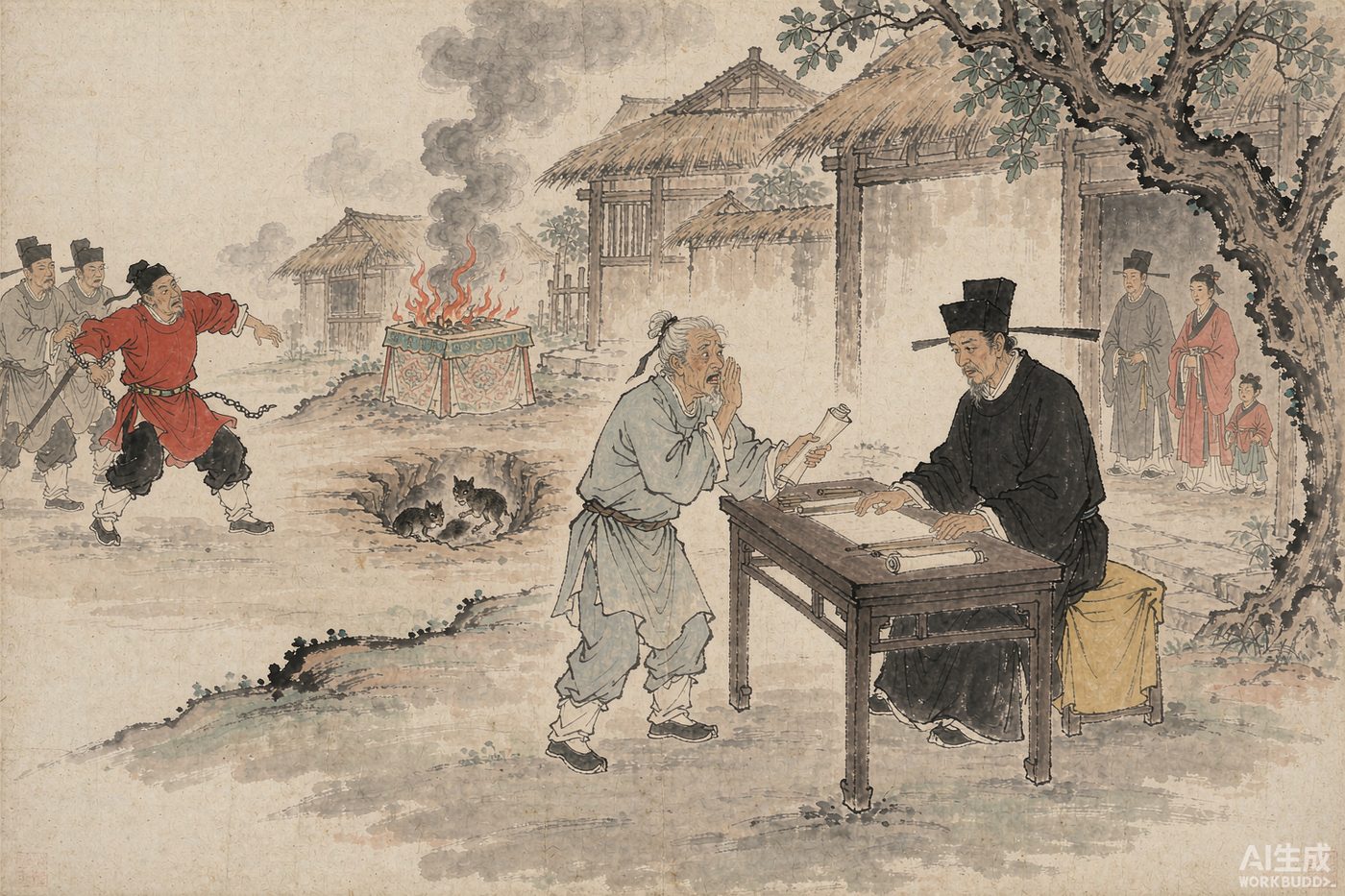
In the Shaoxing era a magistrate of Yihuang county in Fuzhou named Xu was hearing a case when an old man named Hou Lin came weeping and presented a petition, saying he lived beside the village altar, that the archer Xia Sheng had set fire to his house and burned it down, and that his three sons had gone to ashes with it.
Xu read the petition and was horror-struck, and arrested Xia and sent him to prison and questioned him under torture. Xia did not know what to say, and wept and would not eat.
The clerks all said Xia was by nature a reasonable man, and how could he set fire in broad daylight and kill people? They begged to trace the author of the petition to the end, and to send an assistant official to examine the place, and the truth would come out.
Xu took their advice, and went to the altar to look about, and found no address for a Hou the elder and no trace of a fire.
The truth was that Xia Sheng, for the sake of the village sacrifice, had been ordered by the magistrate’s deputy to sweep the altar, cut the brushwood, and carry the dry straw in a basket to an empty hole and burn it — and the hole was a fox’s burrow. Three cubs died, and the old fox therefore used public force to take its revenge. Then Xia was released.
Separately, there was a female fox who took the form of a beautiful woman and came and gone in the magistrates’ hall, seen by every clerk. There was a black mole on the left cheek of her face, big as a bean. Those she deluded who died were not one or two, and she mostly occupied the deputy magistrate’s Bilang hall. A young clerk often saw her at her needlework, and when she heard a human voice she vanished.
In the gengchen year a certain Zhu, who came to be deputy magistrate, slept alone in that hall and met her and was pleased, and took her into his bed; and in time both he and his son died one after the other.