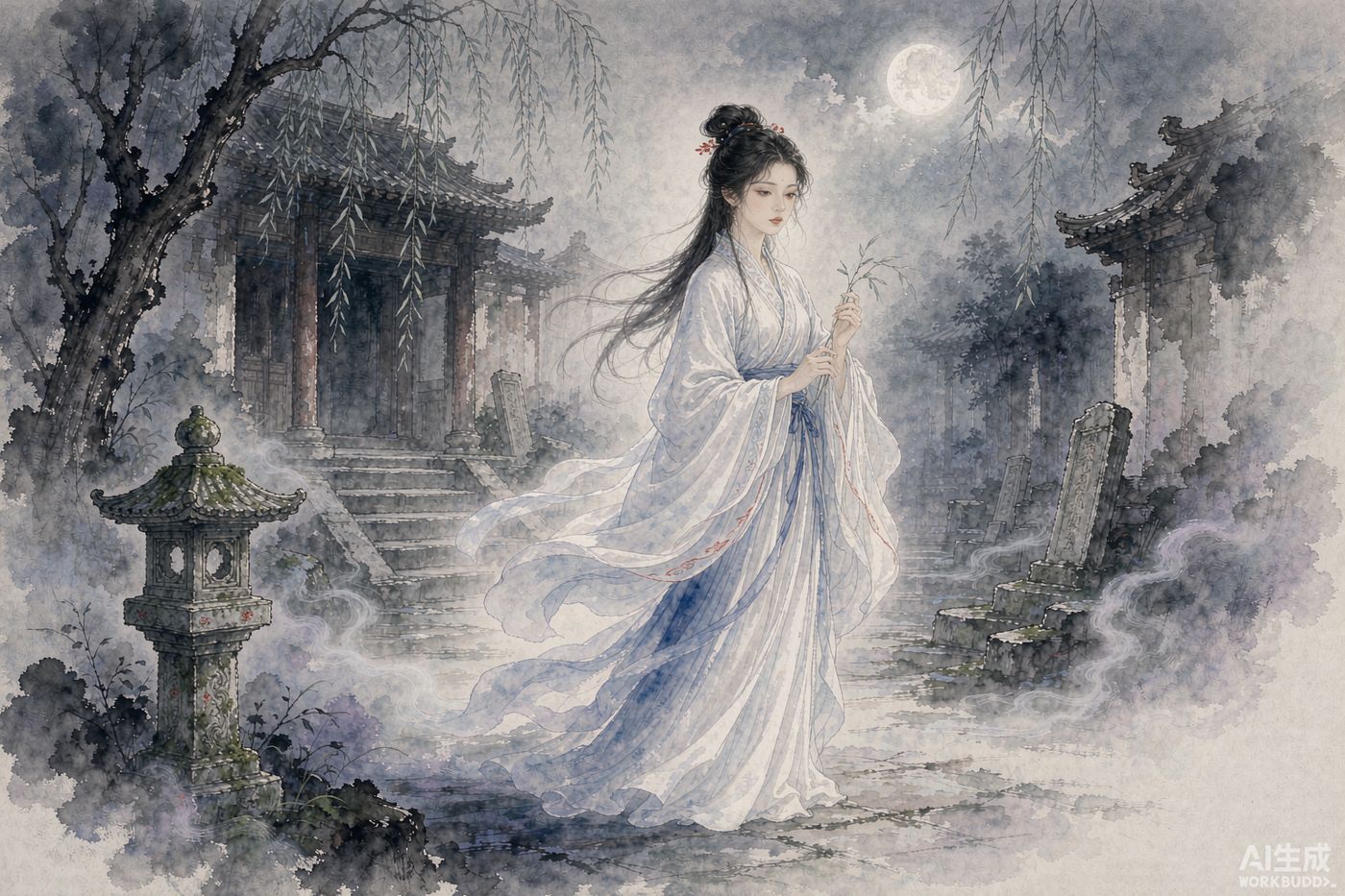
In Jingcheng there was a man named Jiang Sanmang, who was brave and extremely stupid.
One day he heard someone tell the story of Song Dingbo, who caught a ghost on the road and sold it at market for fifteen hundred cash. Jiang was delighted.
“So ghosts can be tied up!” he said. “If I tie one every night, spit on it to turn it into a sheep, and sell it to the butcher at dawn, that will keep me in wine and meat for the day.”
That night he took a cudgel and a coil of rope and set out for the graveyard.
He walked the tombs like a hunter waiting for a fox. Nothing. Not a ghost.
He tried the places where everyone said ghosts had been seen. He lay down beside them pretending to be drunk. Still nothing. One night he saw, through the trees, several will-o’-the-wisps, and charged at them shouting — and by the time he got there they had scattered like sparks.
He went back to his spot and wandered about until he was exhausted, and there was nothing anywhere, not a sound, and then from the edge of the wood he heard a ghost laugh — a real laugh, delighted and helpless — and say:
“Truly, we are cowards today!”
And Ji Yun, who wrote the story down, adds the moral in his own voice, and it is the moral of the whole collection:
A ghost frightens a man because the man is afraid. If you meet one and your heart does not move, it has nothing to work with. The brave are not lucky; they are simply not edible.
He goes further. There is, he says, a kind of man who is afraid of nothing because he has never imagined anything — the thick-headed, the cheerful, the very young, the very drunk. Ghosts avoid all of them. And there is another kind who is afraid of nothing because he has examined his accounts and found them clean, and ghosts avoid him too, though for a different reason and with more respect.
Jiang Sanmang never caught a ghost. He gave it up after a month or so and went back to ordinary work, and if you asked him about it he would say the ghosts in his district had simply moved away.
Which, as Ji Yun notes, is true.