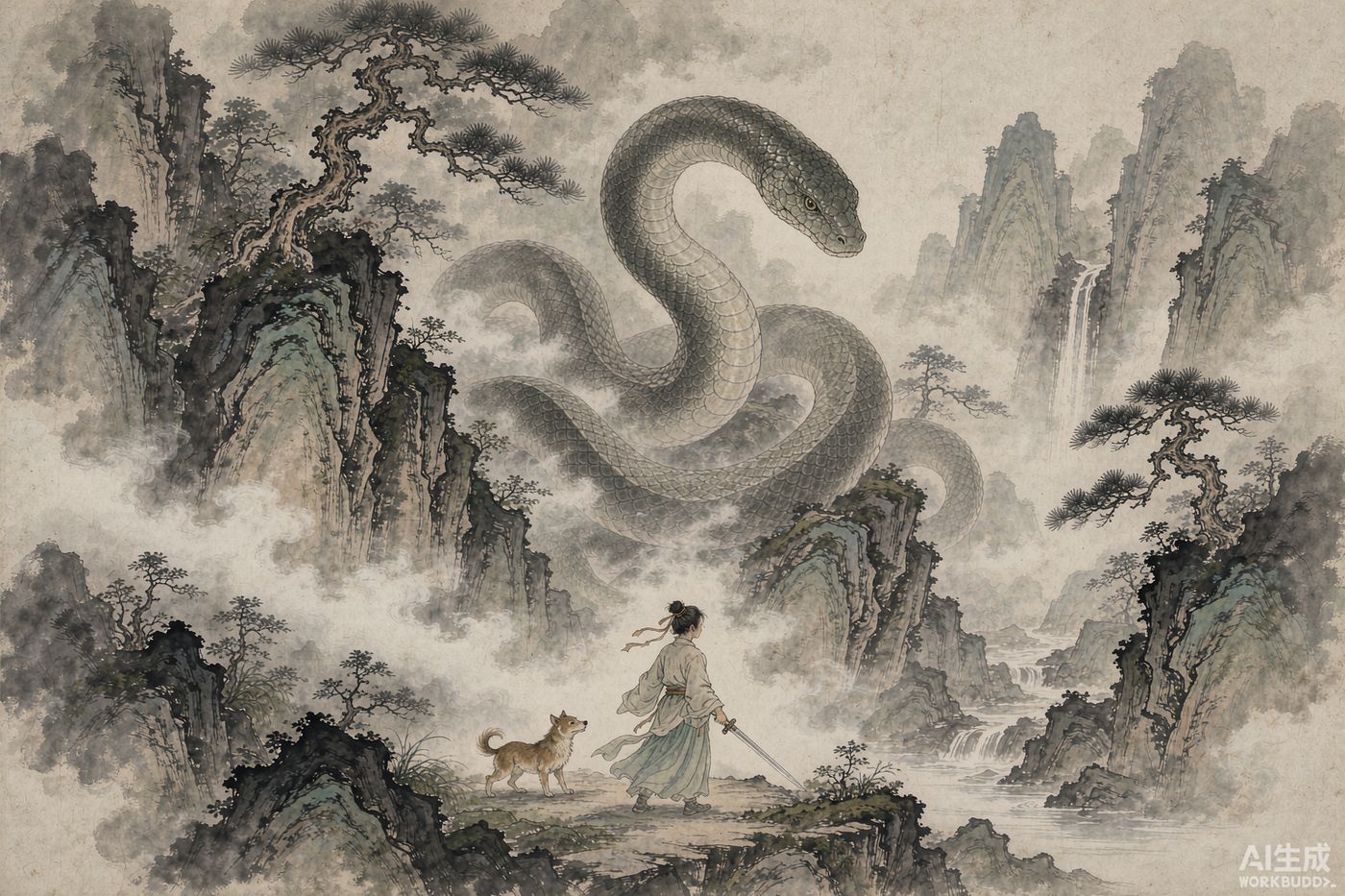
In Chu there was a smith named Gan Jiang who, with his wife Mo Ye, made swords for the king. The king gave him three years, and when three years were gone the swords were finished — two of them, a male and a female — and the king was angry at the delay, and it was known that he meant to kill the smith.
Mo Ye was great with child. Gan Jiang said to her: “I go to my death. If the child is a boy, when he is grown, tell him this: go out of the door and look at the south mountain. A pine grows on a stone; the sword is at its back.” Then he took the female sword and went to the king, and the king’s diviners told him that a pair of swords had been made and only one delivered, and in his rage he had Gan Jiang killed.
The child was a boy, and they named him Chi, and he grew with his eyebrows set unnaturally wide apart. When he asked his mother for his father, she told him all of it, and gave him the message. Chi went out and looked at the south mountain — no pine, no stone. Then he understood: the pine pillar of the house stood on a stone base. Behind it he dug, and found the male sword, and from that day he thought of nothing but the king of Chu.
The king dreamed of a boy with a foot-wide brow vowing vengeance, and set a price on his head. Chi fled into the mountains, and there, weeping beside the road, he was found by a stranger in black. “You are Gan Jiang’s son,” the stranger said. “The whole kingdom hunts you, and you can do nothing but weep. Give me your head and your sword, and I will take your vengeance for you.”
Chi bowed to him, drew the sword, and cut off his own head — and his body stood holding out head and sword, and did not fall. “I will not fail you,” said the stranger; and at that, the body fell.
The stranger carried the head to the king. “This is the head of a brave man,” he said, “and it should be boiled in a cauldron, or its spirit will not rest.” The king had a great cauldron set up, and the head boiled for three days and nights and would not dissolve — and from time to time it leapt out of the boiling water and glared. “The boy’s spirit hates you,” said the stranger. “If the king himself will lean over the cauldron and look at it, it will dissolve.”
The king came and leaned over the cauldron. The stranger drew the sword of Gan Jiang and struck off the king’s head, which fell into the water; and before the guards could move he struck off his own head into the same cauldron. The three heads boiled together until not even the court could tell them apart, and in the end the ministers, unable to separate king from avenger from smith’s son, buried the broth of them in a single grave.
They call it the Tomb of the Three Kings, and it is in Runan to this day, the story says — one tomb for the tyrant, the martyr, and the nameless man in black, who kept his word to a stranger at the cost of everything, and asked for nothing, not even a name.