Stories/ 夷坚志/ The Temple That Moved Itself

The Temple That Moved Itself

七娘子灘龍女廟

SourceYijian Zhi (Record of the Listener)
AuthorHong Mai
EraSouthern Song dynasty · Shaoxing 26 (1156)
Writtenc. 1160–1200
DeityJustice
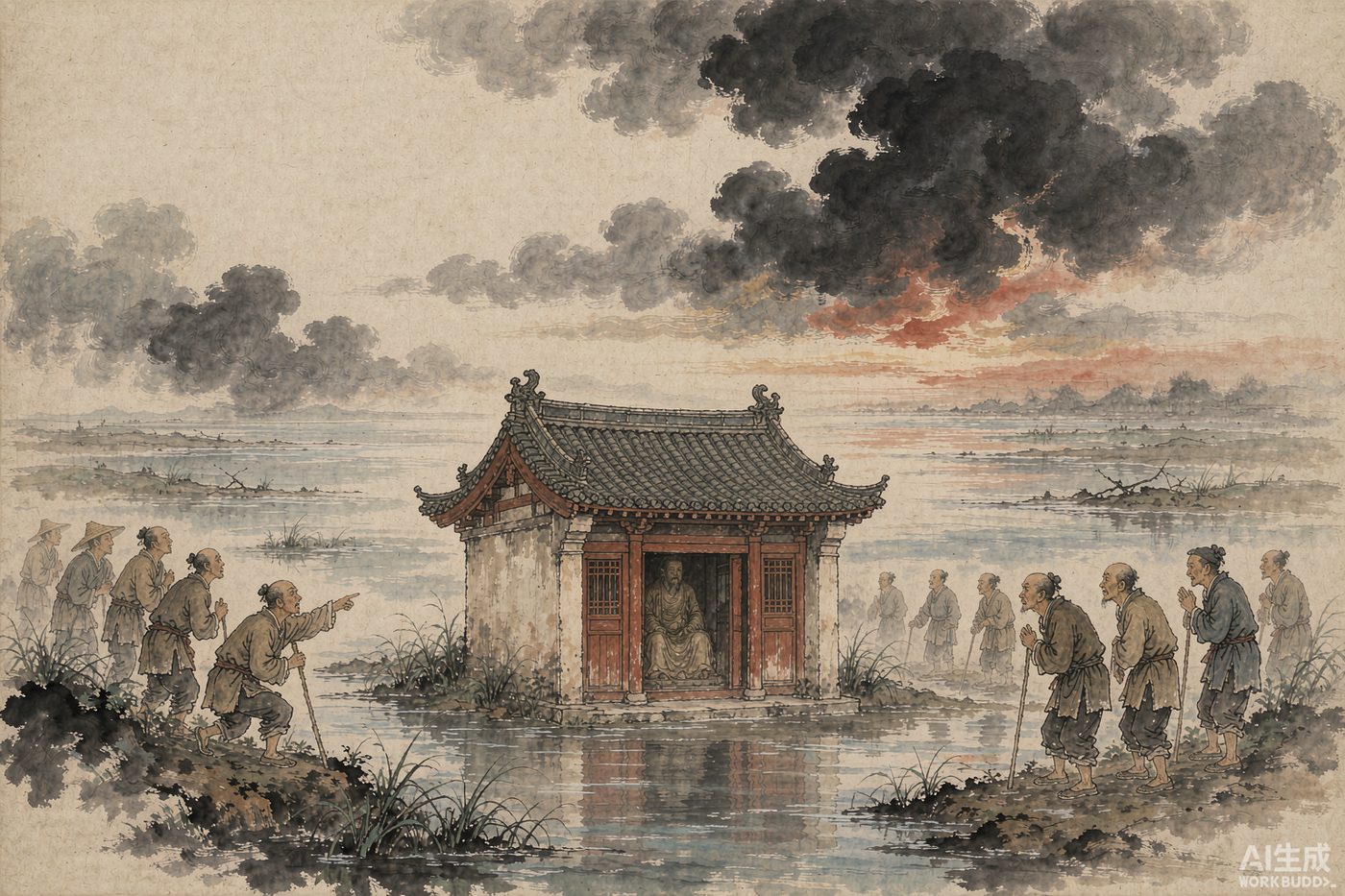
A whole small temple standing intact and level on flat ground at dawn after a great storm while villagers stare from a flooded plain
Illustration generated by AI, based on the ancient Chinese text.

The great river cuts through the Taihang range and flows east, with several dozen sheer rapids so violent that fish and turtles cannot stay. One of them is called the Seventh Girl Rapid. On the top of the mountain is a temple to the Dragon Girl, and below it a thousand households.

Every summer when the floods reached the sky the village had the labour of dykes and the fear of being swallowed. The elders discussed among themselves moving the settlement elsewhere. A scholar named Han Yuanweng, mature and learned, and trusted by the neighbourhood, was consulted.

Han Yuanweng said: “We have lived here for generations. Our graves and houses have been handed down a long time. To abandon them at one go would leave our hearts uneasy in the end. Let us try laying our sincerity before the dragon shrine and see whether it agrees, and then make our plans accordingly. It is not too late.”

So they subscribed money, prepared animals, wine and spirits, chose a day, went to the temple, and asked to move the shrine to the river bank. They cast the divining blocks and got a lucky answer, and the crowd bowed and went home, and were calculating the cost.

That night there was a great storm of thunder and wind, with a sound like a collapsing mountain, and rain pouring in rivers, foxes howling and ghosts wailing. Everyone at the foot of the mountain got up, all thinking they had angered the god.

By dawn the sky was clear and mild, and the whole temple stood on the level ground, with not one rafter or tile damaged, and the mud-plastered statues all in place, facing the right way, its foundations firmer than before and far surpassing the old.

After that, whenever the flood rose it stopped at the temple bank, and the people had no more anxiety.
Original classical Chinese text · 原文

於是醵錢具牲牢酒醴,擇日詣廟,求遷其祠于河濱,擲盃珓以請,得吉卜,衆拜而歸,方撰財慮費。是夜雷風大作,聲如頹山,暴雨傾河,狐嘯鬼哭,山下人盡起,皆以為貽神怒。比曉,霽色融怡,一廟儼在平地,尺椽片瓦無有壞隳,至于壁泥塑像一切妥貼,面勢平正,基宇堅牢,絶勝於舊。自是淫漲抵廟岸即止,民無復憂。

From 《七娘子灘龍女廟》, Yijian Zhi jia 1. 杯珓 are the crescent divining blocks cast for a yes-or-no answer.

Source. From Yijian Zhi (Record of the Listener) (夷坚志), by Hong Mai , c. 1160–1200. The original text is in the public domain; this English rendering and the accompanying notes are original work.
Where this fits in the universe: How a Shrine Gets Built

Keep Reading

Related Stories

Qing dynasty · Qianlong era, c. 1736–1798 · 子不语

The City God Was Drunk

城隍神酗酒

A clerk writes a colleague's name upside down in red ink as a joke, and burns the paper. That night the City God's bailiffs arrive. The rule is that whenever a living document names a man, the underworld arrests him.

UnderworldJusticeDeity
Qing dynasty · Qianlong era, c. 1736–1798 · 子不语

King Ox-Head

牛头大王

A god demands a temple in a dream, clears the village epidemic, and answers prayers for sons for several years. Then one father's boy dies after an auspicious divination, and he takes a hoe to the statue.

DeityJusticeTrickster
Southern Song dynasty · Shaoxing 26 (1156) · 夷坚志

The Protector-General

護國大將軍

Locusts darken the sky and sweep the harvest clean. Thousands of birds with crops the size of several pecks fill them and spit them out again. Ten days later there is not one left, and the bird is given an army rank.

DeityMonsterJustice