Stories/ 夷坚志/ Axu in the Underworld

Axu in the Underworld

阿徐入冥

SourceYijian Zhi (Record of the Listener)
AuthorHong Mai
EraSouthern Song dynasty · 1165, the first year of Qiandao
Writtenc. 1160–1200
UnderworldJusticeWomenMoneyOfficialdom
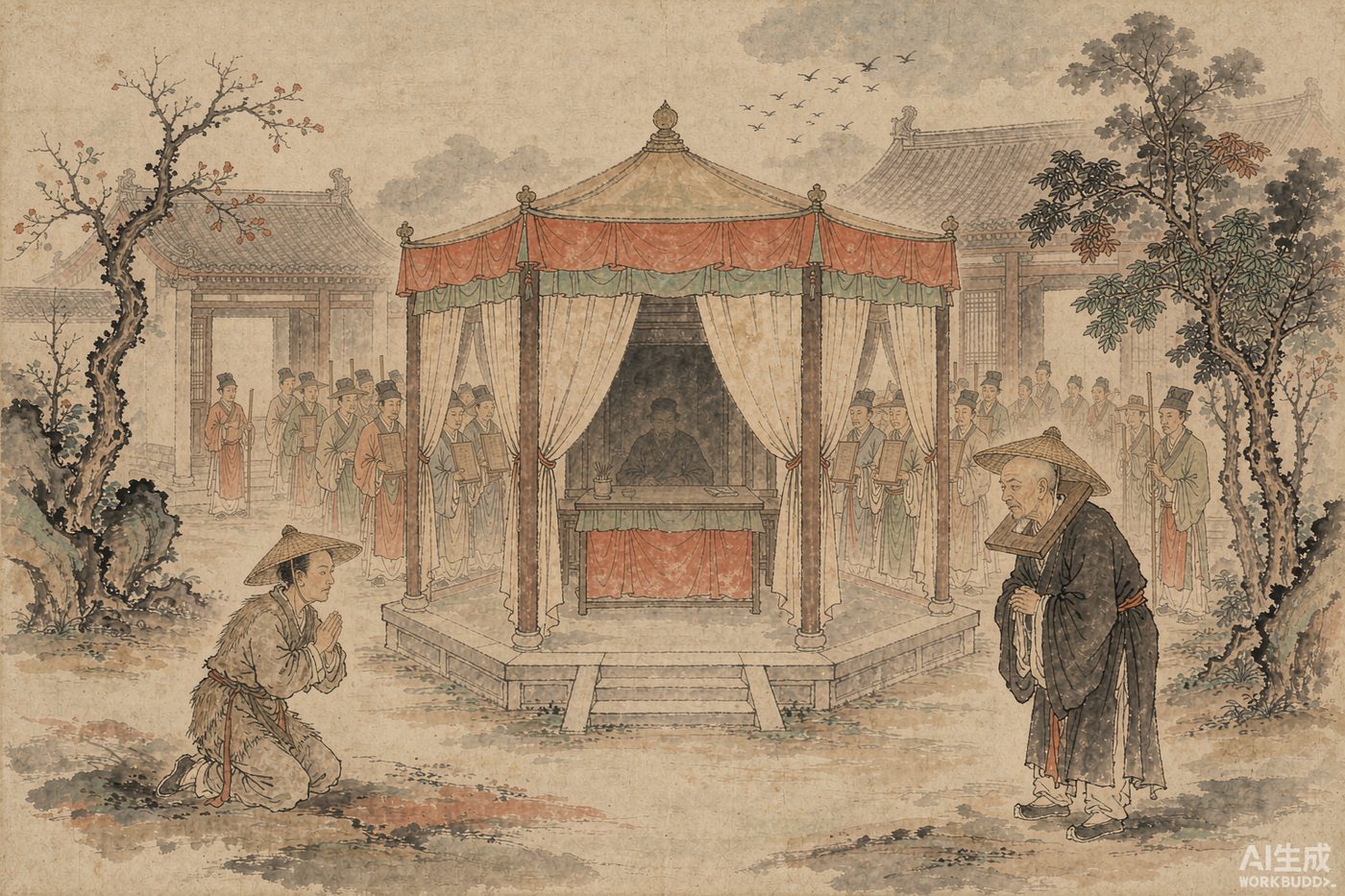
A peasant woman in patched clothes kneeling before a screened underworld tribunal, a cangued old monk-attendant facing her across the court, clerks with document boards, and three red weals visible on her back, ink-wash painting
Illustration generated by AI, based on the ancient Chinese text.

Axu was the wife of a farmer, Wang the Third, of Fengxian village in Jiaxing. In early summer of the first year of Qiandao she died, and after a night she came back to life.

This is what she told.

“While I lay sick and failing, I saw two runners with a written warrant come to arrest me. They said: you are summoned to answer a charge. I said: the ordinary affairs of the house are managed by my husband and my sons; I have no part in them; why are you fetching me? The runners said: we need you to go. Before I knew it I was out of the door with them, along a road dim and cold with no sight of the sky, for some ten li and more, until we came to a government office where people came and went in crowds and clamour.

“The two halted me outside and went in first to write the arrival statement; then they drove me up to the foot of the court. Screens hung on all four sides. A clerk stood before me and asked: why did you forcibly seize the property of a junior kinsman?

“I answered him: I have never concerned myself with the affairs of the house. I have eaten vegetarian and invoked the Buddha for some thirty years. I remember only this — that my husband’s elder brother, Wang Da, divided the ancestral estate equally with my husband, Wang the Third. The elder brother afterwards went to Dasheng monastery and became a lay brother. His share of fields and gardens was pawned by his son, Wang Ba, to the Sun family of Weitang market town, and the money was gambled away and squandered improperly, until only the house plot was left — and that was the plot I leased out to a tenant.

“Some years later the elder brother died. Wang Ba was away from home and had not returned, so my husband Wang the Third cremated him and disposed of the bones. And when Wang Ba came back, we returned the house plot to him. Apart from that, there has been no seizing of anything.”

Then a voice was heard from behind the screen, calling for Wang Da to be brought out to confront her. A man in a cangue stood below the steps — it was her husband’s elder brother.

He said to me: “I have been a long time in the courts below, and did not know the particulars of things in the world above, and so I brought this matter twice. Now that it is clear, I will contend no further.”

I asked him what he was suffering for, to be in such a state.

He said: “When I was a lay brother I went about soliciting money from donors to build the bell tower, and I kept back part of it for myself. And I used to carry home the alms rice that came back from the offerings. That is why I am still in punishment and have not been released.”

When the confrontation was over, I begged to be allowed home.

The voice inside the screen said: “Having come here, how can you go back empty?”

So I was sentenced to the bamboo on the back. And at the third stroke, it was like waking out of a dream — and I came to on the instant.

The family looked at her back: the weals were clear to see. It was very painful, and only after several days did she recover.

A man of the county, Sun Han, newly appointed magistrate of Guangde, told the story.
Original classical Chinese text · 原文

嘉興奉賢鄉民王三妻阿徐乾道元年初夏死經夕復生言方病困時見兩箇公人把文符追我云喚汝對事我云尋常家務自係丈夫與兒子管幹我無所預何故來追公人曰須要你去不覺隨出門行一徑陰慘不見天日約十數里到官府往來憧憧喧閙兩人止我于外先入寫押到狀然後驅至庭下四面垂簾别一吏在前問云汝何故強占卑幼財產我答言平日不曾干預家裏事喫素念佛已三十來年只記的阿伯王大與丈夫王三均分祖業伯後去大聖寺中出家作行者其一分田園是伯兒子王八典與魏塘鎮孫家將錢賭博非理用過只剩得屋基却是阿徐倩佃後累年伯身死王八出外未歸夫王三為焚化抛骨及至將屋基還王八此外即無強占聽得簾裏傳聲押王大出對便有一帶枷罪人階下立乃伯也伯向我說我久在陰府不知陽間事仔細所以兩次理會今此既分曉更不願爭我問伯何事受苦如此曰我作行者時緣化施主錢修造鐘樓隱瞞入已又將打回齋飯歸家所以受罪未脱對訖我乞放回簾内云到這裏如何空囘得遂坐杖脊至第三而下一似夢覺乃頓甦家人視其背杖痕儼然極痛楚數日方愈縣人新廣德宰孫漢傳

From 《阿徐入冥》, Yijian Zhi. Translated in full. 嘉興奉賢鄉 is Fengxian village, Jiaxing, in Zhejiang; 公人 are court runners or bailiffs; 文符 is the written warrant; 對事 is to answer a charge; 行者 is a lay temple labourer, tonsured but not ordained; 卑幼 is a junior kinsman — a legal term of art in Song inheritance law; 典 is to mortgage or pawn land with the right of redemption; 倩佃 is to lease out to a tenant; 簾 is the screen behind which the judge sits; 杖脊 is the heavy bamboo stroke on the back; 新廣德宰 is the newly appointed magistrate of Guangde.

Source. From Yijian Zhi (Record of the Listener) (夷坚志), by Hong Mai , c. 1160–1200. The original text is in the public domain; this English rendering and the accompanying notes are original work.
Where this fits in the universe: The Courts of the Dead · The Ledger: How Cause and Effect Keeps Accounts

Keep Reading

Related Stories

Southern Song dynasty · 12th century · 夷坚志

The Clerk Who Died Twice

臨安吏高生

Two petty embezzlers are beaten in the county jail. The deputy takes pity, breaks them out, and reports them dead. The magistrate is relieved — until two naked figures appear at his bedside and demand that he come down below and give evidence. The cure is a piece of information. And then Hong Mai adds what other people said.

GhostOfficialdomJustice
Qing dynasty · Qianlong era, c. 1736–1798 · 子不语

The Judge Answers Questions

判官答问

A scholar is a magistrate in the underworld by night and an ordinary man by day, so friends keep asking him to look up their life-spans. He explains why he cannot: the dead have no register unless you are in a case. Epidemics are examined separately — and men of standing are entered on a different list entirely.

UnderworldOfficialdomFate
Qing dynasty · Qianlong era, c. 1750–1795 · 子不语

The Scale of Merit

神秤

A revenue clerk is hauled before a green-faced judge of the dead, and his life's record is literally weighed — red slips for good deeds, black for bad, thrown into a scale with golden stars. His whole life comes up wanting. Then one red dossier goes in and outweighs everything.

JusticeUnderworldMoney