Dai Li, grandson of the observer Fuozhai, was a man of large temper with no care for his appearance. He liked to read the Classic of Mountains and Seas, and In Search of the Supernatural, and the Records of Marvels.
One day in heavy snow, drunk and asleep on the noon couch, he saw a noble official arrive with an edict.
“The lord of the commandery summons you. Please mount at once.”
Dai did not ask who. He straightened his clothes and went out. Beyond the gate a servant held a pony small enough to pass under fruit trees, whip in hand, waiting. Dai leapt into the saddle and the official led the way.
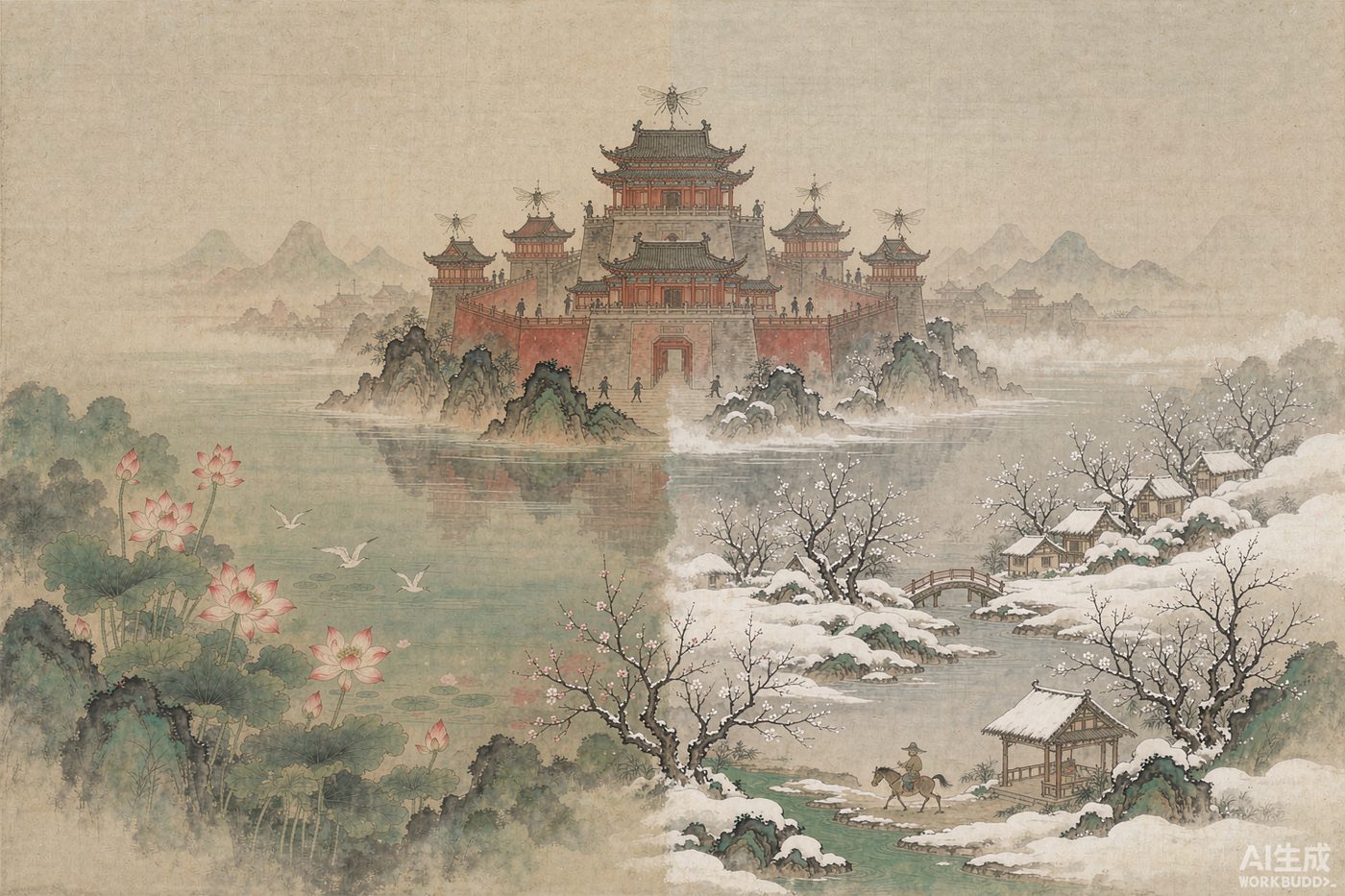
They came to a pavilion, unsaddled and rested. Before it a stream ran clear green, and ten thousand lotuses shone bright upon the water.
Dai said: “In such hard winter, how can this be?”
The official said: “This is early autumn.”
Dai called him a liar. The official laughed.
“You are a scholar of the Middle Kingdom. Truly, little seen and much wondered at. Let me set out the outline for you.”
Dai was all attention.
“My commandery lies more than forty-seven thousand li from the Middle Kingdom, and is called the Commandery of the Summer Cicada. We take the day for the year. Morning is spring, daylight summer, evening autumn, night winter. We keep no calendar of years; we take the plants of the four seasons as our almanac. The lotuses coming out of the water now — that is our early autumn, and your Middle Kingdom’s hour after noon.”
Dai marvelled, and would have asked more. The official started up in alarm.
“One conversation with you, and the north wind is already bitter cold!” Dai looked round: and indeed the lotuses had all fallen, and several old plum trees beyond the pavilion were putting out bud, and little by little taking the shape of braving snow.
The official urged him on, and they mounted again.
They came to a city, inscribed Prolonging Years. The men and women were dressed very much as in the Middle Kingdom, except that every one of them wore a golden lock hanging at the throat — to pray for long life, it seemed.
At dusk they lodged in the outer guest-house.
Next day they came to a rich palace, and the official went in with Dai and first returned his commission.
The prince said: “You left last summer with my command, and return this spring?”
The official apologised.
Dai, hearing it, understood that one night’s lodging had been the same as a year gone by, and came forward and bowed at the throne.
The prince rose and took his hand. “Do you know why I sent for you?”
Dai said: “This poor student is dull. I cannot fathom your depth. I beg to be told.”
The prince said: “I have a daughter not yet well matched. Admiring your great virtue, I offer you the dustpan and the broom.”
Dai knocked his head in thanks.
At the corner of the hall a warm breeze stirred — summer had come round again. The prince ordered a bath in the Clear Wave Pool of the Cooling Hall, had him dressed in ice gauze and given a lotus crown, and led him into the Palace of Beautiful Clouds to complete the marriage with the princess.
Brocade sky and embroidered earth, phoenix flutes and luan pipes. The jade tower of twelve storeys has no such place for ravishing the soul.
Then he was led into the rear palace. The princess had her green cloud of hair piled high, with a small spray of red cassia set at the side, and she bent her head and said: “Autumn is deep.”
The palace maids changed the prince-consort’s cap and gown, and set out a feast in the Pavilion of Heavenly Fragrance.
After three rounds of wine the princess rose, raised a cup, and wished him long life, singing:
How long is the life of a man? Face the wine and sing. If the song will not make you drunk — what will you do with such brightness as this?
Dai answered with his own song, Cassia Seed of Heavenly Fragrance.
The princess laughed. “Does my lord still take it for autumn?”
She had the maids roll up the blinds. Ice-spikes hung from the eaves, and the snow was red on the camellia.
They cleared the mats away and went with red candles into the inner bedchamber. The maids drifted off and pressed the princess to undress. She said, smiling: “A man of thirty-odd, a bridegroom — and still in such a hurry?”
Dai laughed. “In this country the day is a year. Then one moment of a spring night is worth a thousand pieces in truth.”
The princess laughed too. They put out the candles and went to bed, under the embroidered quilt and into one dream.
By the time the morning sun was only just up, the maids were already reporting that the crab-apple had opened. A eunuch came by the prince’s command to call the consort to a cherry banquet, with all of the third rank and above in attendance. Then a little palace girl brought long-life threads on a five-coloured plate.
The prince mounted and ordered the consort to watch the boat-races with him at the Horse-Washing River. Cassia oars and orchid paddles, embroidered banners and coloured pennants, a hundred fish-and-dragon shows wheeling among the pipes and drums. Glancing aside he saw the willows along the bank turning yellow, and at once the order was given to go back.
All along the road the red towers had their pearl blinds rolled high, and melons and fruit laid out before the mats — it was the hour when girls thread needles to pray for skill. Reining in, laughing and pointing, they rode slowly on together.
The prince said to the consort: “This is truly wind and rain fill the city, near the Double Ninth.” And he whipped up and went home in haste.
On entering the palace the maids came running: “The princess has borne a unicorn son. The consort is asked to the Washing-Red feast.”
The prince had Dai go in to see her. She was on the warm couch by the stove, watching the boy take up a spear and seize a seal. They tried his cry — a true hero. They named him A-ying.
After that Dai sat daily in the palace, playing with the boy and teasing his wife. In not half a month A-ying had had his capping.
Some days more, and the prince died, and the consort took over the conduct of government.
One day he saw that the princess’s face had lines in it, and her temples were spotted with white.
She said: “My teeth add to their years. Let me set concubines around you.”
So they made a wide choice of good families to fill the rear palace.
At night he sat with her in the lovebird chamber, talking of what had been. And he asked suddenly: “How many days have I been here?”
The princess said: “Sixty-two years.”
The consort said: “Do not joke. I remember, when we plighted our troth, I stole a fingernail and scratched an itch on my back; you hid your back, lying face upward, then suddenly rose and came to me, and laughed and said: I wanted to hold the plank road, so I let you cross by the granary of Chen. Thinking back on it, it is exactly as yesterday.”
The princess laughed. “That is two months ago to you, so you tell it distinct and clear. To me it is like the old man of Jiangxian counting round the cycle.”
Dai was stricken, and bowed his head and reckoned; and suddenly he longed for his native ground, and asked that he and the princess go home together.
The princess said: “The hills and rivers are different, and the order of the seasons is different too. You go home for a while. I cannot go with you.”
The next day he handed the government to A-ying and packed to return.
The princess feasted him in the Hall of Pleasant Spring, and wept, and said: “I am in the evening of my years. Morning or evening I may be filling a ditch. If you do not cast off the white-haired one, come once.” And then: “A hundred years in a turn of the hand. Coming then would help nothing either.”
A-ying too held his robe and wept.
Dai grieved bitterly and could not bear to part. But he heard that the whole court was waiting to see him off at the Cicada Post, and he had to go, weeping.
When he came to his own house he saw his own body lying stiff on the couch, with the family gathered round it. He climbed on with dignity — and woke with a start.
He asked the household. They said: “You have been dead-drunk for more than two months.”
Dai cried out at the marvel. And because of the promise he had made to go back, he could not put it out of his mind.
Three months later he dreamed his way into that place again.
He asked for the princess. They said: “Dead these eighty years and more. She lies buried on Green Snail Mountain.”
He asked for A-ying. They said: “He is an immortal now.”
He asked for the concubines he had known. They said: “All gone.”
Of the courtiers he met, not one knew him. He turned back in gloom.
Waking, he sighed and said: “A hundred years of honour and wealth, in the space of a breath. Let whoever has understood it not look on it any other way.”
He went back through the Classic of Mountains and Seas and In Search of the Supernatural and the Records of Marvels, and none of them had this in it. So he asked me to write it down, to put to those who love to talk of the wild and the absurd.
The Duo comment: “The immortals have a method for shrinking the earth. I have never heard of a method for shrinking the years. And yet Magu’s twin temples are already half turned to frost, and the Old Man on the black ox is tottering along on a staff. The sun and moon inside the gourd are long — but they are one snap of the fingers. The argument that levels Pengzu with the child who died young is truly not a vain invention.”