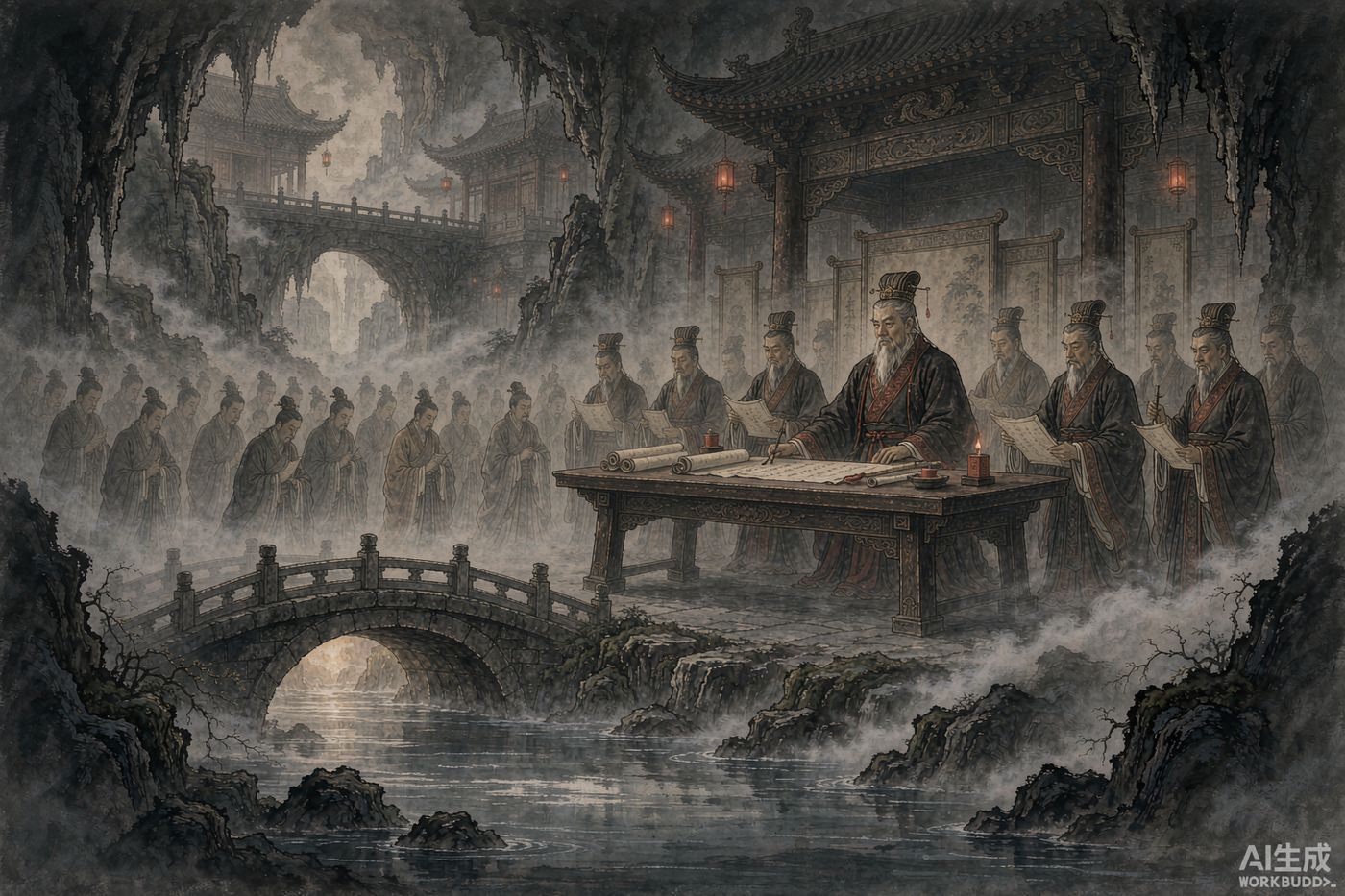
Ask a Chinese ghost story where the dead go, and you get a precise address: the courts of Fengdu, ten magistrates, a bridge, an old lady with a soup. Ask where that came from, and the answer spans two thousand years and three religions — and it explains why the Chinese afterlife feels less like Dante and more like a tax office.
The Yellow Springs
The oldest idea is barely an idea at all. In the ancient texts the dead go to the Yellow Springs (黄泉) — the yellow groundwater that rises when you dig a grave, made into a place by metaphor. It is dark, wet, final and featureless. There is no judgment there, no administration, no road back; the dead simply go down, as the living go down into the earth. When the statesman Ying Kao Shu engineered the famous reconciliation of Duke Zhuang with his mother by digging a tunnel ‘to the Yellow Springs’, the phrase meant only: down in the ground, where the dead are.
This underworld has no stories. It is not a society of the dead but the absence of one.
Mount Tai Takes Charge
The first real administration appears in the Han dynasty, and it appears as jurisdiction. The dead, it came to be believed, are registered — and their register is kept at Mount Tai, the sacred eastern peak, whose god received the souls of the dead the way a prefecture receives census documents. Grave texts of the period read like official transfers: they inform the administration below that a new subject has arrived, list his grave-goods like customs declarations, and request that the clerks treat him correctly.
This is the founding insight of the Chinese afterlife, and everything later is a development of it: the dead are citizens of another government. Once you believe that, the underworld can only grow departments.
The Buddhist Merger
The explosion came with Buddhism, arriving from India across the first centuries CE, bringing two things the native afterlife lacked: karma — a rigorous, individual, cross-lifetime accounting of deeds — and hells: elaborately specific places of punishment where debts are paid. The Chinese system fused these with its own bureaucracy and produced the mature underworld: the Ten Kings, magistrate-judges of ten successive courts; the ledger in which every act of your life is recorded; the earth prisons (diyu) with their precisely matched torments — the tongue-pullers for liars, the oil-friers for cheats — serving sentences rather than eternity, until the account is cleared and the soul is passed on to rebirth.
The genius of the merger is that it made the afterlife reviewable. Judgment is a legal proceeding, and like all legal proceedings in Chinese fiction, it can be appealed, negotiated, bribed and audited. The dead man’s relatives can file supplementary merit on his behalf — masses said, paper money burned, good deeds dedicated — like posting bail. An unjust judgment can be overturned. The underworld has clerks, and clerks make mistakes, and some of the finest stories in the tradition are about catching them at it.
The Finishing Touches
The folk imagination kept renovating. The bridge appeared — the Naihe Qiao, the Bridge of Helplessness — which the virtuous cross and the guilty fall from. Meng Po appeared with her broth of forgetfulness, wiping each soul clean before rebirth, so that justice is done but never remembered. The City Gods — divine magistrates of each walled town — were plugged into the system as the underworld’s local branches, so that the first processing of a death happens at the same yamen where the living filed their lawsuits.
By the Ming and Qing, the geography was fixed enough for satire. Pu Songling’s ghosts sue in underworld courts and win; corrupt underworld clerks are caught and punished by incorruptible underworld judges; the whole machinery of imperial misgovernment is reproduced below, including its reform.
Why It Is Not Hell
The differences from the Western inferno are the point. There is no eternal damnation: every sentence is finite, every account can be settled. There is no devil: the Ten Kings are not enemies of humanity but its magistrates, and the worst torment in the system is administered with the enthusiasm of a filing clerk. And there is no final separation: the dead are recycled, not discarded, and the worst that awaits anyone is a worse rebirth — which is also, always, another chance.
The Chinese underworld is, in the end, what a civilisation that ran itself on examinations, registers and magistrates’ courts was always going to build for its dead: justice as a government service. The horror in these stories is never the underworld itself. It is the suggestion that the clerks might be behind on the paperwork — and that your case, like a zhiguai ghost’s, might slip through the cracks.