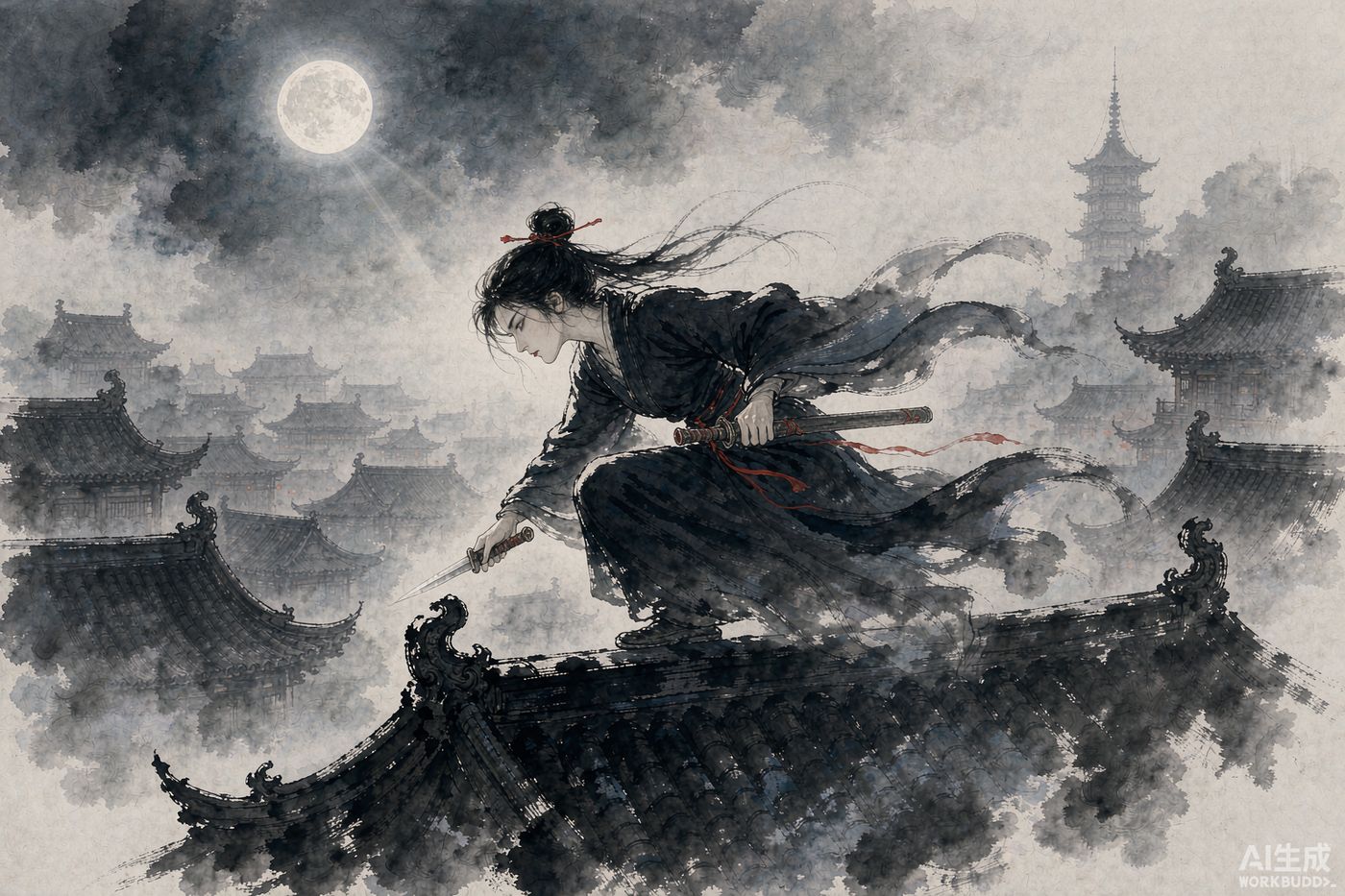
Every genre has a birthplace, and the Chinese martial-fantasy tradition — wuxia, the literature of the swordsman-hero — was born in a specific place and time: the short ‘tales of the marvellous’ of the late Tang dynasty, in the violent, fragmented decades when the great empire was coming apart and regional warlords held real power. It is not an accident. When central authority fails, fiction invents individuals who can enforce justice personally.
The Toolkit
The Tang superhuman is a hybrid: one-third assassin, one-third Taoist magician, one-third monk. The tales give them a consistent toolkit that a thousand years of sequels never fundamentally altered:
The flight. They run over rooftops and city walls, leap between buildings, cross a province in a night. Gravity is optional. The source is the Taoist art of lightness — the body refined until it barely consents to fall.
The impossible weapon. Nie Yinniang’s dagger is two inches long and can take a hawk on the wing; other heroes keep swords that fold into their hair, or spit out a miniature blade that grows in flight. The sword in these tales is half tool, half familiar — the culmination of a tradition in which Gan Jiang and Mo Ye’s blades were practically living creatures with loyalties of their own.
The transformation. They shrink into sleeves, fold through keyholes, change into birds and serpents. Yinniang meets a rival’s white falcon as a red krait; the fight happens in a darkness no witness can parse. This is the borrowing that makes wuxia unique: the combat grammar of the yaoguai, the shape-changing spirits, imported into human warfare.
The apprenticeship. Every Tang superhuman was made, not born — and made by a taking. A nun or a mountain master sees the gifted child and simply removes her, as Yinniang was removed at ten, for five years of pills, sword-drills and progressively harder killings: monkeys, tigers, hawks, men. The stories narrate this without horror, and that is their coldest, most interesting feature: the art is real, and its price is childhood.
The Code
What separates the Tang swordsman from a mere killer is the code, and the code is the old one of the xia — the knight-errant — sharpened to a point. Three rules run through all the tales.
The debt of bread. Whoever feeds and honours the swordsman owns his blade — until he judges otherwise. The assassin’s loyalty is intense, personal and transferable.
The right to choose. And this is the radical one: the swordsman chooses. Yinniang, sent to kill the governor Liu, inspects him, prefers him to her employer, and changes sides on the spot. The tale treats this not as betrayal but as judgment — the superhuman’s real qualification is the ability to tell a worthy master from an unworthy one. In an empire run on hereditary and bureaucratic loyalty, the swordsmen of fiction owed loyalty to merit, which is to say, to their own reading of the world.
The exit. The great ones leave. When the work is done, Yinniang rides out on her white mule and declines to follow her master into the maze of the capital. The swordsman’s final freedom is the refusal to be absorbed — into court, into rank, into history. They belong to the mountains, and to the moment, and to no one.
The Descendants
The line from these tales to the modern world is unbroken. The Ming novel Water Margin inherited the code; the Qing court-case novels inherited the methods; the twentieth-century novelists — Jin Yong above all — rebuilt the whole edifice into the wuxia novel; the films of King Hu, Tsui Hark and Ang Lee carried it onto the world’s screens. When the bride in Crouching Tiger, Hidden Dragon runs up a wall, she is moving exactly as Nie Yinniang moved eleven hundred years before her, over the rooftops of a Tang city, in the dark.
And the original tales still have a strangeness their descendants smoothed away. Jin Yong’s heroes are chivalrous in a way the Tang would have found sentimental. The originals are colder: the nun takes the child; the child takes the head; the swordsman chooses, strikes, and vanishes — loyal to something the tales never name, out beyond the last rooftop, where the city ends and the mountains begin.